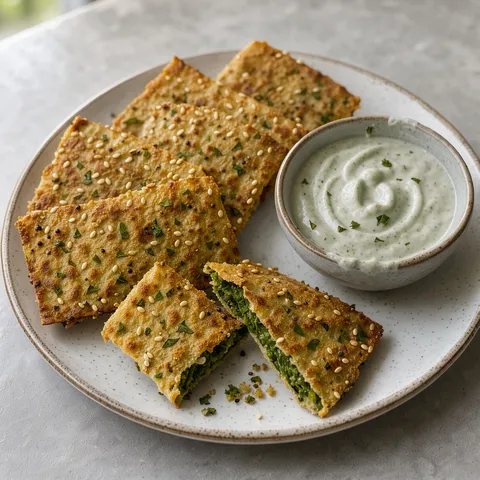
Maharashtrian Fried Coriander Slices Kothimbir Vadi
An Indian meze. Takes 1 hr 13 min, Makes 24. Difficulty: medium.
At a glance
- Total time
- 1 hr 13 min
- Serves
- Makes 24
- Difficulty
- Medium
- Cuisine
- Indian cuisine
- Dish type
- Meze
- Diet
- Gluten-free
- Allergens
- Tree nuts, Sesame, Mustard, Sulphites
Ingredients
- Mixture (24 slices, 20 g each, 480 g in total): 200 g fresh coriander (with stalks, finely chopped)
- 120 g gram flour (besan)
- 30 g rice flour
- 1 tbsp paste of grated ginger and 2 green chillies
- 1 tbsp sesame seeds
- 1/2 tsp turmeric
- 1/2 tsp ground cumin
- 1/2 tsp salt
- 1 tsp sugar
- 1 tbsp lemon juice
- 100 ml water
For the dish
- 20×14 cm greased small ovenproof dish
Tadka and frying
- 4 tbsp neutral oil
- 1/2 tsp mustard seeds
- 1 tbsp sesame seeds. Coconut chutney (24 × 5 g, about 120 g): 40 g desiccated coconut (soaked in 30 ml hot water)
- 20 g coriander
- 1 green chilli
- 1 tbsp lemon juice
- 1/4 tsp salt
- 60 ml water
Equipment
- Steamer basket
- Mixing bowls
- Sauté pan
- Stick blender
- Silicone spatula
- Chef's knife
- Chopping board
- Baking tray
- Fine grater (optional)
Method
- Prepare the coriander: Wash the coriander, dry thoroughly and finely chop with its leaves and thin stalks. Wet coriander adds extra water to the mixture and spoils the consistency, so drying is essential. Make the ginger and green chilli into a paste in a pestle and mortar or finely grate them (~6 min)
- Mix the batter: Mix the gram flour, rice flour, salt, turmeric, cumin, sesame, sugar, paste and lemon juice in a bowl, add the coriander, add the water a little at a time and mix by hand or with a spoon. Sign of doneness: it should be a heavy, thick mixture that holds its shape in the hand but is not sticky. If there is too much water the slices fall apart, and if too little they turn out hard. The mixture comes to about 480 g (~6 min)
- Put in the dish and steam: Grease the 20×14 cm dish and spread the mixture evenly with a spoon, pressing it to about 1.7 cm thick, and smooth the surface with a wet spatula. Put the dish in a steamer basket or on a rack set over boiling water, cover and steam for 22 min. Sign of doneness: a skewer pushed into the surface comes out clean, and the surface is matt and firm. The raw gram flour taste disappears during steaming (~24 min)
- Cool and cut: Rest the dish for 12 min, then chill in the fridge for 6 min so that the slices firm up. If cut hot they fall apart. Loosen the edge of the dish with a knife, turn out onto a board and cut into 24 rectangles of 3.3×3.5 cm on a 6×4 grid. Wet the knife for each cut. Each slice should weigh about 20 g. Prepare the chutney meanwhile (~20 min)
- Make the chutney: Blend the coconut, coriander, green chilli, lemon juice, salt and water with a stick blender to a smooth, green paste. The chutney should not run off a spoon but be thick enough to spread, and if it is too thin it slides off the slice. It comes to about 120 g and waits in the fridge
- Make the tadka and fry: Heat 2 tbsp oil in a sauté pan over medium heat, add half the mustard seeds (1/4 tsp), and when they begin to pop, add half a tablespoon of the sesame seeds. Spread 12 of the slices in the pan and fry, turning, 2.5 min on each side, until golden with crisp edges. Make a second tadka with the remaining 2 tbsp oil, the remaining 1/4 tsp mustard seeds and half a tablespoon of sesame seeds and fry the second batch in the same way. Do not move them too much, because the slices come away from the pan easily only once they have browned. Lift the fried slices onto a tray lined with kitchen paper (~14 min)
- Serve: Arrange the slices on a flat ceramic plate, put 5 g of chutney on or beside each, and sprinkle over a few sesame seeds. Eat within the first 15 min while hot, so the edges stay crisp (~3 min)
Chef's note
Serve hot. 3 per person, 80 people × 3 = 240 pieces. As the recipe makes 24, the multiplier is 240/24 = 10, or 10.5 with 5% allowed for waste (2.3 kg fresh coriander, 1.25 kg gram flour, 320 g rice flour, 42 tbsp neutral oil, 420 g desiccated coconut, 21 tbsp lemon juice). Entirely plant-based and naturally gluten-free (gram flour and rice flour). Asafoetida (hing) contains wheat flour in most brands, so it is not used in this recipe. If you use it, choose one labelled gluten-free. In Maharashtra, kothimbir vadi is a lunchtime snack and a teatime treat, traditionally steamed and then fried. The recipe makes a single 20×14 cm dish. For 10.5 times the quantity 11 dishes are needed, and with 3 steamers it takes about 1.5 hr in 4 rounds. The steamed block keeps for 2 days in the fridge under cling film, and is sliced and fried just before serving. Fried slices are refreshed for 5 min in a 180°C oven. Frying capacity: 264 slices in 22 batches (12 slices per batch, about 5 min), about 1 hr 50 min in a single pan, about 40 min in 3 pans.
Frequently asked questions
- Why is the coriander dried well?
- Wet coriander adds extra water to the mixture and ruins the consistency. Dry it well after washing.
- How thick should the kothimbir vadi mixture be?
- It should be thick and heavy and hold its shape in the hand without being sticky. Too much water makes the slices fall apart, and too little makes them hard.
- Why is the steamed mixture not cut while hot?
- If cut hot the slices fall apart. Rest the dish for 12 minutes, chill it for 6 minutes, then cut into 24 rectangles.
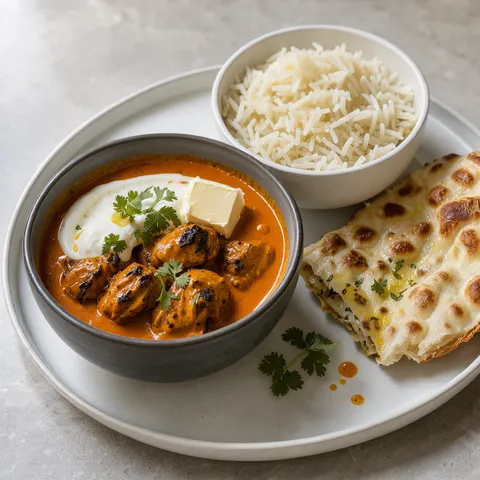 Indian Butter Chicken50 min · Main course
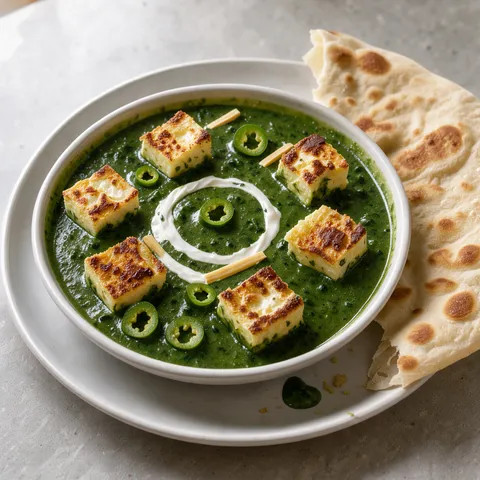 Spinach with Homemade Paneer45 min · Main course
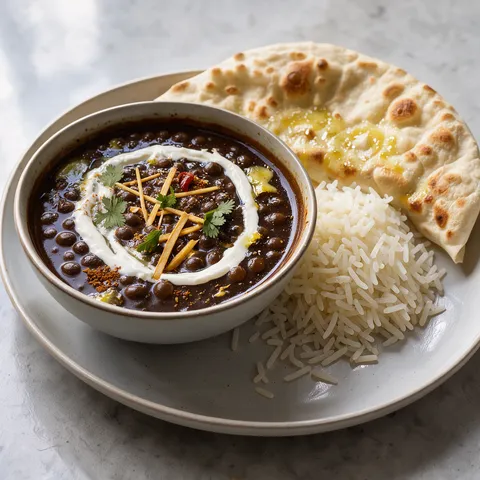 Black Lentil and Kidney Bean Stew1 hr 30 min · Main course
 Chicken Dum Biryani1 hr 30 min · Main course
 Indian Potato Pastries1 hr 30 min · Bread & pastry
 Fermented Rice Crêpes with Spiced Potato50 min · Bread & pastry