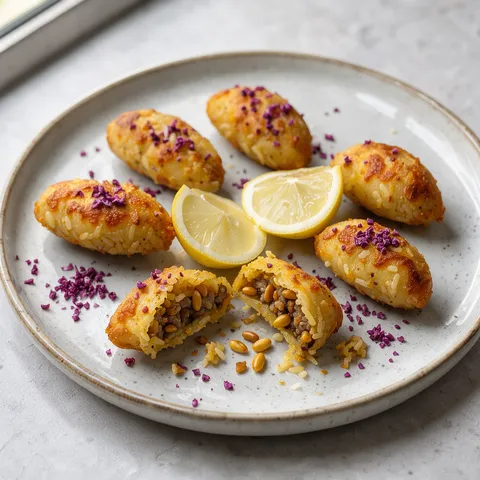
Iraqi Fried Rice Lamb Kibbeh Kubba Halab
An Iraqi meze. Takes 1 hr 47 min, Makes 24. Difficulty: medium.
At a glance
- Total time
- 1 hr 47 min
- Serves
- Makes 24
- Difficulty
- Medium
- Cuisine
- Iraqi cuisine
- Dish type
- Meze
- Diet
- Gluten-free
- Allergens
- Eggs
Ingredients
- Shell (24 × 20 g, about 490 g): 140 g baldo rice
- 1.2 litres water (for boiling)
- 1 egg
- 4 tbsp cornflour
- 1 tsp turmeric
- 1 tsp salt. Filling (24 × 10 g, about 250 g): 200 g lamb mince
- 100 g onion (2 mm dice)
- 30 g pine nuts
- 1 tsp seven-spice mix
- 1/2 tsp salt
- 1 tbsp sunflower oil
Frying
- 1.5 litres sunflower oil (about 4.8 cm deep in a 20 cm pan)
To serve
- 1 lemon (24 wedges)
- Sumac Onions (24 × 3 g, about 72 g, Basics)
Equipment
- Saucepan
- Colander
- Mixing bowls
- Potato masher
- Sauté pan
- Precision scales
- Baking tray
- Baking paper
- Heavy-based saucepan
- Probe thermometer
- Chef's knife
Method
- Boil the rice: Wash the rice and boil it in 1.2 litres of boiling salted water in a pan for 20 min, until the grains are soft enough to crush when pressed with a finger. The rice for kubba is cooked for longer than other pilafs, because the shell has to take shape like a sticky dough. Drain in a colander and leave for 10 min until lukewarm (~32 min)
- Cook the filling: Finely dice the onion to 2 mm with a chef's knife, fry the onion and pine nuts in the oil in a sauté pan for 5 min, until the onion is golden, then add the mince and cook for 6 min, breaking it up with a spoon. Add the seven-spice mix and salt and stir for 1 min. The filling should be dry, since a wet filling bursts in frying. It makes about 250 g. Spread on a plate and cool completely, because hot filling melts the rice shell. Make this while the rice boils
- Knead the shell dough: Mash the lukewarm rice with a potato masher in a bowl for 4 min, until the grains are almost invisible. Add the egg, cornflour, turmeric and salt and knead for 3 min. The consistency should be a firm, sticky dough that can still be gathered in the palm. If it is too soft, add 1 more tbsp cornflour (~10 min)
- Shape: Weigh the dough into 24 pieces of 20 g. With a cornflour-dusted palm, flatten each piece into a disc 6 cm across, put 10 g filling in the centre, close it from the edges and, with cornflour-dusted fingers, shape it into a torpedo 6.5 cm long and 2.6 cm across with pointed ends. The surface should be smooth with no cracks, because the filling escapes into the oil through a crack (~24 min)
- Rest: Chill the torpedoes in the fridge on a tray lined with baking paper for 20 min. As it cools the starch dough firms, so the shape does not distort in frying. Meanwhile heat the oil to 175°C in a heavy-based 20 cm pan, checking with a thermometer (~20 min)
- Fry: Drop the first 2 torpedoes into the oil as a test, and if they fall apart, add 1 more tbsp cornflour to the shell dough. Fry the kubba in batches of 6 for 3.5 min each, until deep golden and crisp, giving 24 in 4 batches. The oil must return to 175°C for each batch. At a low temperature the rice shell falls apart, at a high temperature the outside burns. Lift out with a slotted spoon and drain for 1 min on a tray lined with kitchen paper (~18 min)
- Plate: Lay 2 kubba crossed over each other on a flat ceramic plate and put a lemon wedge and 3 g Sumac Onions beside them. Kubba should be eaten within the first 10 min, while the shell is crisp and the filling hot, since the rice shell softens as it waits (~3 min)
Chef's note
Serve hot. 2 per person, 120 people × 2 = 240 pieces. As the recipe makes 24, the multiplier is 240/24 = 10, or 10.5 with 5% allowed for waste (1.47 kg baldo rice, 2.1 kg lamb mince, 1.05 kg onion, 320 g pine nuts, 11 eggs, 42 tbsp cornflour). The boiled rice and filling are prepared 1 day ahead, and the shaped kubba can wait in the fridge for 3 hr. Raw kubba can be frozen on a tray, bagged and kept for 1 month, and fried from frozen for 5 min without thawing. Capacity: 6 pieces per 3.5 min, 252 pieces in 42 batches, about 50 min with 3 pans. The frying oil is 1.5 litres at 4.8 cm deep in a 20 cm pan. The internal temperature of the lamb should reach 71°C. The name Kubba Halab refers to Aleppo, and rice-shelled kibbeh is found in Iraqi, Syrian and Lebanese cooking. This recipe differs from Quipes (Dominican Beef and Bulgur Croquettes) and from the bulgur-based Kubba Mosul (Mosul-Style Flat Stuffed Bulgur Pies) in its rice dough.
Frequently asked questions
- Why does kubba fall apart in the fryer?
- The rice shell breaks up if it is too soft or the oil is not hot enough. The recipe suggests frying the first 2 torpedoes as a test and adding 1 tablespoon of cornflour to the shell mixture if they break up.
- Why is the rice cooked longer than usual?
- The rice for kubba is cooked longer than for other rice dishes, as the shell has to shape like a sticky dough. The grains should be soft enough to squash when pressed with a finger.
- Why must the filling be dry and cooled?
- A wet filling bursts when fried and a hot filling melts the rice shell. Cook the filling until dry, then spread it on a plate and let it cool completely.
 Tigris-Style Butterflied Carp Cooked by the Embers1 hr 30 min · Main course
 Mosul-Style Flat Stuffed Bulgur Pies1 hr 45 min · Main course
 Iraqi Aubergine and Meatball Bake1 hr 55 min · Main course
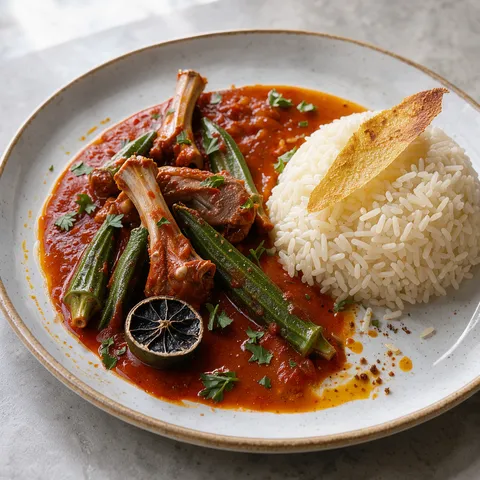 Margat Bamia and Timman2 hr · Main course
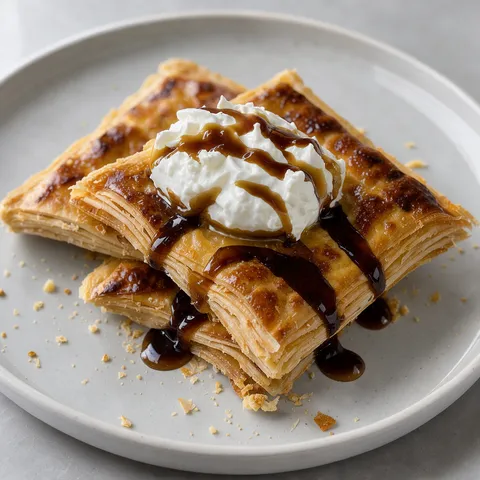 Baghdad-Style Layered Pastry with Cream1 hr 50 min · Dessert
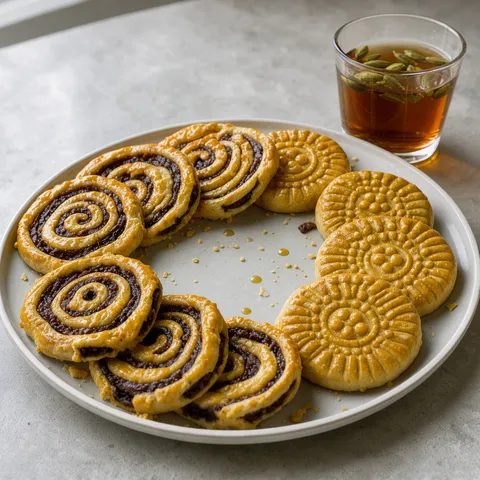 Iraqi Date Cookies1 hr 15 min · Patisserie