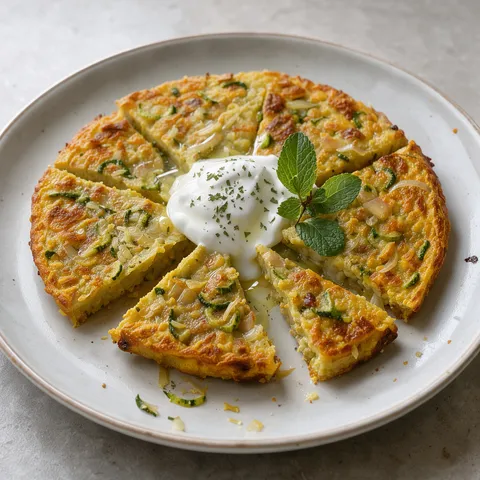
Persian Courgette and Onion Omelette Kuku Kadu
An Iranian main course. Takes 46 min, Serves 4. Difficulty: medium.
At a glance
- Total time
- 46 min
- Serves
- Serves 4
- Difficulty
- Medium
- Cuisine
- Iranian cuisine
- Dish type
- Main course
- Diet
- Vegetarian
- Allergens
- Gluten, Milk, Eggs
Ingredients
Kuku
- 500 g pale green courgettes
- 2 medium onions (about 250 g)
- 6 eggs
- 2 tbsp plain flour
- 1/2 tsp baking powder
- 1/2 tsp turmeric
- 1 tsp salt
- 1/2 tsp black pepper
- a pinch of saffron (about 0.2 g) in 2 tbsp hot water
- 3 tbsp sunflower oil
To serve
- 200 g strained yoghurt
- 1 tbsp dried mint
- 1 tbsp butter
- a few sprigs fresh mint
Equipment
- Box grater
- Mixing bowls
- Muslin
- Frying pan
- Balloon whisk
- Wooden spoon / spatula
- Chopping board
- Chef's knife
- Oven (optional)
Method
- Grate the courgettes: Wash the courgettes, trim the ends and grate them on the fine side of a coarse grater. Put the grated courgette in a bowl, sprinkle with 1/2 tsp salt and leave for 8 min. The salt draws the water out of the courgettes. If the water is not drawn out, the kuku turns watery and falls apart (~6 min)
- Fry the onion: Slice the onions into half-moons and cook in 2 tbsp oil in a frying pan over medium heat for 8-9 min, stirring, until the edges are golden. Add the turmeric last and stir for 30 sec, as it releases its colour and aroma once it dissolves in the oil. Take off the heat and let cool slightly (~10 min)
- Squeeze out the water: Squeeze the grated courgette in a clean piece of muslin with your hands to remove the water. The courgette must be dry, because any remaining water separates the eggs as they cook. About 300 g of squeezed courgette should remain (~4 min)
- Prepare the mixture: Whisk the eggs in a large bowl with a whisk until frothy. Add the flour, baking powder, remaining salt, black pepper and the saffron water. Add the squeezed courgette and the warm onion and mix with a wooden spoon. The mixture should be like a thick batter that hardly runs off the spoon (~5 min)
- Cook: Heat the remaining 1 tbsp oil in a 22 cm lidded frying pan. Pour in the mixture and level the top with the back of a spoon. Cover and cook over the lowest heat for 12 min. When the edges have set and the top is half dry, the underside is golden (~12 min)
- Invert: Cover the pan with a flat plate and turn the pan over onto the plate in one quick move. Slide the kuku back into the pan from the plate and cook the other side uncovered for 5 min. If you are wary of flipping it, brush the top with butter and bake in a 180°C oven for 8 min (~5 min)
- Rest: Move the kuku to a board and rest for 5 min. Resting lets the egg set, so it does not fall apart when cut. Cut into 8 triangular slices with a sharp knife (~5 min)
- Plate: Melt the butter in a small frying pan and stir in the dried mint for 20 sec. Put 2 slices on each plate with a spoonful of strained yoghurt alongside. Drizzle the mint butter over the yoghurt and garnish with fresh mint leaves. Serve hot or at room temperature (~3 min)
Chef's note
In Persian cooking, kuku is both a hot dish and a picnic food. The side that half-fries in the oil is its character, which is why the pan must be kept on a very low heat and covered. If you have no saffron, the colour of the turmeric is enough. The most important rule is to squeeze the courgette thoroughly.
Frequently asked questions
- What is kuku kadu?
- It is a thick Persian omelette made with grated courgette, onion and eggs. It is cooked in a pan or the oven and eaten with yoghurt.
- How do I stop the kuku falling apart?
- Salt the courgette and squeeze it well in a cloth, then rest the kuku for 5 minutes after cooking. Covering with a lid and keeping the heat very low also helps it set.
- Can kuku be eaten the next day?
- Yes, it keeps in the fridge for 2 days and can be eaten cold. To reheat, warm it in a dry pan with the lid on.
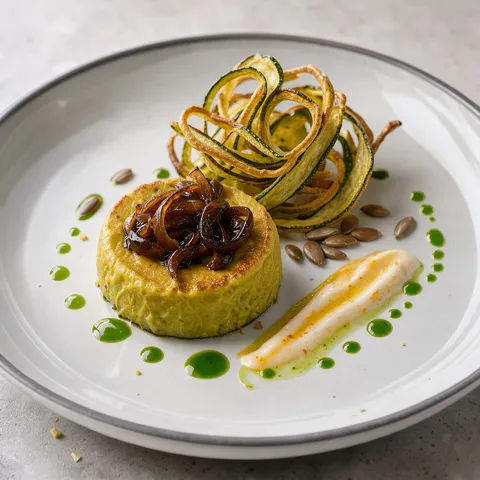 Persian Courgette and Onion Omelette 2.01 hr 6 min · Main course
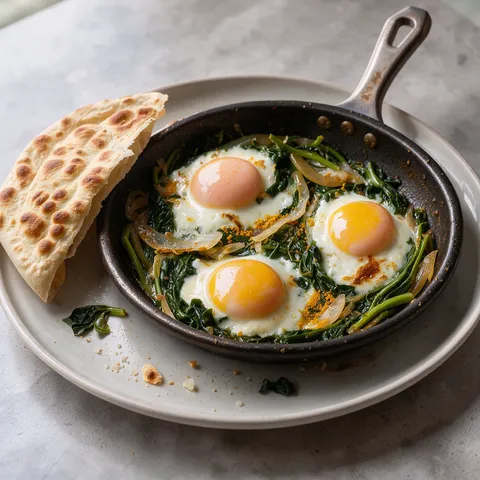 Iranian Spinach and Egg Skillet27 min · Main course
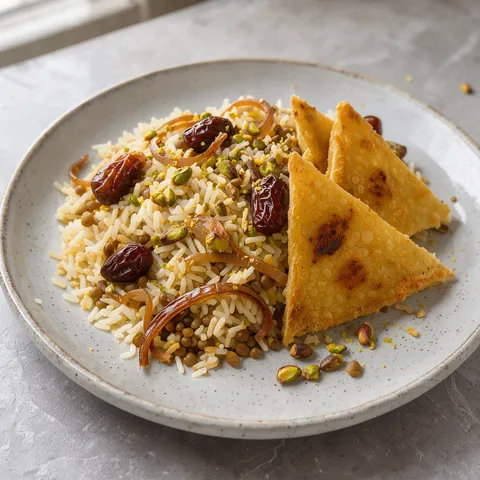 Iranian Lentil and Date Rice1 hr 43 min · Main course
 Adas Polo 2.01 hr 17 min · Main course
 Iranian Onion and Fenugreek Soup27 min · Soup
 Gilan Chickpea and Beef Patties1 hr 32 min · Meze
 Iranian Potato Squares 5×5 cm1 hr 21 min · Meze