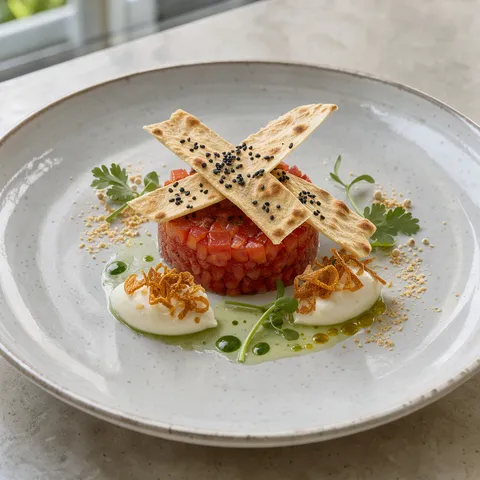
Kurutob 2.0
A Tajik main course. Takes 1 hr 25 min, Serves 4. Difficulty: professional.
At a glance
- Total time
- 1 hr 25 min
- Serves
- Serves 4
- Difficulty
- Professional
- Cuisine
- Tajik cuisine
- Dish type
- Main course
- Allergens
- Gluten, Milk, Celery
Ingredients
Layered fatir crisps
- 200 g plain flour
- 115 ml lukewarm water
- 1/2 tsp salt
- 60 g soft butter
- 1 tbsp nigella seeds
Kurut cream
- 120 g kurut (finely grated)
- 150 ml lukewarm water
- 80 ml double cream
If kurut is unavailable
- 300 g strained (Greek-style) yoghurt
- 50 ml cold water
- 1 tsp salt
Fried onion oil
- 2 onions (very thin rings)
- 120 ml sunflower oil
Tomato tartare
- 4 ripe tomatoes
- 1 small red onion (very finely chopped)
- 1 long green pepper (very finely chopped)
- 1/2 tsp salt
- 1 tsp cider vinegar
Cucumber water
- 1 cucumber
- a pinch of salt
- 1 tsp lemon juice
Green oil
- 1 bunch coriander
- 1/2 bunch purple basil
- 100 ml sunflower oil
To finish
- coriander and purple basil cress
- flaky salt
Equipment
- Stick blender
- Fine sieve / chinois
- Mixing bowls
- Oven
- Blender
- Muslin
- Rolling pin / oklava
- Baking tray
- Baking paper
- Saucepan
- Colander
- Chef's knife
- Cake ring / food ring
- Fine grater
Method
- Prepare the kurut: Finely grate the kurut on a microplane (hard kurut is difficult to grate by hand, so if you have no grater, pound it in a pestle and mortar). Soak the grated kurut in the lukewarm water for 20 min: grating lets the kurut absorb water quickly, so there is no need to soak whole balls for hours. Then dissolve completely with a stick blender for 1 min and pass through a fine sieve. Fold in the cream with a cold spoon without whipping: unlike the runny sauce of the classic, it should be a dense cream that holds its shape on a spoon. Firm up in the fridge for 10 min before shaping quenelles, and if it does not hold, adjust the consistency with 1 tbsp strained yoghurt. If you are using strained yoghurt, whisk it with the salt, cold water and cream. Keep in the fridge
- Knead the fatir dough: Mix the flour with the salt, add the lukewarm water and knead for 6 min, until soft and smooth. Cover and rest for 15 min. Preheat the oven to 210°C
- Green oil: Blanch the coriander and purple basil in boiling water for 10 sec, transfer to iced water and squeeze out well. Blend with the oil in a blender on high speed for 2 min, until the oil is warm. Strain through muslin without pressing: a bright emerald-green oil remains. This oil takes the place of the fresh herbs of the classic
- Build the layers: Roll the dough out into a large sheet 1 mm thin, spread with the soft butter and sprinkle with the nigella seeds. Fold the sheet into 3 layers like a wallet,, then roll out again to 2 mm. This single fold gives thin, separate layers in the crisps
- Bake the crisps: Cut the sheet into long 12×3 cm strips, arrange on a tray lined with baking paper and weigh down with a second sheet of baking paper and a second tray. Bake at 210°C for 14-16 min, until the strips are evenly golden brown and snap when broken. Baking under weight keeps the strips flat and thin. Cool on a wire rack
- Onion oil: Put the onion rings in a small saucepan with the cold oil and cook over medium heat for 15 min, stirring now and then, until golden brown. Starting in cold oil makes the onion brown evenly. Lift the onion out with a slotted spoon onto kitchen paper: it crisps up as it cools. Strain the oil and keep warm
- Tomato tartare: Blanch the tomatoes in boiling water for 15 sec, transfer to iced water and peel. Quarter them and put the seedy centres in a separate bowl. Cut the tomato flesh into 4 mm dice and mix with the red onion, pepper, salt and vinegar. Leave in a sieve until serving so the juice does not run onto the plate
- Cucumber water: Blend the cucumber and tomato seeds with the salt and lemon juice in a blender and strain through a fine sieve. You get a greenish, cool, slightly sour liquid: chill in the fridge. The vegetable juices that the fatir soaks up in the classic now come to the plate as a separate sauce
- Break the fatir: Crumble a third of the crisp strips by hand into coarse crumbs and leave the rest whole
- Plate: Place an 8 cm ring mould in the centre of a deep, wide plate. Fill it with the tomato tartare to 2 cm high without pressing, then lift off the ring. Place two quenelles of kurut cream beside the tartare. Scatter the fried onion over the quenelles
- Finish: Lean three whole fatir strips crosswise against each other on top of the tartare. Scatter the crumbs around the cream. Pour about 3 tbsp cucumber water into the empty part of the plate and dot the surface with drops of green oil and warm onion oil. Finish with the cress and flaky salt. Serve immediately, before the fatir softens
Chef's note
The six elements of the classic kurutob are kept: kurut, layered fatir, fried onions and their oil, tomato, cucumber and herbs. In the classic everything is soaked in kurut sauce on a shared platter until soft, whereas here the textures are separated: the fatir stays crisp, the kurut becomes a dense cream and the vegetable juices a separate cool sauce. Dipping the crisp into the cream and tartare as you take each mouthful imitates the soaked bread of the classic. Kurut is a product that is bought ready-made.
Frequently asked questions
- Why is the kurut finely grated in this recipe?
- The kurut is finely grated with a microplane because grating lets it take up water quickly, so there is no need to soak the whole ball for hours. The grated kurut rests in lukewarm water for 20 minutes. Then it is blended smooth with a stick blender and passed through a fine sieve.
- How do the fatir strips stay flat and crisp?
- The strips are pressed between two sheets of baking paper with a second tray on top and baked at 210°C for 14-16 minutes. Baking under pressure keeps the strips flat and thin. They are ready when evenly golden brown and they snap with a crack.
- Why is the fried onion started in cold oil?
- The onion rings cook with the cold oil over a medium heat for 15 minutes, stirring occasionally. Starting in cold oil makes the onion brown evenly. Lifted out with a sieve onto kitchen paper, the onion turns crisp as it cools.
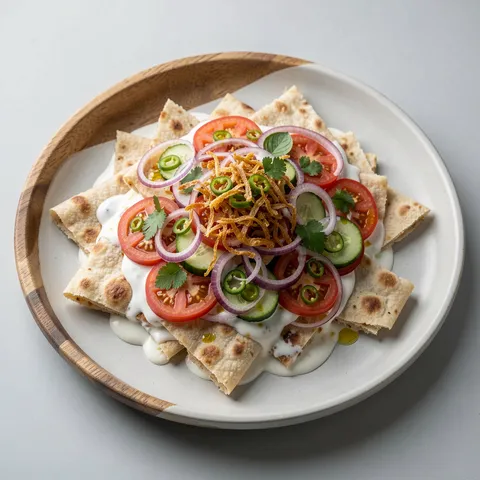 Tajik Layered Fatir Bread in Kurut Sauce1 hr 35 min · Main course
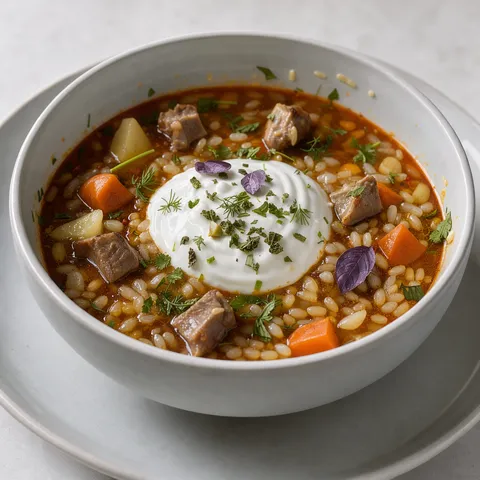 Tajik Meat and Rice Soup with Strained Yoghurt1 hr 40 min · Soup
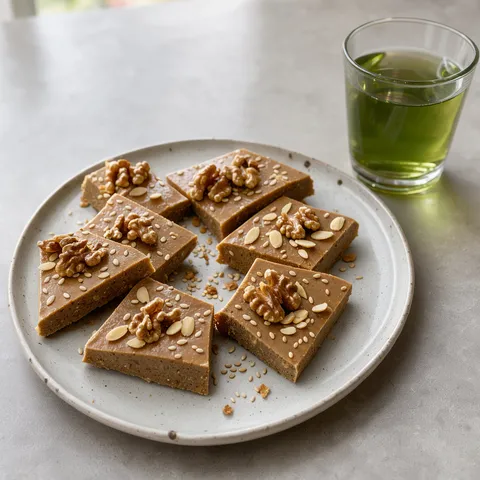 Tajik Milky Flour Halva40 min · Dessert
 Tajik Cold Strained Yoghurt Soup and Cucumber35 min · Soup
 Tajik Lamb and Chickpea Soup with Noodles1 hr 50 min · Soup
 Tajik Baked Layered Samsa with Pumpkin2 hr · Bread & pastry
 Oshi Burida 2.01 hr 25 min · Soup