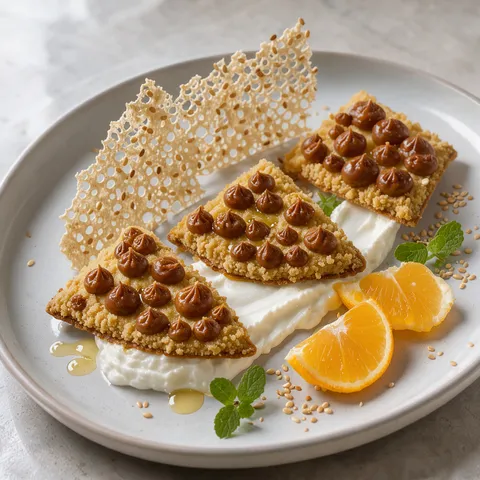
Makroud 2.0
An Algerian dessert. Takes 1 hr 10 min, Serves 4. Difficulty: professional.
At a glance
- Total time
- 1 hr 10 min
- Serves
- Serves 4
- Difficulty
- Professional
- Cuisine
- Algerian cuisine
- Dish type
- Dessert
- Allergens
- Gluten, Milk, Eggs, Sesame
Ingredients
Semolina sablé
- 120 g fine semolina
- 40 g plain flour
- 70 g cold butter (cubed)
- 40 g icing sugar
- a pinch of salt
- 1 egg yolk
- 1 tsp orange blossom water
Date cream
- 200 g soft stoned dates (medjool preferably)
- 70 ml hot water
- 30 g butter
- 1/2 tsp ground cinnamon
- a pinch of ground cloves
- 1 tbsp orange blossom water
- a pinch of salt
Sesame tuile
- 20 g butter
- 25 g caster sugar
- 15 g honey
- 15 g plain flour
- 25 g sesame seeds
Honey sauce
- 80 g honey
- 40 ml fresh orange juice
- 10 g butter
Orange blossom labneh cream
- 150 g Strained Yoghurt and Labneh (Basics)
- 100 ml cold whipping cream (35% fat)
- 20 g icing sugar
- 1 tbsp orange blossom water
Orange
- 2 oranges (segments cut free from the membranes)
To finish
- 1 tbsp toasted sesame seeds
- a few fresh mint tips
Equipment
- Rolling pin / oklava
- Baking paper
- Baking tray
- Oven
- Blender
- Piping bag
- Saucepan
- Chef's knife
- Palette knife
- Balloon whisk
- Pastry brush
- Mixing bowls (optional)
Method
- Make the sablé dough: Mix the semolina, flour, icing sugar and salt. Rub in the cold butter with your fingertips until it resembles fine sand. Add the egg yolk and orange blossom water and press together without kneading, only until it comes together. Overworked sablé shrinks and toughens when baked
- Roll out and chill: Roll the dough out between two sheets of baking paper to a neat rectangle 5 mm thick. Put on a tray with the paper and firm up in the freezer for 15 min. Cold dough cuts with sharp corners and does not spread in the oven. Preheat the oven to 170°C
- Make the date cream: While the dough chills, soak the dates in hot water for 10 min. Blend with their water, the butter, cinnamon, cloves, orange blossom water and salt for 2 min, until completely smooth. It should be a thick cream that holds its shape when piped, and if it is too thick, add hot water a spoonful at a time. Fill a piping bag with a plain nozzle (not a star nozzle)
- Mix the tuile batter: Heat the butter, sugar and honey in a small pan over low heat only until melted. Off the heat, stir in the flour and sesame seeds. On a second tray lined with baking paper, drop 8 small mounds with a teaspoon, at least 6 cm apart, as the tuile spreads in the oven
- Cut and bake the sablé: Cut the firm dough with a sharp knife into diamonds with 4 cm sides, the shape of classic makroud. About 30 pieces come out, so bake all of them and use 12, and the rest keeps for 1 week in a covered box. Arrange spaced out on a tray lined with baking paper and press light lines on top with the tines of a fork. Bake at 170°C for 14-16 min, until the edges are light golden. Cool on the tray for 10 min, as it is fragile when hot
- Bake the tuile: When the sablé comes out, bake the tuile tray at 170°C for 7-8 min, until the sesame caramel is lacy and the colour of dark honey. Wait 1 min, then lift with a palette knife and leave flat. It breaks like glass once cool
- Reduce the honey sauce: Boil the honey and orange juice in a small pan over medium heat for 4-5 min, until a glossy syrup that coats the back of a spoon. Off the heat, whisk in the butter. It thickens as it cools and sits on the plate without running
- Whip the labneh cream: Whip the cold cream with the icing sugar to soft peaks. Loosen the labneh and orange blossom water in a separate bowl and fold in the cream in two additions. This lightly tart cream balances the intense sweetness of the dates
- Prepare the orange: Cut the peel and white pith off the oranges with a sharp knife and cut out the segments between the membranes. Squeeze the juice left in the membranes into the honey sauce, and if it is not enough, use a third orange. Pat the segments on kitchen paper to remove the juice
- Assemble the sablés: Use three sablés per plate. Pipe the date cream in small beads on each sablé, covering the surface completely. Brush a thin layer of honey sauce over the beads with a pastry brush so they shine
- Plate: On a flat plate, slightly left of centre, draw a line of labneh cream with the back of a spoon. Place three sablés on the line, leaning lightly against each other in a diagonal row. Place three orange segments beside the sablés
- Finish: Break the tuile and stand two pieces upright against the sablés. Drop a few drops of honey sauce on the plate and scatter over the toasted sesame seeds and mint tips. Serve straight away, as sablé and tuile draw moisture from the cream if left
Chef's note
In this version the semolina dough, date filling and honey syrup of the classic makroud are separated: the fried dough became a thin, crisp sablé, the filling a silky cream and the honey syrup an orange sauce. The sesame sprinkled over makroud became a caramelised tuile, and labneh and fresh orange bring a freshness not found in the classic. The sablés can be baked a day ahead and kept in a covered box.
Frequently asked questions
- Why does makroud sablé dough shrink or turn hard when baked?
- Overworked dough shrinks and turns hard when baked. So after adding the egg yolk and orange blossom water, press it together just until it comes together, without kneading.
- Why are sesame tuiles spaced apart in the oven?
- Tuile mixture spreads in the oven, so leave at least 6 cm between teaspoon mounds. After baking, wait a minute before lifting them off, and they snap like glass once cool.
- Can leftover sablé be stored?
- The recipe makes about 30 sablés and 12 are used for plating. The rest keeps for 1 week in an airtight container.
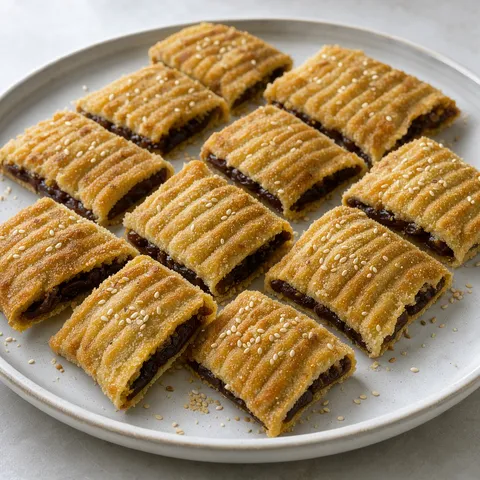 Constantine-Style Date-Filled Semolina Pastries1 hr 20 min · Dessert
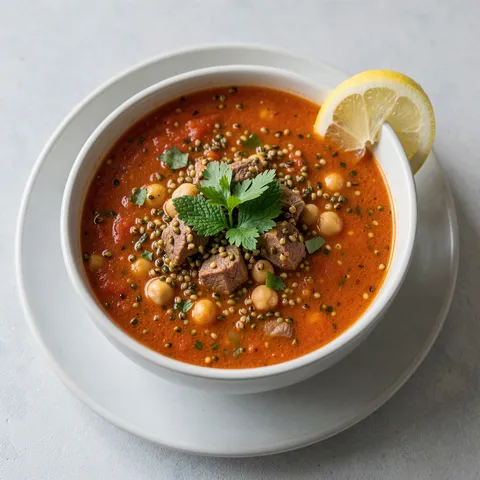 Chorba Frik1 hr 45 min · Soup
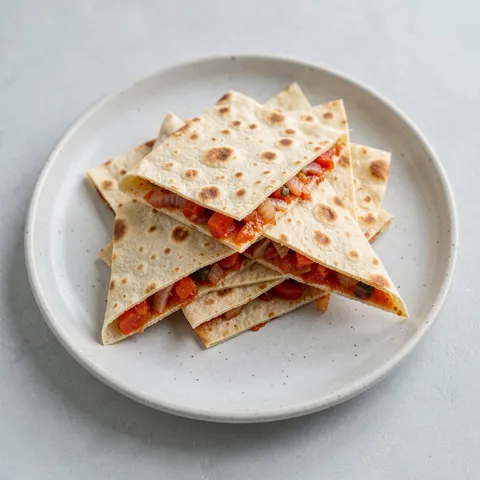 Algerian Stuffed Semolina Flatbread1 hr 45 min · Bread & pastry
 Biskra-Style Torn Flatbread with Lamb Stew2 hr 45 min · Main course
 Algerian Almond Semolina Cake1 hr 45 min · Dessert
 Kalb el Louz 2.01 hr 25 min · Dessert
 Karantika, Algerian Baked Chickpea Flour Cake1 hr 30 min · Starter