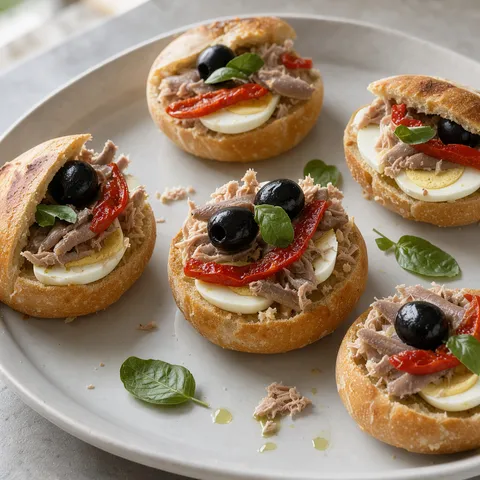
Nice Tuna Sandwich Rolls, 6.5 cm Mini Pan Bagnat
A French meze. Takes 2 hr 59 min · 1 hr 15 min if the bread is baked the day before, Makes 24. Difficulty: medium.
At a glance
- Total time
- 2 hr 59 min · 1 hr 15 min if the bread is baked the day before
- Serves
- Makes 24
- Difficulty
- Medium
- Cuisine
- French cuisine
- Dish type
- Meze
- Allergens
- Gluten, Eggs, Fish, Sulphites
Ingredients
- Mini rolls (24 rolls, 6.5 cm across, about 40 g of dough each, about 960 g in total): 550 g plain flour
- 8 g fast-action dried yeast
- 11 g salt
- 360 ml lukewarm water
- 2 tbsp olive oil
- flour (for the worktop)
Filling (about 40 g per roll)
- 320 g tuna in olive oil (2 tins, drained, 24 × 13 g)
- 3 eggs (boiled and each cut into 8 slices, about 6 g per slice)
- 120 g firm tomatoes (24 thin half-moons, deseeded)
- 60 g red onion (thin half-rings)
- 100 g Charred Peppers and Aubergines (Basics, peppers only)
- 40 g black olives (24 halves)
- 8 salted anchovy fillets (rinsed of salt, 24 pieces)
- 12 basil leaves (24 half-leaves)
- 4 tbsp olive oil
- 1 tbsp wine vinegar
- 1/2 tsp salt
Equipment
- wire rack
Equipment
- Mixing bowls
- Baking tray
- Baking paper
- Oven
- Bread knife
- Chef's knife
- Saucepan
- Precision scales
- Chopping board
Method
- Knead the dough: Dissolve the yeast in the lukewarm water, then knead with the flour, salt and olive oil in a bowl for 10 min, until the dough is soft and elastic. Nice bread comes from a slightly damp dough: a dry dough soaks up the filling and falls apart. Cover in an oiled bowl and leave to rise for 45 min, until doubled in size (~55 min)
- Shape: Knock the air out of the dough, then weigh it and divide into 24 equal pieces (about 40 g) and roll each one in your palm into a ball with a taut surface. Arrange 12 on each of two 30×40 cm trays lined with baking paper, in 3 columns × 4 rows, leaving 3 cm between them. A taut surface does not split as the rolls rise in the oven. Cover and rest for 25 min, and preheat the oven to 230°C meanwhile (~35 min)
- Prepare the filling: Boil the eggs in a pan for 9 min, cool them in cold water, peel and cut each into 8 slices. Slice the tomatoes into thin half-moons on a board with a chef's knife, then salt for 5 min and drain. Soak the onion in the vinegar for 5 min and squeeze out the liquid, cut the pepper into strips, halve the olives and cut the anchovies into 3 pieces. Salt draws the excess water out of the tomatoes, and wet tomatoes make the bread soggy later. Make this while the rolls rise
- Bake: 1 min before baking, put a bowl of boiling water on the floor of the oven to create steam. Put the trays on the middle and top shelves and bake for 16 min, until the tops are deep golden and the rolls sound hollow when tapped underneath, swapping the trays' positions at 8 min. The steam keeps the crust glossy and thin. Cool on a wire rack for 20 min, until completely cold, since hot bread is crushed by the knife (~36 min)
- Fill: Cut the cooled rolls in half horizontally with a bread knife. Drizzle 1/2 tsp olive oil over each bottom half (4 tbsp in total), then layer the tomato half-moon, onion, 13 g tuna, pepper strip, egg slice, olives and anchovy piece. Put a basil leaf on top and close with the lid. The olive oil seeps from the filling into the bread, which is what makes a Pan Bagnat a "soaked bread" sandwich (~20 min)
- Press: Arrange the sandwiches side by side in a tight dish, put baking paper and a flat tray on top and press in the fridge (4°C) for 30 min under a 500 g weight, as the tuna, egg and anchovies must stay in the cold chain. The pressure helps the oil seep into the bread and makes the layers stick together. If you press too hard, the bread is crushed (~30 min)
- Plate: Place 2 mini sandwiches side by side on a flat ceramic plate and secure the tops with cocktail sticks. Take them out of the fridge and serve at room temperature, to be eaten within the first 2 hr (~3 min)
Chef's note
Serve at room temperature. Allow 2 per person, 120 people × 2 = 240 pieces. Because the recipe makes 24, the multiplier is 240/24 = 10, or 10.5 with 5% waste (5.78 kg flour, 3.36 kg tuna in olive oil, 32 eggs, 1.26 kg firm tomatoes, 84 anchovy fillets, 420 g black olives). The bread is baked 1 day ahead. The sandwiches can be filled 3 hr ahead and kept pressed in the fridge, and the cold chain is essential for the tuna and egg: the sandwiches keep in the fridge (4°C) for up to 6 hr, and once brought out they stand at room temperature for up to 2 hr. Oven capacity: in a 2-shelf oven, 24 rolls bake in one round, so 10.5 batches need 11 rounds, which is why for a large service it makes sense to bake the bread 2 days ahead and freeze it. In Nice, the original Pan Bagnat is made on a large round loaf with tuna, anchovies, olives, raw vegetables and olive oil, and some purists reject cooked vegetables and egg. Here egg and charred pepper are added too.
Frequently asked questions
- Why is the bread soaked in olive oil for pan bagnat?
- The olive oil lets the filling seep into the bread, which is what makes a pan bagnat. Drizzle 1/2 teaspoon of olive oil over each bottom half.
- Why do the sandwiches need pressing in the fridge?
- Pressing helps the oil soak into the bread and the layers hold together. Press the sandwiches in the fridge under a 500 g weight for 30 minutes. The tuna, eggs and anchovies must stay chilled.
- Why are the tomatoes salted and drained, and how soon should the sandwiches be eaten?
- Salt draws out the excess water from the tomatoes, as wet tomatoes would soften the bread later. Serve the sandwiches at room temperature and eat them within the first 2 hours.
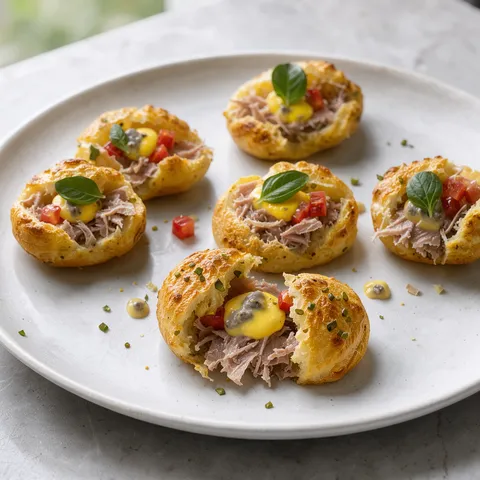 Mini Pan Bagnat 2.01 hr 26 min · Meze
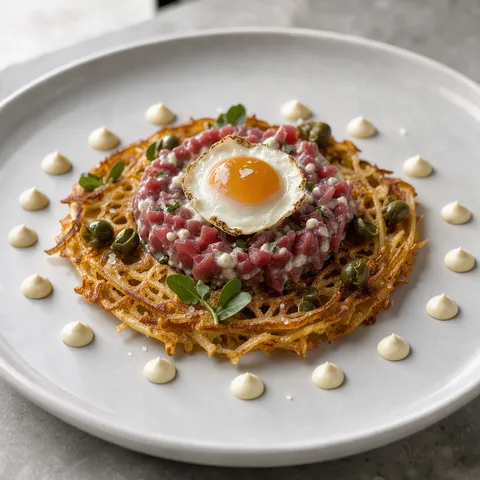 Tuna Tartare, Potato Rösti Disc, Quail's Egg55 min · Starter
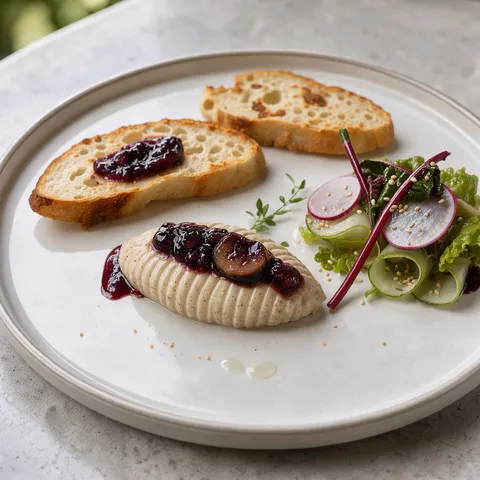 Duck Rillettes, Fig Jam, Crunchy Crostini, Pickle Salad1 hr 30 min · Starter
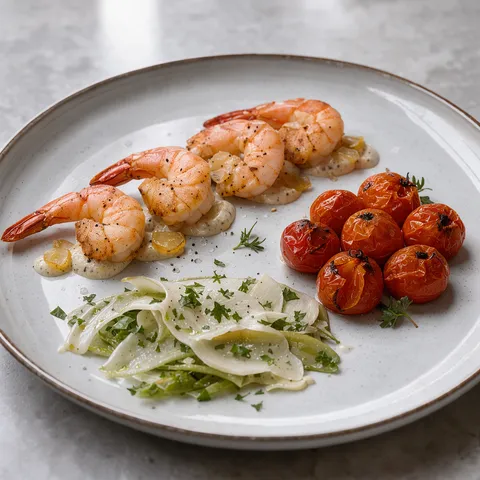 Prawns, Garlic Confit Aioli, Charred Tomatoes, Fennel Salad35 min · Starter
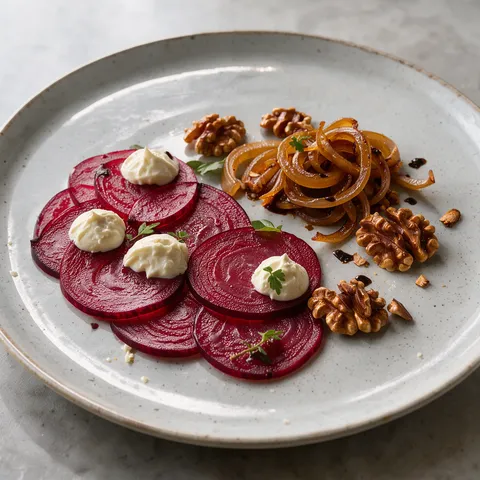 Beetroot Carpaccio, Goat's Cheese Mousse, Walnuts1 hr · Starter
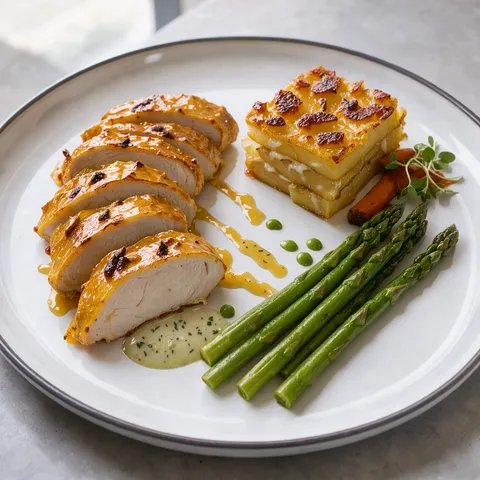 Honey Mustard Chicken, Potato Gratin, Asparagus1 hr 30 min · Main course
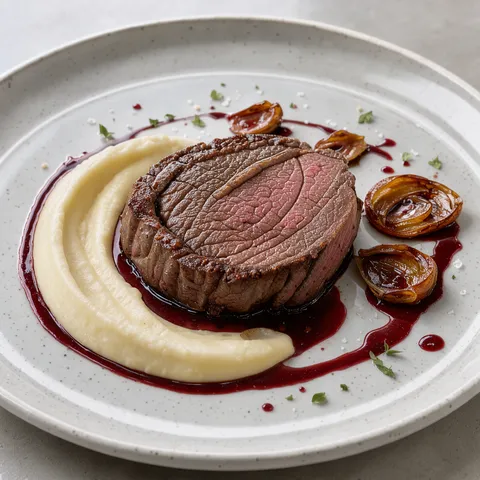 Beef Fillet, Red Wine Sauce, Pommes Purée1 hr 10 min · Main course