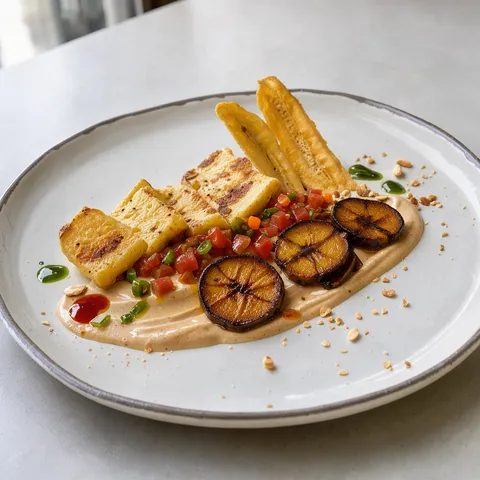
Ngou ti Kassa 2.0
A Central African Republic main course. Takes 1 hr 10 min, Serves 4. Difficulty: challenging.
At a glance
- Total time
- 1 hr 10 min
- Serves
- Serves 4
- Difficulty
- Challenging
- Cuisine
- Central African Republic cuisine
- Dish type
- Main course
- Diet
- Gluten-free
- Allergens
- Milk, Peanuts, Tree nuts
Ingredients
Taro
- 600 g small taro (if unavailable, small waxy potatoes)
- 1.5 litres water
- 1 tsp salt
- 3 tbsp sunflower oil
- a pinch of flaky salt
Red oil
- 4 tbsp sunflower oil
- 1 tsp sweet paprika
Peanuts
- 120 g raw peanuts (100 g for the cream, 20 g for the crumb)
Peanut cream
- 250 ml hot water
- 2 tbsp red oil (from above)
- 1/2 tsp salt
- 1 tsp lemon juice
Ripe plantain
- 2 ripe plantains (skins yellow-black; if unavailable, 3 firm bananas)
- 15 g butter
- a pinch of salt
Plantain crisps
- 1 green plantain
- about 1.2 litres sunflower oil (for frying)
- a pinch of salt
Tomato relish
- 2 ripe tomatoes (deseeded)
- 1/2 red onion
- 1 red chilli (deseeded)
- 1 tbsp lemon juice
- a pinch of salt
Spring onion oil
- 4 spring onions
- 60 ml sunflower oil
- a pinch of salt
Crushed peanuts
- a pinch of sweet paprika
- a pinch of salt
Equipment
- Oven
- Baking tray
- Paring knife
- Colander
- Saucepan
- Frying pan
- Fine sieve / chinois
- Blender
- Muslin
- Squeezy bottle
- Chopping board
- Chef's knife
- Mixing bowls
- Probe thermometer
- Mandoline
- Potato masher
- Sauté pan
- Wooden spoon / spatula
Method
- Start the oven and the peanuts: Preheat the oven to 170°C fan. Spread the peanuts in a single layer on a baking tray and roast for 10-12 min, until the skins crack and the insides are pale golden. Let cool on the tray for 5 min and rub the skins off in your palms. The peanuts that are toasted in a pan in the classic version colour evenly in the oven here, and the cream does not turn bitter
- Boil the taro: Put on kitchen gloves, as raw taro irritates the skin. Peel the taro with a paring knife, halve the large ones and rinse in a colander. Put in a 4 litre pan with 1.5 litres water and 1 tsp salt, bring to the boil (about 8 min) and cook with the lid ajar for 18 min, until a knife slides in without resistance. The taro must be fully cooked, as half-raw taro makes the throat itch
- Make the red oil: Warm the 4 tbsp oil in a small pan over low heat for 1 min, take off the heat, stir in the paprika and leave to infuse for 3 min. Strain through a fine sieve. Use 2 tbsp in the peanut cream and keep the rest for plating
- Blend the spring onion oil: Roughly chop the spring onions and blend with the 60 ml oil and the salt in a blender on high for 1 min. Strain without pressing through a fine sieve lined with muslin and pour the clear green oil into a squeeze bottle. The spring onion that is sprinkled over the classic bowl becomes a layer of colour and aroma, drop by drop, here
- Blend the peanut cream: Put 100 g of the skinned peanuts in the blender (just wipe it after the green oil), with the 250 ml hot water, 2 tbsp red oil, 1/2 tsp salt and the lemon juice, and blend on high for 2 min, until velvety smooth. Strain through a fine sieve into a small pan. The pounded peanuts that thicken the sauce in the classic become a fluid cream here, the base of the plate
- Prepare the tomato relish and crushed peanuts: On a chopping board, dice the tomatoes into 3 mm cubes with a chef's knife, chop the red onion and chilli very finely and mix in a bowl with the lemon juice and salt. Roughly crush the remaining 20 g peanuts with a knife and mix with a pinch of paprika and salt. The tomato and chilli base of the classic stew returns as a raw, lively accompaniment
- Fry the plantain crisps: Heat 1.2 litres oil (about 6 cm deep) to 175°C in a small 16 cm pan, checking with a thermometer. A narrow pan holds less oil and makes the temperature reading more reliable. The pan should be no more than half full. Peel the green plantain (cut off the ends, score the skin lengthways and pull it off) and slice with a mandoline into long, thin diagonal slices 1.5 mm thick directly over the oil. Fry in 3 batches for 2-3 min, until the bubbles subside and the slices turn pale golden, lift out with a slotted spoon onto a tray lined with kitchen paper and salt. If the oil temperature drops below 160°C, the crisps soak up oil
- Crush and crisp the taro: Drain the boiled taro and leave to steam off in a colander for 5 min, as a dry surface browns better. Press each piece to 1.5 cm thick with the base of a potato masher. Heat 3 tbsp oil in a sauté pan over medium-high heat, arrange the taro in a single layer in two batches (8 + 4 pieces) and fry for 4 min on each side in each batch, until a deep golden, crisp crust forms (about 16 min in total). This 3 tbsp of oil is enough for both batches. The soft, sauce-soaking taro of the classic becomes crisp outside and creamy inside here
- Caramelise the ripe plantain: Transfer the taro to a plate, wipe the same pan with kitchen paper and foam the butter over medium heat. Peel the ripe plantains, slice diagonally 2 cm thick and cook for 2 min on each side, until dark caramel-coloured, then sprinkle with a pinch of salt. Ripe plantain is sweet and burns quickly, so do not raise the heat
- Heat the cream: Heat the peanut cream over low heat for 2-3 min, stirring with a wooden spoon, until steaming. Do not boil it, because peanut cream thickens and clumps when it boils. If it gets too thick, add 1-2 tbsp hot water
- Plate: Pour 3 tbsp of the peanut cream onto one side of a warm, deep plate and spread it with the back of a spoon. Place three crisp taro pieces and two slices of caramelised plantain on the cream. Put a dessertspoon of tomato relish on each taro, and drip a few drops of the red oil and the spring onion oil over the cream. Sprinkle with the crushed peanuts, scatter flaky salt over the taro and lean 3-4 plantain crisps upright against it. Serve immediately, as the crisps and the taro crust soon absorb moisture
Chef's note
Each element of the classic Ngou ti Kassa (taro, plantain, peanuts, red oil, tomato and chilli) is split into its own texture on this plate. There is still no meat, and the dish is a vegetarian main course. At most three hob rings (the taro pan, the frying pan, the sauté pan) are used at once. The frying oil can be strained after it cools and used once more. The peanut cream and red oil keep in the fridge for 3 days. The cream thickens when cold and is loosened with hot water.
Frequently asked questions
- Why take care when handling raw taro?
- Raw taro irritates the skin, so the recipe says to wear kitchen gloves. It must also be cooked through, as half-cooked taro makes the throat itch. If you can't find it, small waxy potatoes work.
- What happens if the peanut cream boils?
- It thickens and goes lumpy when boiled. Heat it gently over a low heat until it steams. If it gets too thick, add 1-2 tbsp hot water.
- How do I stop the plantain crisps absorbing oil?
- Heat the oil to 175°C and check it with a thermometer. If it drops below 160°C the crisps soak up oil, so fry the slices in 3 batches.
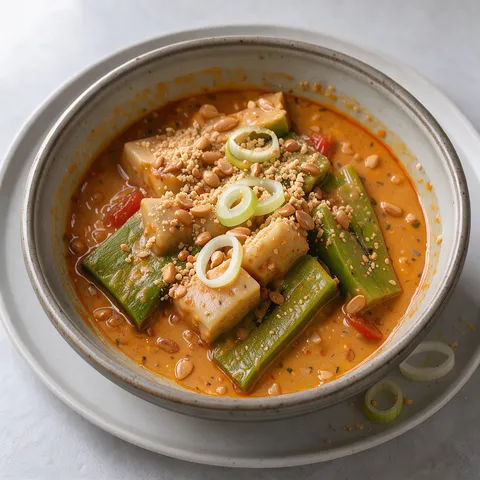 Taro and Plantain Peanut Stew1 hr 25 min · Main course
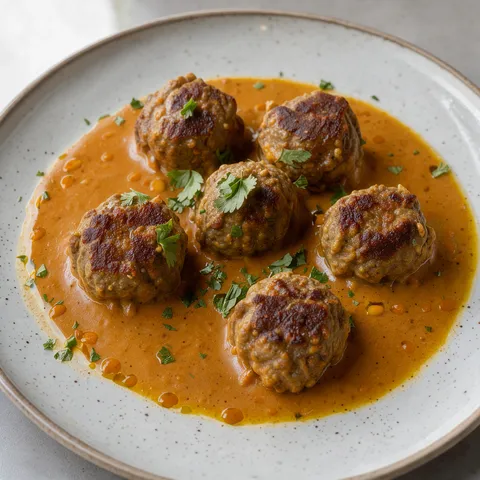 Beef Meatballs in Peanut Sauce1 hr 15 min · Main course