Nikujaga 2.0
A Japanese main course. Takes 1 hr 20 min, Serves 4. Difficulty: challenging.
At a glance
- Total time
- 1 hr 20 min
- Serves
- Serves 4
- Difficulty
- Challenging
- Cuisine
- Japanese cuisine
- Dish type
- Main course
- Allergens
- Gluten, Milk, Fish, Sesame, Soya, Celery
Ingredients
Fondant potatoes
- 4 large waxy potatoes (about 900 g)
- 2 tbsp neutral oil
- 40 g butter
- 300 ml Dashi (Basics)
- 2 tbsp mirin
- 1 tbsp Japanese soy sauce
Beef
- 600 g beef ribeye (2 pieces, 3 cm thick)
- 6 g salt
- 1 tbsp neutral oil
- 20 g butter
Nikujaga jus
- beef trimmings (from the edges of the ribeye)
- 1 small onion
- 400 ml Dashi (Basics)
- 2 tbsp sake
- 2 tbsp mirin
- 1.5 tbsp Japanese soy sauce
- 1 tsp sugar
- 20 g cold butter
Onion cream
- 2 onions (400 g)
- 30 g butter
- 100 ml Dashi (Basics)
- 1 tsp white miso
- salt
Carrot
- 2 carrots (200 g)
- 2 tbsp rice vinegar
- 1 tbsp sugar
- 1/4 tsp salt
Shirataki kinpira
- 150 g shirataki
- 1 tsp sesame oil
- 1 tsp soy sauce
- 1 tsp mirin
- 1 tsp toasted sesame seeds
To finish
- a handful of pea shoots
- 1/4 tsp shichimi togarashi
- flaky salt
Equipment
- Paring knife
- Chef's knife
- Chopping board
- Cast-iron frying pan
- Oven
- Saucepan
- Blender
- Fine sieve / chinois
- Wooden spoon / spatula
- Vegetable peeler
- Frying pan
- Balloon whisk
- Probe thermometer
- Mixing bowls
Method
- Cut the fondant potatoes: Peel the potatoes and cut them into 8 cylinders, 3 cm high, using a 5 cm round cutter or a knife. Bevel the edges with a paring knife. Soak the cylinders in cold water for 5 min, drain and pat completely dry with kitchen paper: wet potatoes steam instead of browning. Preheat the oven to 200°C
- Sear and bake the fondants: Heat the oil over high heat in an ovenproof cast-iron pan. Arrange the potatoes flat-side down and fry, without moving them, for 4-5 min, until a deep golden crust forms. Turn, add the butter and, once it foams, pour in the dashi, mirin and soy sauce. The liquid should come halfway up the potatoes. Transfer to the oven and cook for 25-30 min, until the liquid is absorbed and a knife slides in without resistance. This is the classic's dashi-simmered potato rebuilt with the French fondant technique: caramelised outside, saturated with dashi inside
- Cook the onion cream: Thinly slice the onions. Melt the butter in a saucepan over medium-low heat, add the onions with a pinch of salt and cook, covered, for 15 min, stirring now and then, until soft but not coloured. Uncover and cook for another 5 min, until pale golden. Add the dashi and miso, blend for 1 min until completely smooth and pass through a fine sieve. It should be a glossy cream that holds its shape on a spoon. Keep warm
- Start the jus: Trim the strip of fat and the uneven ends from the ribeye and chop the trimmings into 1 cm pieces. Brown them in their own fat in a small saucepan over medium-high heat for 5-6 min, until deep brown. Add the finely chopped onion and fry for 3 min. Pour in the sake and scrape up the brown layer from the bottom with a wooden spoon
- Reduce the jus: Add the dashi, mirin, soy sauce and sugar and boil over medium-high heat for 15 min, until about 150 ml of liquid remains. Pass through a fine sieve. Just before serving, reheat on the hob, then take off the heat and whisk in the cold butter piece by piece. You will have a glossy, dark brown jus that coats a spoon: a concentrated version of the classic stew's sauce
- Lightly pickle the carrot: Shave the carrots into long, thin ribbons with a peeler. Stir the vinegar, sugar and salt together until the sugar dissolves, add the ribbons and leave for at least 15 min. This gentle acidity cuts through the richness of the buttery potatoes and the fatty meat
- Make the shirataki kinpira: Blanch the shirataki in boiling water for 2 min, drain and cut into 8 cm lengths. Stir in a dry frying pan over medium-high heat for 3-4 min, until the sizzling stops and the surface is dry. Add the sesame oil, soy sauce and mirin, glaze for 1 min and sprinkle with the sesame seeds. Dried-out shirataki takes up the sauce and gains a firm, slightly chewy texture
- Sear the meat: Salt the ribeye 20 min before cooking so it comes to room temperature. Heat a cast-iron pan over very high heat until smoking and add the oil. Sear the steaks for 2-3 min on each side, edges included, until a dark crust forms. In the last minute, add the butter and spoon the foam over the meat. When the internal temperature reaches 52-54°C (rare to medium-rare), transfer to a wire rack and rest for 8 min: unrested meat releases its juices onto the plate when cut
- Slice: Slice the rested meat against the grain, 1 cm thick, and sprinkle flaky salt over the cut faces
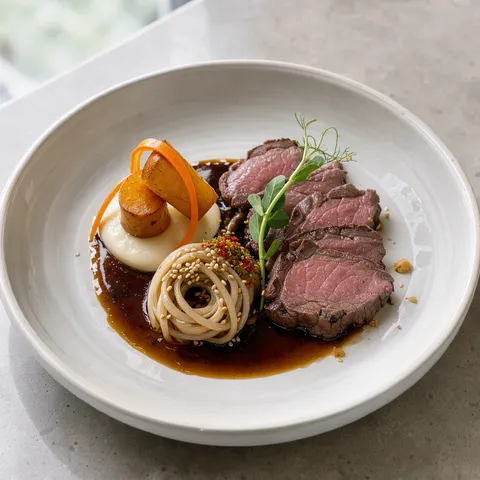
- Plate: Put a spoonful of onion cream in the centre of a warm, slightly dished plate and swirl a small circle with the back of the spoon. Set two fondant potatoes side by side on the cream, caramelised side up. Lean 3-4 slices of beef between and beside the potatoes, pink cut faces showing. Twirl the shirataki kinpira into a small nest with a fork and place it next to the meat. Drain the carrot ribbons, curl them and arrange on top of the potatoes
- Finish: Pour 2-3 tbsp of hot jus from the edge of the plate around the base of the meat and potatoes, so a glossy pool forms in the centre. Scatter the pea shoots over the carrot, add a pinch of shichimi to the beef slices and serve at once
Chef's note
The five elements of the classic are kept, but each moves to its own technique: the dashi-simmered potato becomes a fondant, the stew's sauce becomes a butter-mounted jus, the onion becomes a cream. Thick ribeye replaces the thin beef slices, so the meat is seared separately. The only thing not in the classic is the acidity of the pickled carrot. If you run the fondants and the jus at the same time, there is plenty of time.
Frequently asked questions
- Why do the fondant potatoes steam instead of browning?
- Wet potatoes don't brown, they steam. After soaking the cylinders in cold water, drain them and dry them completely with kitchen paper.
- Why is the steak rested after cooking?
- Meat that isn't rested leaks its juices onto the plate when cut. Take the steaks off at an internal temperature of 52-54°C and rest them on a wire rack for 8 minutes.
- How do I get a glossy jus that coats the spoon?
- Just before serving, heat the jus, take it off the heat and whisk in cold butter piece by piece. This gives the jus its shine.
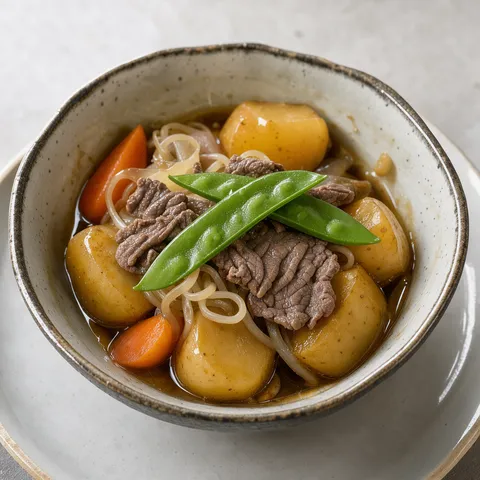 Japanese Beef and Potato Stew1 hr 15 min · Main course
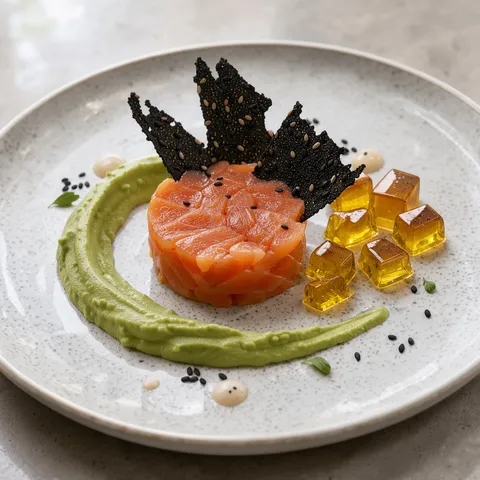 Salmon Tartare, Black Sesame Crisp, Wasabi Avocado45 min · Starter
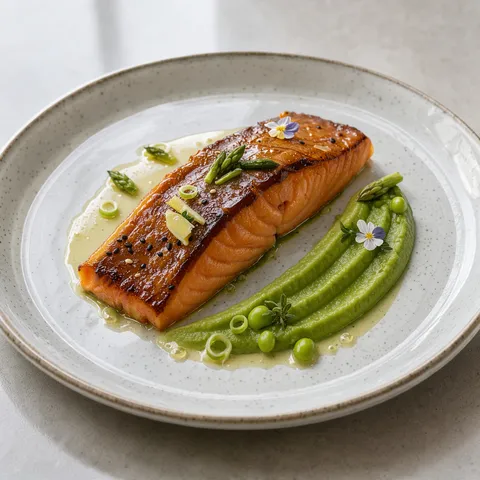 Salmon, Miso Glaze, Dashi Beurre Blanc, Edamame Purée50 min · Main course
 Ichiban Dashi1 hr 45 min · Basic recipe
 Miso Soup15 min · Soup
 Sushi Rice1 hr 15 min · Basic recipe
 Nigiri45 min · Main course