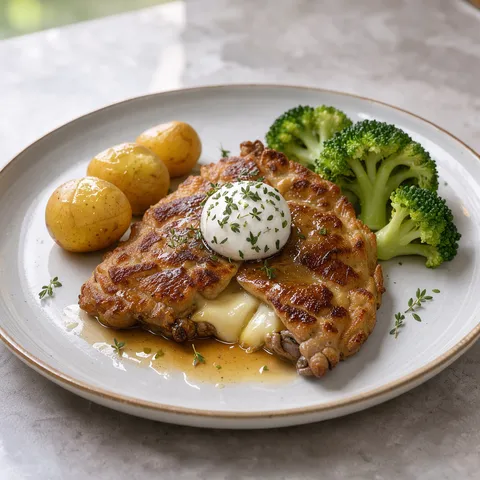
Montenegrin Stuffed Beef Steak Njeguški Stek
A Montenegrin main course. Takes 1 hr, Serves 4. Difficulty: medium.
At a glance
- Total time
- 1 hr
- Serves
- Serves 4
- Difficulty
- Medium
- Cuisine
- Montenegrin cuisine
- Dish type
- Main course
- Allergens
- Gluten, Milk, Sulphites
Ingredients
Meat
- 4 slices of beef topside or sirloin (about 170 g each, 1 cm thick)
- 1/2 tsp salt
- 1/2 tsp black pepper
- 30 g plain flour
- 2 tbsp sunflower oil
- 30 g butter
Filling
- 120 g beef bacon (smoked beef brisket without fenugreek coating, thinly sliced)
- 120 g aged semi-hard cheese (thinly sliced)
- 1 tsp fresh thyme leaves
- 8 cocktail sticks
Pan sauce
- 100 ml dry white wine (alcohol-free: 100 ml water + 1 tsp lemon juice)
- 15 g cold butter
Clotted cream balls
- 150 g clotted cream
- 1 tbsp fresh thyme leaves (finely chopped)
Garnish
- 600 g small potatoes
- 300 g broccoli
- 3 litres water (1.5 litres for the potatoes + 1.5 litres for the broccoli)
- 1.5 tsp salt (1 tsp for the potatoes + 1/2 tsp for the broccoli)
- 20 g butter
Equipment
- Saucepan
- Colander
- Cling film
- Cast-iron frying pan
- Silicone spatula
- Probe thermometer
Method
- Boil the potatoes: Put the potatoes in their skins in a pan, add 1.5 litres cold water and 1 tsp salt, and after it comes to the boil cook for 18-20 min, until a knife slides in easily. Drain in a colander, halve and toss with the butter in the pan, keeping them hot with the lid on
- Prepare the clotted cream balls: Using two teaspoons, shape the cold clotted cream into 4 small balls. Spread the chopped thyme on a plate, roll the balls in it and put in the fridge. Cold clotted cream melts slowly on the hot meat and acts like a sauce
- Flatten the meat: Place each slice of meat between two sheets of cling film and, using the flat side of a meat mallet, pound from the centre outwards to 5 mm thick. The slice grows to about twice its size. Even thinness keeps the meat from drying out while the filling cooks. Remove the film and sprinkle both sides with salt and pepper
- Fill and fold: Put the bacon slices on one half of each slice, then the semi-hard cheese slices, and sprinkle with thyme leaves. Leave 1 cm free around the edge. Fold the other half over, press the edges together and hold with two cocktail sticks. If cheese leaks from the edges, it burns in the pan
- Dredge in flour: Dredge the stuffed steaks in the flour and shake off the excess. The thin coating of flour forms a golden crust in the pan and later thickens the sauce
- Fry: Heat a cast-iron pan over medium-high heat and add the oil. Add the steaks and cook for 4 min without touching, until the underside is deep golden. Turn with a spatula, add the butter and, once it foams, spoon it over the steaks and cook for 4 min more. Insert a thermometer into the thick part: the internal temperature should reach 65°C and the cheese should be melted. Transfer the steaks to a plate
- Boil the broccoli: While the meat cooks, bring 1.5 litres of water with 1/2 tsp salt to the boil in a separate pan, divide the broccoli into small florets, boil for 3 min and drain in a colander. It should be bright green and crisp-tender
- Make the pan sauce: Pour most of the fat out of the cast-iron pan, add the wine and boil for 1-2 min, scraping up the sediment on the bottom, until reduced by half. Turn off the heat and swirl in the cold butter until melted. The sauce should be glossy and slightly thickened
- Plate: Remove the cocktail sticks. Put one stuffed steak on each plate, drizzle with the pan sauce and place a thyme clotted cream ball in the middle. Add the potatoes and broccoli alongside and serve immediately
Chef's note
It takes its name from the village of Njeguši, on the slopes of Lovćen, and from its famous smoked ham and cheese. In the former Yugoslavia it is described as a 20th-century dish attributed to Milovan Stojanović, Tito's cook. The original recipe uses smoked pork leg (Njeguški pršut) and Njeguški cheese; here it is made with thinly sliced beef bacon and aged semi-hard cheese. In some restaurants the meat is coated in dried breadcrumbs and fried. Doneness is a matter of taste: for beef, 60°C is pink and 65°C is medium-well. If you do not have a meat mallet, use a rolling pin or the flat base of a pan.
Frequently asked questions
- Why are the steaks flattened to 5 mm?
- Flatten the slices between two sheets of cling film with a meat mallet and they spread to about twice their size. Even thickness stops the meat drying out while the filling cooks.
- How do you stop the cheese in the filling from leaking into the pan?
- Leave a 1 cm border when filling, press the edges together and fasten with two cocktail sticks. Cheese that escapes at the edge burns in the pan.
- Why are the kaymak balls served cold?
- They need to stay cold. Cold kaymak melts slowly on the hot steak and acts like a sauce. So keep the balls in the fridge and put them on last.
 Montenegrin Potato Cornmeal Porridge1 hr 5 min · Main course
 Montenegrin Lamb Braised in Milk2 hr 30 min · Main course
 Montenegrin Kale and Lamb Stew1 hr 40 min · Main course
 Baked Carp from Lake Skadar1 hr 40 min · Main course
 Skewer-Rolled Montenegrin Pasta1 hr 30 min · Main course
 Perast Almond Meringue Lattice Tart1 hr 35 min · Dessert