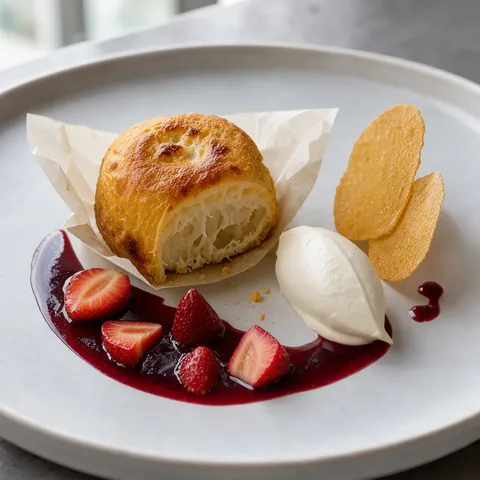
Pão de Ló 2.0
A Portuguese dessert. Takes 1 hr, Serves 4. Difficulty: challenging.
At a glance
- Total time
- 1 hr
- Serves
- Serves 4
- Difficulty
- Challenging
- Cuisine
- Portuguese cuisine
- Dish type
- Dessert
- Diet
- Vegetarian
- Allergens
- Gluten, Milk, Eggs, Sulphites
Ingredients
Pão de ló molhado (4)
- 3 eggs + 3 egg yolks (at room temperature)
- 120 g caster sugar
- 40 g plain flour
- a pinch of salt
Ramekins
- 10 g butter (melted)
Lemon leaves (8 tuiles)
- 25 g soft butter
- 30 g icing sugar
- 1 egg white left over from the batter (about 30 g)
- 30 g plain flour
- half the finely grated zest of 1 lemon
Strawberries in port
- 300 g strawberries
- 40 g caster sugar
- 100 ml port (alcohol-free: 100 ml red grape juice + 1 tsp lemon juice, from the same lemon)
Lemon cream
- 100 ml cold whipping cream (35% fat)
- 60 g mascarpone
- 1 tbsp icing sugar
- the other half of the lemon zest
Equipment
- Oven
- Fine grater
- Mixing bowls
- Silicone spatula
- Baking tray
- Baking paper
- Palette knife
- Kitchen scissors
- Saucepan
- Fine sieve / chinois
- Ladle
- Balloon whisk
- Stand mixer
- Chef's knife
- Chopping board
Method
- Prepare the oven and the tuile batter: Preheat the oven to 180°C (conventional). Finely grate the lemon zest and divide it in half. In a bowl, beat the soft butter and 30 g icing sugar with a spatula until creamy, add the egg white, then fold in the flour and half the lemon zest. You get a smooth, spreadable batter. The egg white is left over from the yolks, so no part of the recipe goes to waste
- Bake the tuiles: Line a baking tray with baking paper. Take 1 tsp batter and spread it on the paper with a palette knife into a very thin oval, about 10×4 cm. Make 8. Bake for 7-8 min, until the edges turn golden. As soon as the tray comes out, lift them off with the palette knife and leave to cool: within a few minutes they become crisp as glass. Raise the oven to 210°C. These tuiles are a wafer-thin, crisp version of the sponge's browned crust
- Prepare the ramekins: Grease the inside of four 200 ml ceramic ramekins with the melted butter. With scissors, cut four strips of baking paper that stand 3 cm above the rim of the ramekins and four circles for the bases, and press the paper into the ramekins, crumpling it to fit. In Portugal pão de ló is traditionally baked in paper and served in it
- Cook the strawberry sauce: Wash and hull the strawberries. Quarter 150 g of them, toss with 10 g sugar in a bowl and set aside to release their juice. Roughly chop the remaining 150 g strawberries and boil them in a small saucepan (ring 1) with 30 g sugar and the port (or the alcohol-free mix) over medium heat for 8-10 min, until the strawberries break down and the liquid is syrupy. Strain through a fine sieve into a bowl, pressing with a ladle, and leave to cool. You are left with a glossy, deep red sauce
- Make the cream: Whisk the cold cream, mascarpone, 1 tbsp icing sugar and the remaining half of the lemon zest in a bowl for 1 min, until slightly thickened and airy. Over-whipped, it splits: soft peaks are enough. Keep in the fridge
- Whisk the eggs: Whisk the whole eggs, yolks and 120 g caster sugar in the bowl of a stand mixer on high speed for 10 min. The mixture should be very pale, tripled in volume, and leave a thick ribbon when you lift the whisk. In the molhado version there is little flour, so this foam carries the whole structure
- Fold in the flour: Sift the flour and salt over the foam through a fine sieve in two goes and fold in with a spatula, using wide movements from the bottom up. Do not overmix: if the foam collapses, the cake will not rise and the centre will be like wet batter rather than runny
- Fill and bake: Divide the batter evenly between the four ramekins (about 90 g foam each: the ramekins fill to the brim and the paper collar stops it overflowing). Put the ramekins on a baking tray and bake on the middle shelf at 210°C for 8-9 min. The top should puff up and turn deep golden and the edges should firm up, while the centre still wobbles when you shake the ramekin gently. This wobbling centre is the creamy, runny heart of pão de ló molhado
- Rest: Take the ramekins out of the oven and leave to rest for 3 min. The top of the cake sinks a little: this is normal and part of the character of molhado. Meanwhile, prepare the plates
- Plate: Pour 1 tbsp strawberry sauce into a round pool on one side of each plate and top with a few pieces of the sugared strawberries. Holding the paper, lift the cake out of the ramekin, set it in the centre of the plate and fold the paper back from the edges. Place a quenelle of lemon cream, shaped with two spoons, beside the cake and stand two lemon tuiles upright against the cream. When your guest breaks into the cake with a spoon, the creamy centre meets the strawberry sauce. Serve at once
Chef's note
This plate starts from the fully baked sponge of the site's Pão de Ló recipe and turns the molhado tradition of Ovar and Alfeizerão, where the inside is left creamy, into a warm, single-serving dessert. Port and strawberries belong to northern Portugal, and lemon zest is the classic aroma of pão de ló. The centre of the cake contains undercooked egg, so it is not recommended for children, pregnant women, older people or anyone with a weakened immune system. For them, use pasteurised eggs or bake the cakes for 13-14 min, until the centre is fully set. If mascarpone is unavailable, whisk 160 ml whipping cream with 2 tbsp strained (Greek-style) yoghurt.
Frequently asked questions
- Why does the centre of the pão de ló molhado stay runny?
- The cake uses very little flour, and the whole structure is held by egg foam whisked for 10 minutes. After 8-9 minutes at 210°C the centre should still wobble, which gives the creamy middle.
- What happens when the egg foam deflates, and how is the flour folded in?
- Sift the flour and salt in two additions and fold in with a spatula using wide movements from the bottom up. If overmixed, the foam deflates, the cake doesn't rise and the middle turns like wet batter.
- Why does the lemon cream split?
- Whisk the cold cream and mascarpone for only about 1 minute. If overwhisked, the cream splits, and soft peaks are enough.
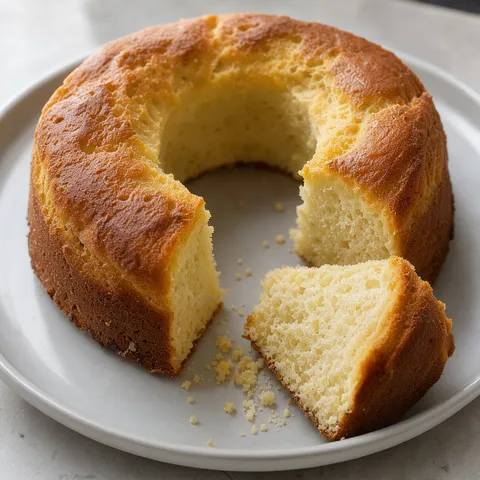 Portuguese Egg Sponge without Baking Powder1 hr 10 min · Dessert
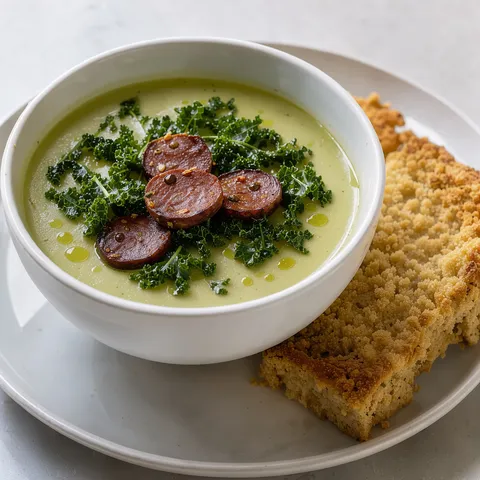 Portuguese Kale, Potato and Sausage Soup50 min · Soup
 Salt Cod with Eggs and Crisp Potatoes50 min · Main course
 Portuguese Custard Tarts1 hr 20 min · Patisserie
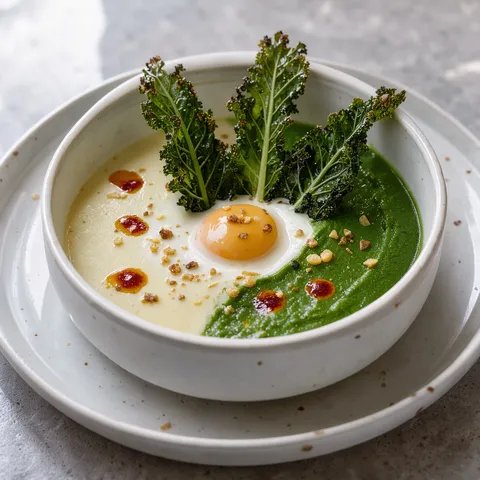 Caldo Verde 2.01 hr 15 min · Soup
 Alentejo Coriander Bread Soup30 min · Soup
 Algarve-Style Barbecued Chicken1 hr 40 min · Main course