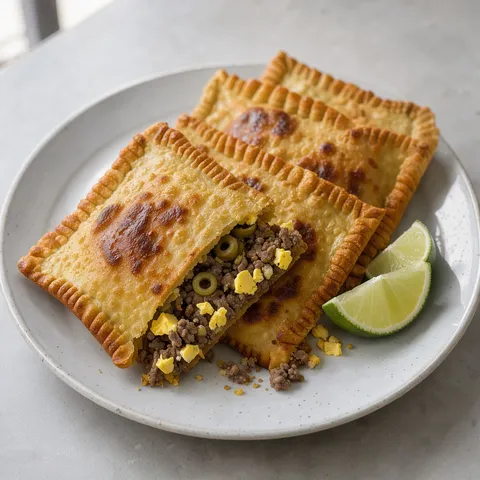
Crisp Brazilian Mince Pastries Pastel de Feira
A Brazilian bread & pastry. Takes 1 hr 30 min, 12 pieces (4 servings). Difficulty: medium.
At a glance
- Total time
- 1 hr 30 min
- Serves
- 12 pieces (4 servings)
- Difficulty
- Medium
- Cuisine
- Brazilian cuisine
- Dish type
- Bread & pastry
- Allergens
- Gluten, Eggs
Ingredients
Dough (12 pieces)
- 400 g plain flour
- 1 tsp salt
- 30 ml sunflower oil
- 30 ml cachaça (or vodka)
- about 180-200 ml lukewarm water
Filling
- 400 g medium-fat beef mince
- 1 tbsp olive oil
- 1 onion (finely chopped)
- 2 garlic cloves (finely chopped)
- 2 ripe tomatoes (grated)
- 1 tsp salt
- 1/2 tsp black pepper
- 1/2 tsp sweet paprika
- 60 g stoned green olives (chopped)
- 2 eggs
- 1/2 bunch flat-leaf parsley and 2 spring onions (finely chopped)
Frying
- 1.5 litres sunflower oil
Equipment
- Mixing bowls
- Rolling pin / oklava
- Frying pan
- Saucepan
- Heavy-based saucepan
- Probe thermometer
- Ladle
- Colander
- Chef's knife
- Chopping board
- Baking tray
Method
- Knead the dough: Put the flour and salt in a bowl and make a well in the middle. Pour in the oil and cachaça and mix in the water a little at a time. Knead on the work surface for 8 min, until the dough is smooth, not sticky and springs back slowly when pressed. The alcohol makes small bubbles in the dough as it fries, and this gives pastel its familiar blistered surface. Wrap in cling film and rest for 30 min, so the gluten relaxes and the dough can be rolled out paper-thin
- Boil the eggs: While the dough rests, boil the eggs in boiling water for 10 min, plunge into cold water, peel and cut into small cubes
- Cook the filling: Heat the olive oil in a large frying pan over high heat, add the mince and brown it for 6-8 min, breaking up any lumps, until all the liquid has evaporated and it is browned in places. Add the onion and cook for 5 min, then the garlic for 1 min. Add the tomatoes, salt, pepper and paprika and cook for 5 min, until no liquid is left in the pan. A wet filling soaks the dough and bursts when fried
- Cool the filling: Fold in the olives, eggs, parsley and spring onions. Spread the mixture on a wide plate and cool completely by the time the dough has finished resting. A hot filling softens and tears the dough
- Roll out the dough: Divide the dough into 12 equal pieces (about 55 g each). On a floured surface, roll each piece with a rolling pin into a rectangle about 12×24 cm and 1-1.5 mm thick. A dough thin enough almost to let light through turns crisp and blistered when fried
- Fill and seal: Put 2 tbsp filling (about 45 g) on one half of the rectangle, leaving a 1.5 cm gap at the edges. Moisten the edges with water on your finger, fold over the other half and press out the air inside towards the edge. Seal by pressing the edges with a fork. A pastel with air left in puffs up like a balloon in the oil and may burst. Arrange the finished ones in a single layer on a floured tray, without stacking
- Heat the oil: Heat the oil to 180°C in a deep, heavy-based pan. The oil should not fill more than a third of the pan, there should be no water or wet container nearby, and the temperature should be checked constantly with a thermometer
- Fry: Lower the pastels into the oil two at a time. If you spoon hot oil over them with a ladle, the surface blisters. Fry for 1.5-2 min on each side, until golden and crisp. Lift out with a slotted spoon and drain standing upright on kitchen paper. Wait for the oil to return to 180°C after each batch, as in cool oil the pastel soaks up oil. The total frying takes about 25 min
- Serve: Arrange the pastels side by side on a large plate while hot, with lemon slices. As at Brazilian markets, eat them at once by hand, wrapped in paper, as the crust softens the longer it waits
Chef's note
Pastel de feira is the symbol of Brazil's open-air markets (feira livre), and is described as having been popularised on market stalls by Japanese and Chinese immigrants who came to São Paulo. At the market it is usually eaten with sugarcane juice (caldo de cana). The same dough is also filled with cheese (halloumi or semi-hard cheese), hearts of palm or chicken. The cachaça adds no flavour to the dough and is used only for blisters and crispness. Use a wide pan 24-26 cm across for frying, as two pastels should float comfortably side by side.
Frequently asked questions
- Why is the surface of pastel blistered?
- The cachaca in the dough creates tiny bubbles as it fries. That is where the familiar blistered surface comes from.
- Why do pastéis burst while frying?
- If air is trapped inside, the pastel puffs up like a balloon in the oil and can burst. Press the air out towards the edges, and make sure the filling is not wet.
- What temperature should the oil be for frying pastel?
- 180°C. Wait for the oil to return to 180°C after each batch, as pastéis soak up oil in cooler oil.
 Brazilian Fried Tapioca Cheese Cubes1 hr 5 min · Meze
 Brazilian Street Picanha Skewers1 hr 2 min · Meze
 Brazilian Coconut Condensed Milk Balls1 hr 19 min · Meze
 Brazilian Cachaça and Lime Cocktail12 min · Drink
 Bolo de Laranja1 hr 10 min · Patisserie
 Tutu de Feijão1 hr 5 min · Main course