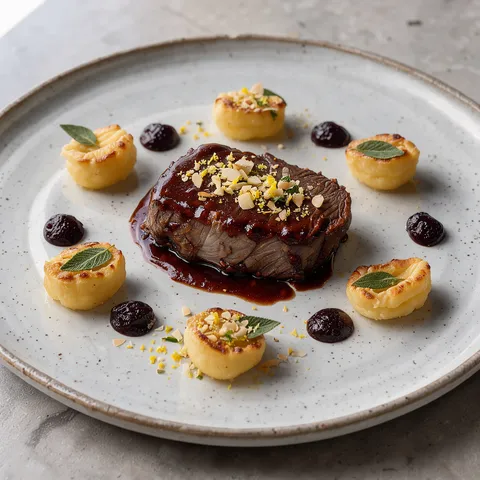
Pašticada 2.0
A Croatian main course. Takes 1 hr 30 min, Serves 4. Difficulty: challenging.
At a glance
- Total time
- 1 hr 30 min
- Serves
- Serves 4
- Difficulty
- Challenging
- Cuisine
- Croatian cuisine
- Dish type
- Main course
- Allergens
- Gluten, Milk, Eggs, Tree nuts, Celery, Sulphites
Ingredients
Beef cheeks
- 4 beef cheeks (about 900 g in total, trimmed)
- 1 tsp salt
- 1/2 tsp black pepper
- 2 tbsp olive oil
- 1 onion
- 1 carrot
- 100 g celeriac
- 3 garlic cloves
- 4 cloves
- 1 tbsp tomato paste
- 60 ml red wine vinegar
- 250 ml dry red wine
- 150 ml prošek or sweet red wine
- 300 ml Brown Beef Stock (Basics)
- 80 g prunes
- 1 dried fig
- 1 bay leaf
- 1 rosemary sprig
- 1 strip of lemon peel
- 1/4 tsp nutmeg
Prune purée
- 80 g prunes
- 60 ml prošek
- 60 ml water
- 1 tsp red wine vinegar
Crisp njoki
- 250 g floury potatoes
- 55-60 g plain flour
- 1 egg yolk
- 10 g grated hard cheese
- 1/4 tsp salt
- 30 g butter
- 8 sage leaves
Gremolata
- finely grated zest of 1 lemon
- 1 tbsp finely chopped flat-leaf parsley
- 1 tbsp toasted and chopped almonds
- flaky salt
Equipment
- Filleting knife
- Chef's knife
- Pressure cooker
- Steamer basket
- Potato ricer
- Saucepan
- Colander
- Baking tray
- Stick blender
- Squeezy bottle
- Blender
- Fine sieve / chinois
- Cast-iron frying pan
Method
- Plan the workflow (0 min): This plate fits into 90 min for a single cook, because all the garnishes are made while the cheeks are in the pressure cooker. First, remove the outer membrane and excess fat from the cheeks with a filleting knife, pat them dry and rub with salt and black pepper. Finely chop the onion, carrot and celeriac. This prep takes 8 min
- Sear the cheeks (8 min): Heat the olive oil in the pressure cooker over high heat and sear the cheeks for 6 min in total, until deep brown on all sides. In place of the leg of the classic, left overnight in vinegar, collagen-rich cheek is used here: in the pressure cooker it quickly becomes tender enough to cut with a spoon, and the dark sear gives the sauce its colour
- Vegetables, vinegar and wine (14 min): Lift out the cheeks and fry the vegetables in the same pan over medium-high heat for 6 min, until deep golden. Add the garlic, cloves and tomato paste and fry for 1 min. Pour in the vinegar and boil for 1 min, scraping up the sediment from the bottom: this short step brings in the sourness of the classic's marinade. Add the red wine and prošek and boil for 2 min to cook off the alcohol. Add the stock, prunes, fig, bay leaf, rosemary, lemon peel and nutmeg, and return the cheeks to the pan
- Pressure-cook (24 min): Close the lid and, once steam starts to escape (about 5 min), lower the heat to medium-low and cook for 40 min. When the time is up, carefully open the valve to quick-release the pressure (3 min). The cheeks are done when they fall apart into fibres when pressed with a spoon. While they are under pressure, prepare the three garnishes below
- Steam the potatoes for the njoki (25 min): Peel the potatoes, slice them 1 cm thick and steam them over boiling water for 12 min, until a knife slides in without resistance. Thin slices cook in half the time of boiling them in their skins, and steaming stops the potatoes absorbing water, which means less flour in the njoki. Pass them through a ricer while hot and spread them out on the work surface for 3 min to let the steam escape
- Shape and boil the njoki (40 min): Add the egg yolk, cheese, salt and 55 g flour to the potato and mix only until the dough comes together: if it is sticky, add the remaining flour. Roll into two ropes 2 cm thick and cut into 2 cm pieces: you should get about 20 njoki, five per plate. Cook in boiling salted water, lift out with a slotted spoon 1 min after they rise to the surface and spread out on an oiled tray: the surfaces need to dry so they crisp up in the pan
- Prune purée and gremolata (52 min): Soften the prunes with the prošek and water in a small saucepan for 8 min, then blend with the vinegar until smooth using a stick blender and transfer to a squeeze bottle. It should be thick and glossy. Mix the lemon zest, parsley, almonds and a pinch of flaky salt. The prune that disappears into the sauce in the classic becomes a separate, deep note of flavour on the plate here, and the citrusy gremolata lifts the weight of the dark, winey sauce
- Glaze with the sauce (72 min): Lift out the cheeks and cover them with a ladleful of sauce to keep warm. Remove the bay leaf, rosemary and lemon peel from the sauce, blend the rest with the prunes and fig until smooth and pass through a fine sieve. Reduce in a wide frying pan over high heat for 6 min, until it coats the back of a spoon in a thick, mirror-glossy layer. Put the cheeks into this sauce and glaze for 2 min, spooning the sauce over them: they should be coated in a dark, glossy crust
- Crisp up the njoki (74 min, at the same time as the sauce): Heat the butter in a cast-iron frying pan over medium-high heat until foaming and arrange the njoki in a single layer. Fry for 2 min on each side, until golden brown and crisp. Add the sage leaves in the last 30 sec so they crisp up. The soft njoki of the classic become a garnish here, crusted outside and cloud-like inside
- Plate (82 min): Put a spoonful of sauce in the centre of a warm plate and draw a short line with the back of the spoon. Set a glazed cheek on the line and spoon over another spoonful of glossy sauce. Arrange five crisp njoki in a curved row beside the cheek, with two crisp sage leaves between them
- Finish (88 min): Pipe three dots of prune purée between the njoki. Sprinkle a pinch of gremolata over the cheek and serve immediately. The plate should be on the table at 90 min: if the sauce sits, it forms a skin
Chef's note
The identity of the classic is intact: a dark, sweet-sour sauce with vinegar and wine, cloves and prunes, beef, and potato njoki. What changes: collagen-rich cheek and a pressure cooker in place of an overnight vinegar marinade, crisp njoki instead of soft, and the prune also appears on the plate as a separate purée alongside the sauce. The pork bacon of the classic pašticada is not used here at all. The cheeks become tender enough after 40 min under pressure: cooked any longer, they fall apart and won't glaze.
Frequently asked questions
- Why are beef cheeks chosen for Pašticada 2.0?
- The collagen-rich cheeks become spoon-tender quickly in a pressure cooker. The dark sear also gives the sauce its colour.
- How is the pressure released?
- After 40 minutes of cooking, open the valve carefully and release the pressure quickly over about 3 minutes. The cheeks are ready when they fall into strands under the press of a spoon.
- Why are the gnocchi made with steamed potatoes?
- Thinly sliced potatoes steam in 12 minutes and don't take on water. That means less flour goes into the gnocchi.
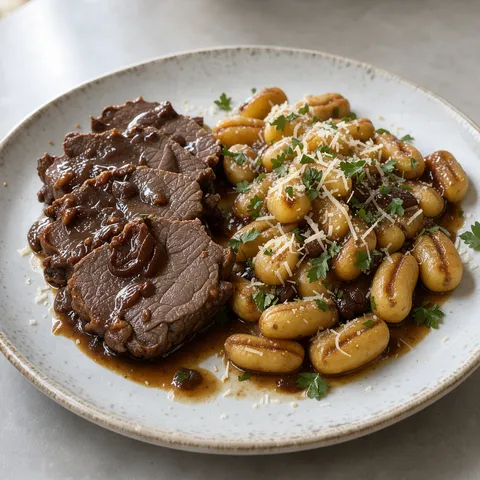 Dalmatian Beef with Prunes3 hr 30 min · Main course
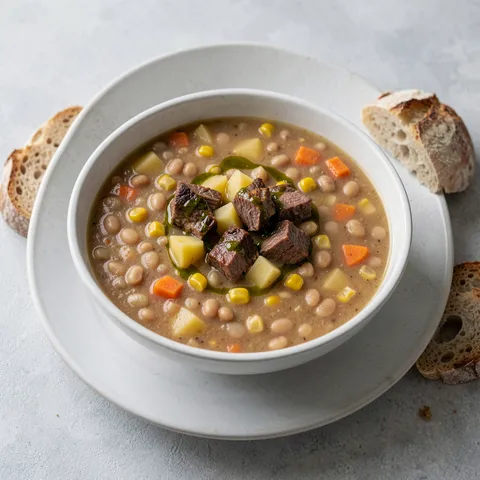 Istrian Bean and Sweetcorn Soup1 hr 55 min · Soup
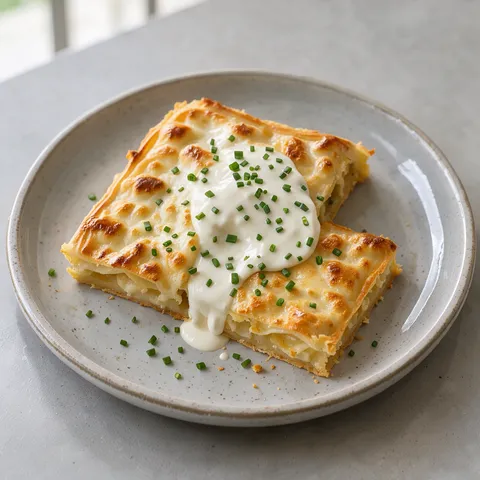 Zagorje Curd Cheese Parcels2 hr · Bread & pastry
 Dubrovnik Caramel Custard1 hr 20 min · Dessert
 Dalmatian Black Risotto with Cuttlefish Ink1 hr · Main course
 Dalmatian Mixed Fish Stew with Polenta1 hr 15 min · Main course
 Zagorje Roast Turkey Legs2 hr 15 min · Main course