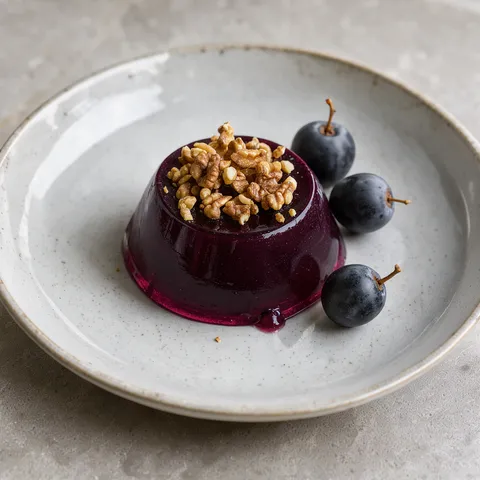
Pelamushi Georgian Grape Must Pudding with Walnuts
A Georgian dessert. Takes 45 min · +3 hr cooling, Serves 4. Difficulty: medium.
At a glance
- Total time
- 45 min · +3 hr cooling
- Serves
- Serves 4
- Difficulty
- Medium
- Cuisine
- Georgian cuisine
- Dish type
- Dessert
- Diet
- Vegetarian, Vegan
- Allergens
- Gluten, Tree nuts
Ingredients
Grape must
- 1.8 kg dark red or black seeded grapes (Saperavi, Isabella or other black grapes) or 1 litre freshly pressed dark grape juice
Pudding
- 100 g fine cornmeal (or 80 g plain flour)
- 0-60 g caster sugar (depending on the sweetness of the grapes)
- a pinch of salt
To serve
- 80 g walnuts
- 8-12 fresh grapes
Equipment
- Stick blender
- Muslin
- Fine sieve / chinois
- Mixing bowls
- Balloon whisk
- Heavy-based saucepan
- Wooden spoon / spatula
- Frying pan
- Chef's knife
- Chopping board
- Silicone mould (optional)
Method
- Pick over the grapes: Pull the grapes off their stalks, wash and drain them, and discard any rotten or soft ones. The stalks give the must tannin and bitterness. Takes 10 min
- Extract the must: Pulse the grapes in a large bowl with a stick blender for 20-30 sec in short bursts, just enough to burst the skins: if the seeds break, the must turns bitter. Pour into a sieve lined with muslin, twist the muslin and squeeze hard. You will get about 1 litre of dark purple must. Takes 5 min
- Slake the flour: Pour 250 ml of the must into a separate bowl, sift the flour over it and whisk until smooth, 3 min. Because the flour is mixed into cold liquid, it does not form lumps when it meets the heat
- Heat the must: Bring the remaining must and the salt to the boil in a heavy-based saucepan over medium heat, about 5 min. Taste it: if it is sour, add the sugar at this stage and let it dissolve
- Cook the pudding: Whisking constantly, pour the flour mixture into the pan in a thin stream. Lower the heat to medium-low and cook for 12-15 min, scraping the bottom with a wooden spoon. At first it looks cloudy and pinkish purple. As it cooks it thickens, turns glossy and deepens to a dark ruby red. It is ready when a line drawn with your finger across the back of the spoon does not close up. The cornmeal version takes a little longer to cook than the wheat-flour one: the raw flour taste must disappear completely
- Mould: Rinse four bowls or small moulds with cold water: the wet surface stops the pudding sticking. Fill them with the hot pudding and smooth the tops with the back of a wet spoon, 5 min
- Toast the walnuts: While you fill the moulds, toast the walnuts in a dry frying pan over medium heat for 3 min, tossing, just until fragrant, then roughly chop them with a knife. Over-toasted walnuts turn bitter and overpower the fruitiness of the pudding
- Chill: Leave the bowls at room temperature for 30 min to cool slightly, then chill in the fridge for 2 hr 30 min. The pudding sets to a sliceable, wobbly consistency that does not fall apart
- Plate: Run a thin knife around the edge of each mould and invert the pudding onto the centre of a plate. Pile the chopped walnuts on top in a small mound and add 2-3 fresh grapes alongside. You can also serve it in the bowl, with the walnuts scattered over
Chef's note
Pelamushi is the dessert of the grape harvest (rtveli) and comes from the same base as the thick must jelly (tatara) inside churchkhela: poured over walnuts threaded on a string, the mixture becomes churchkhela; poured into a bowl, it becomes pelamushi. It is traditional to leave out the sugar entirely and rely on the grapes' own sweetness. Shop-bought juice gives a flat, sugary result in this dessert, so use fresh must.
Frequently asked questions
- Why does Pelamushi go lumpy, and how do you prevent it?
- First whisk the flour smooth into 250 ml of the cold must. Flour loosened in cold liquid doesn't go lumpy when it goes into the hot must.
- Why is the blender run briefly when making the grape must?
- Blend the grapes in short pulses for just 20-30 seconds, only enough to burst the skins. If the pips break, the must turns bitter.
- How do you tell when Pelamushi is ready?
- The pudding should thicken and turn glossy and a deep ruby colour. It is ready when a line drawn with a finger on the back of the spoon doesn't close up, and it should no longer taste of raw flour.
 Mini Imeruli Khachapuri1 hr · Meze
 Georgian Cinnamon Raisin Bread1 hr 7 min · Breakfast
 Georgian Sour Plum Sauce52 min · Sauce
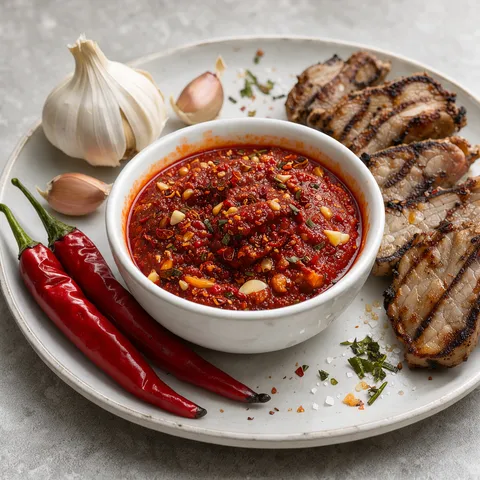 Abkhazian Chilli Garlic Paste26 min · Sauce
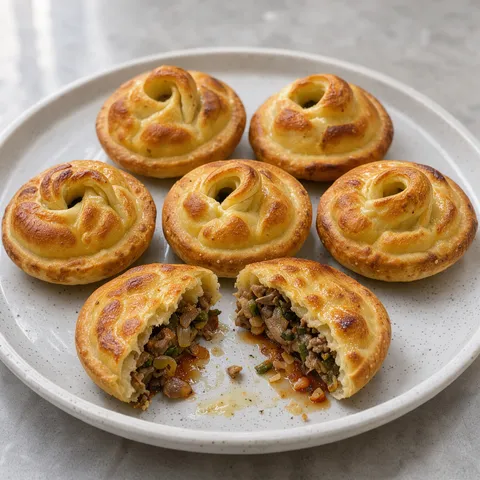 Svan Lamb and Beef Pastries 5.5 cm1 hr 37 min · Meze
 Khachapuri Adjaruli2 hr 15 min · Bread & pastry