
Khachapuri Adjaruli Adjarian Cheese Bread
A Georgian bread & pastry. Takes 2 hr 15 min, 4 servings (4 boats). Difficulty: challenging.
At a glance
- Total time
- 2 hr 15 min
- Serves
- 4 servings (4 boats)
- Difficulty
- Challenging
- Cuisine
- Georgian cuisine
- Dish type
- Bread & pastry
- Allergens
- Gluten, Milk, Eggs
Ingredients
Dough
- 500 g flour (strong white bread flour or plain flour)
- 280 ml lukewarm milk (about 35°C)
- 7 g fast-action dried yeast
- 1 tbsp sugar
- 8 g salt
- 1 egg
- 30 ml sunflower oil
Cheese filling
- 300 g imeruli cheese (if unavailable, fresh, soft white brined cheese desalted in water)
- 300 g sulguni (if unavailable, 200 g mozzarella + 100 g young semi-hard cheese)
- 1 egg
- 50 ml milk
Egg wash
- 1 egg + 1 tbsp milk
To finish
- 4 fresh egg yolks (at room temperature)
- 80 g cold butter (4 pieces). Makes 4 boats
Equipment
- Mixing bowls
- Box grater
- Baking tray
- Baking paper
- Pastry brush
- Oven
Method
- Activate the yeast: Stir the sugar and yeast into half the lukewarm milk and leave for 10 min. If no froth forms on the surface, the yeast is dead: start again with a new batch
- Knead the dough: Put the flour and salt in a large bowl. Add the yeasted milk, the remaining milk, the egg and the oil and knead for 10 min. The dough should be soft and slightly sticky: when you can stretch it by hand into a thin membrane, the gluten is developed enough. This elasticity stops the edges tearing as they are shaped
- Prove: Transfer the dough to a lightly oiled bowl, cover and leave in a warm place for 1 hr, or until doubled in size. It is ready when a dent pressed with a finger slowly fills back
- Prepare the cheese: Crumble the imeruli by hand and coarsely grate the sulguni. Taste a piece of the sulguni first: if it is very salty, choose an unsalted imeruli. Mix the cheeses with the egg and milk: the mixture should hold together like damp sand. The milk stops the cheese releasing its fat and separating in the oven
- Preheat the oven: Preheat the oven to 250°C (conventional) for at least 30 min, with a baking tray or pizza stone inside. The hot base cooks the underside of the boats without leaving them soggy
- Divide into balls: Divide the dough into 4 equal pieces (about 210 g), shape into balls and rest, covered, for 15 min. Rested gluten relaxes and the dough stretches without springing back
- Shape the boats: On a floured surface, stretch each ball by hand into an oval of about 25×15 cm. Lay a thin strip of cheese along each of the two long edges and roll the edges tightly inwards over the cheese. Join the two ends and twist them into a pointed boat prow, leaving the centre open. The rolled edges should be at least 2 cm thick, or the cheese will overflow as it bakes
- Fill and glaze: Transfer the boats onto baking paper and spread the cheese filling generously (about 150 g) in the centre. Brush the rolled edges with the egg and milk mixture
- Bake: Slide the boats, on their paper, onto the hot tray and bake at 250°C for 10-12 min. They are ready when the edges are deep golden and the cheese has puffed up and browned in places
- Add the egg: Take out of the oven, make a small well in the centre of the cheese with a spoon and drop a yolk into it. Return the boat to the oven for 1-2 min: the yolk should warm through and turn glossy but stay runny. For pregnant women, young children or anyone with weakened immunity, use pasteurised eggs or keep the yolk in the oven for 3-4 min
- Plate: Transfer each boat to a wooden serving board or a large white plate. Put a piece of cold butter beside the yolk and take it to the table immediately, as the butter starts to melt into the hot cheese
- To eat: At the table, quickly stir the yolk, butter and cheese together with a fork. Tear pieces of dough from the edges, dip them into the mixture and, when the edges are finished, eat the centre
Chef's note
In Adjara the boat shape is likened to a vessel setting out on the Black Sea, and the yolk in the centre to the sun. If you cannot find imeruli, fresh, lightly salted white brined cheese gives the closest result, while mild semi-hard cheese should be used only sparingly, for stretch. Putting cheese inside the rolled edges is a home-style touch: the edges can also be rolled from plain dough.
Frequently asked questions
- How do I know the yeast is working?
- Mix the sugar and yeast into half of the milk and leave for 10 minutes. If no foam forms on the surface, the yeast is dead and you should start again with fresh.
- Why does the cheese spill over as the khachapuri bakes and how do I prevent it?
- The side rolls must be at least 2 cm thick or the cheese spills over. The milk mixed into the cheese also stops the cheese releasing fat and splitting in the oven.
- Is the raw egg yolk safe?
- For pregnant women, small children or anyone with a weak immune system, use pasteurised egg or keep the yolk in the oven for 3-4 minutes.
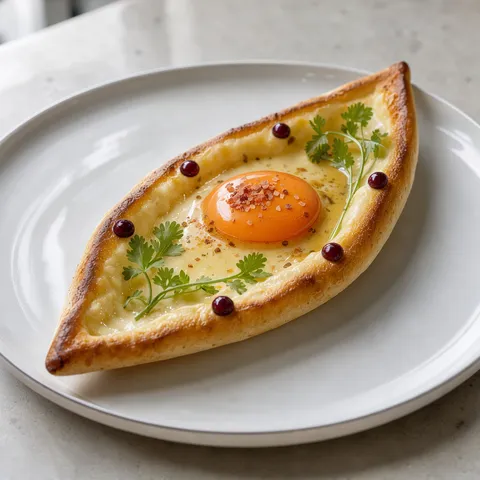 Khachapuri Adjaruli 2.01 hr 30 min · Bread & pastry
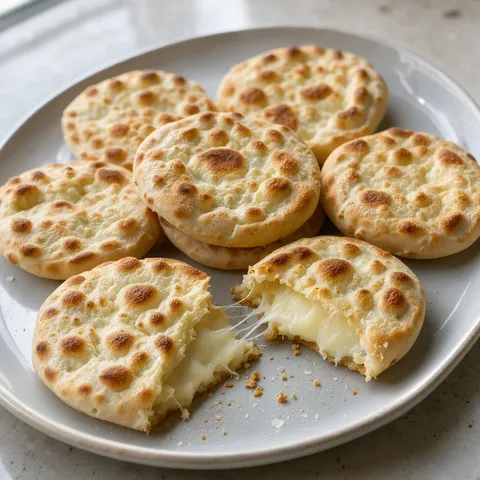 Mini Imeruli Khachapuri1 hr · Meze
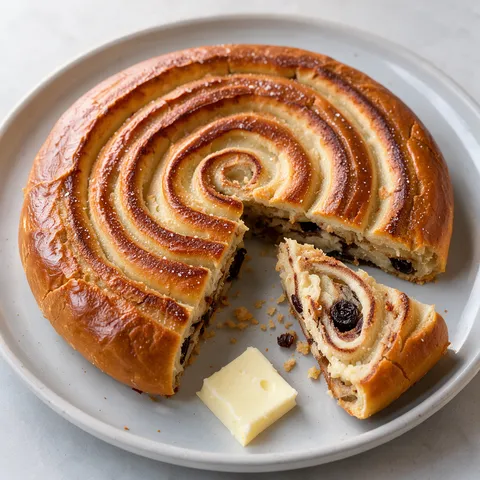 Georgian Cinnamon Raisin Bread1 hr 7 min · Breakfast
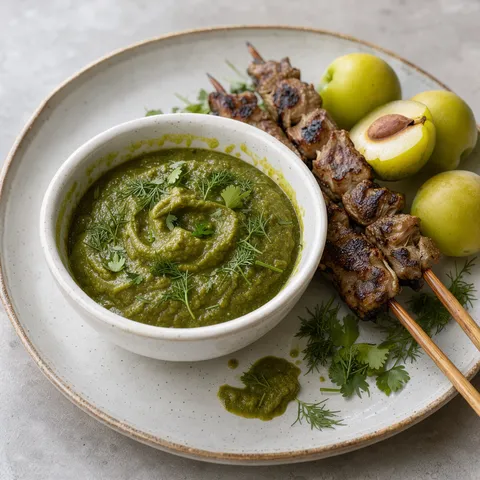 Georgian Sour Plum Sauce52 min · Sauce
 Abkhazian Chilli Garlic Paste26 min · Sauce
 Svan Lamb and Beef Pastries 5.5 cm1 hr 37 min · Meze
 Khinkali2 hr · Bread & pastry