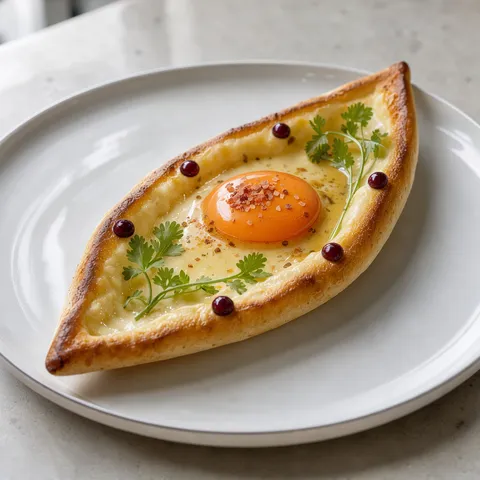
Khachapuri Adjaruli 2.0
A Georgian bread & pastry. Takes 1 hr 30 min, Serves 4. Difficulty: challenging.
At a glance
- Total time
- 1 hr 30 min
- Serves
- Serves 4
- Difficulty
- Challenging
- Cuisine
- Georgian cuisine
- Dish type
- Bread & pastry
- Allergens
- Gluten, Milk, Eggs
Ingredients
Quick-rise boats
- 250 g strong white bread flour
- 140 ml lukewarm milk (about 35°C)
- 6 g fast-action dried yeast
- 5 g sugar
- 5 g salt
- 1 egg yolk
- 15 g soft butter
- 1 egg + 1 tbsp milk for glazing
- 60 g grated sulguni (for the edges)
Cheese sauce
- 150 g sulguni (grated)
- 100 g imeruli cheese (crumbled, if unavailable fresh white brined cheese)
- 200 ml milk
- 6 g sodium citrate
- a pinch of white pepper
Eggs
- 4 very fresh eggs (at room temperature)
Brown butter
- 80 g butter
- a pinch of flaky salt
Svan salt
- 1 tbsp coarse sea salt
- 1 garlic clove
- 1/2 tsp coriander seeds
- 1/4 tsp utskho suneli (blue fenugreek)
- 1/4 tsp ground marigold petals
- 1/4 tsp cumin
- 1/4 tsp hot paprika
- 1/4 tsp dill seeds
Tkemali drops
- 80 g dried sour cherry plums (alycha) or 200 g fresh sour red plums
- 200 ml water
- 1 garlic clove
- 1 tsp sugar
- 1/4 tsp coriander seeds
- 4 mint leaves
- 4 coriander sprigs
- salt
To finish
- coriander cress
Equipment
- Mixing bowls
- Oven
- Probe thermometer
- Saucepan
- Blender
- Fine sieve / chinois
- Squeezy bottle
- Pestle and mortar
- Rolling pin / oklava
- Pastry brush
- Baking tray
- Baking paper
- Balloon whisk
- Stick blender
- Sous vide circulator (optional)
Method
- Make the dough (0-15 min): Mix the flour, yeast, sugar and salt. Add the lukewarm milk and egg yolk and knead for 6 min, then add the butter and knead for another 4 min. The dough should be smooth and elastic. Transfer to a bowl, cover and set it over a large bowl of hot water (about 30-35°C) to prove outside the oven for 35 min. The 1-hr rise of the classic is halved with twice the yeast and a warm environment. It is ready when doubled in size
- Start the eggs (at 15 min): Set the sous-vide water bath to 63.5°C and cook the eggs in their shells for 45 min. Without a water bath, cook them in a large saucepan of water held at 63-64°C with a thermometer. At this temperature the yolk turns custard-like: it keeps its shape but flows out heavily when cut. Instead of the raw yolk of the classic, this gives a controlled and safer texture. Once ready, the eggs can wait at the same temperature until serving
- Cook the tkemali (15-35 min, during proving): Boil the dried plums or fresh plums with the water for 12 min, until the plums fall apart. Remove the stones, then blend until smooth with the garlic, sugar, coriander seeds, mint, coriander and salt. Pass through a fine sieve and thicken over low heat for 5 min, until it becomes a thick sauce that leaves a trail on the back of a spoon. Transfer to a squeeze bottle and cool it in a bowl of iced water. These sour drops are a new element, absent from the classic, that cuts the richness of the cheese
- Preheat the oven (at 30 min, during proving): Set the oven to 250°C with a pizza stone or an upturned heavy baking tray inside. Heating the stone for at least 30 min makes the base crisp in the blind bake
- Make the Svan salt (35-40 min): Pound the garlic with the coarse salt in a mortar, add the spices and crush to the texture of damp sand. Spread thinly on a small tray and leave to dry in front of the oven door while the oven heats
- Shape the boats (50-60 min): Divide the dough into 4 pieces (about 100 g). Roll each piece into an 18×11 cm oval. Lay a thin strip of sulguni along the long edges, roll the edges tightly inwards and twist the ends into points. Put a handful of dried chickpeas wrapped in paper in the central hollow, so that the boat keeps its shape. Brush the edges with egg
- Blind-bake the boats (60-72 min): Bake the boats for 8 min, remove the paper with the chickpeas and bake for another 3-4 min, until the inner base is lightly golden and dry. This blind bake creates a crisp shell instead of the soft dough base of the classic: the cheese will be poured in afterwards
- Brown butter (62-68 min): Melt the butter in a small saucepan over medium heat and cook, swirling constantly. When the foam subsides, the milk solids at the bottom turn hazelnut brown and the aroma intensifies (about 150°C), transfer immediately to a cold bowl. Do not leave the milk solids behind: use them with the butter
- Make the cheese sauce (68-75 min): Heat the milk and sodium citrate in a saucepan and, before it boils, add the cheeses a handful at a time, whisking. Whisk over low heat for 2-3 min, until the sauce is completely smooth and glossy, then blitz with a stick blender for 20 sec. Sodium citrate binds the fat and protein of the cheese without separating: the cheese that puffs up in the oven in the classic becomes a silky, flowing sauce here. Keep hot at around 70°C
- Separate the eggs (75-80 min): Crack each egg, gently scrape away the white with a spoon and lift out the yolk whole. The white will be half set: use only the yolk
- Plate (80-88 min): Place a boat slightly diagonally in the centre of a warm, matt white plate. Pour the hot cheese sauce into the boat right up to the edges. Make a small well in the centre with a spoon and set the egg yolk in it. Drizzle a spoonful of brown butter with its milk solids over the yolk and sprinkle with a pinch of flaky salt
- Finish: Sprinkle a pinch of Svan salt over the yolk. Squeeze three tkemali drops onto the plate on each side of the boat. Put a few sprigs of coriander cress along the edge of the boat. Serve immediately and tell your guests to stir the yolk into the cheese as in the classic and eat it with the edges
Chef's note
Three elements of the classic are kept: the boat-shaped dough, the cheese, and the egg yolk with butter. The textures change: a blind-baked crisp shell, flowing cheese bound with sodium citrate, a yolk turned to custard at 63.5°C, and nutty brown butter. The two elements absent from the classic are Svan salt and tkemali, both from the Georgian table. If the cheese sauce drops below 60°C it thickens, so keep it hot until serving. An egg cooked at 63.5°C does not count as pasteurised: for those in risk groups, use pasteurised eggs. Serves 4.
Frequently asked questions
- Why is the cheese sauce in Khachapuri Adjaruli 2.0 made with sodium citrate?
- Sodium citrate binds the fat and protein in the cheese so they don't separate. The cheese becomes a silky, flowing sauce instead of puffing up in the oven. Heat it with the milk until just before boiling and add the cheeses a handful at a time.
- Why are the egg yolks cooked in a water bath?
- Eggs cooked in their shells at 63.5°C for 45 minutes give a custard-like yolk that holds its shape and runs slowly when cut. It is more controlled and safer than a raw yolk. Without a machine, use a pan of water held at 63-64°C with a thermometer.
- Why are the boats part-baked with chickpeas in the middle?
- The boats bake for 8 minutes first, then the paper-wrapped chickpeas are removed and they bake for another 3-4 minutes. The chickpeas keep the boat shape, and the blind bake keeps the inner base dry and crisp. The cheese sauce is poured in after baking, so the base doesn't go soggy.
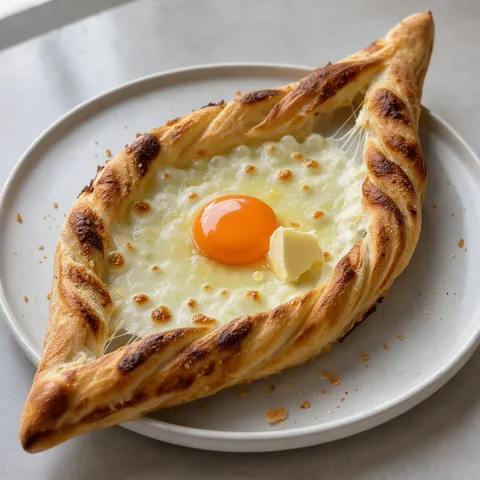 Khachapuri Adjaruli2 hr 15 min · Bread & pastry
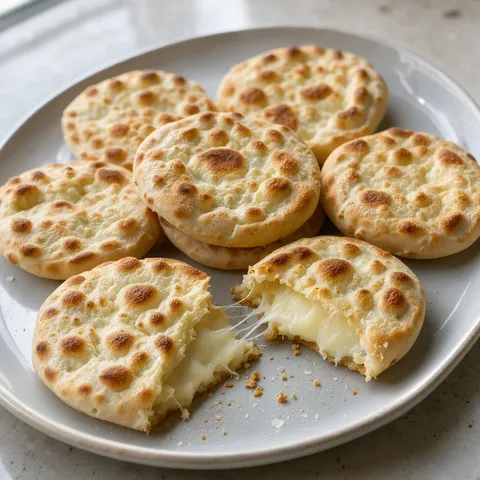 Mini Imeruli Khachapuri1 hr · Meze
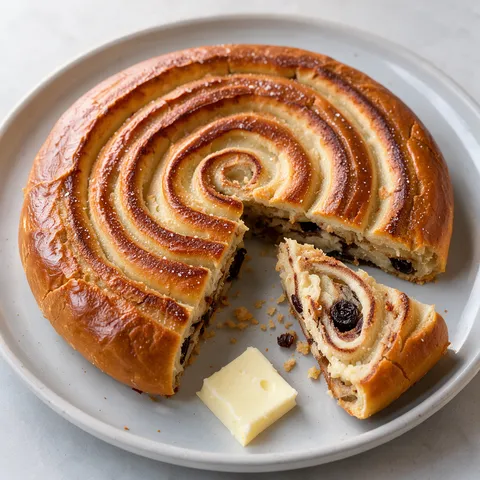 Georgian Cinnamon Raisin Bread1 hr 7 min · Breakfast
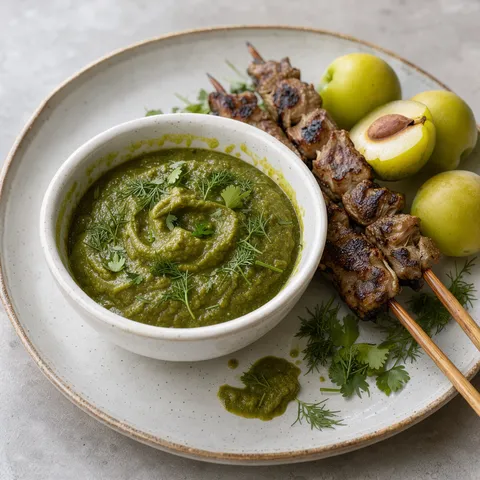 Georgian Sour Plum Sauce52 min · Sauce
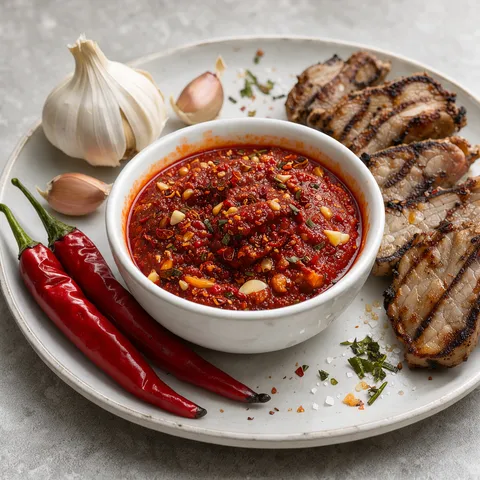 Abkhazian Chilli Garlic Paste26 min · Sauce
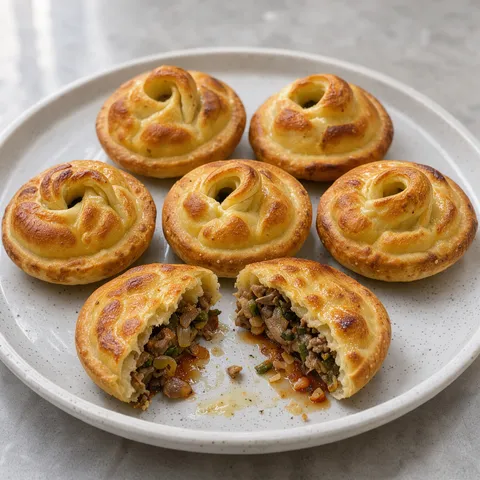 Svan Lamb and Beef Pastries 5.5 cm1 hr 37 min · Meze
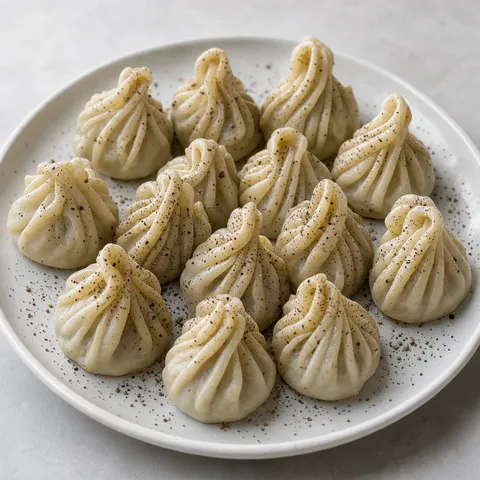 Khinkali2 hr · Bread & pastry