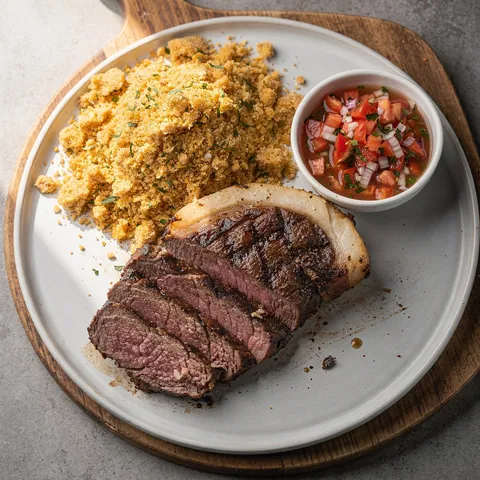
Barbecued Picanha Picanha com Farofa e Vinagrete
A Brazilian main course. Takes 1 hr, Serves 4. Difficulty: medium.
At a glance
- Total time
- 1 hr
- Serves
- Serves 4
- Difficulty
- Medium
- Cuisine
- Brazilian cuisine
- Dish type
- Main course
- Allergens
- Gluten, Milk, Eggs, Celery, Sulphites
Ingredients
Meat
- 1 piece beef picanha (rump cap with a layer of fat about 1 cm thick, about 1.1 kg)
- 30 g coarse rock salt (sal grosso)
Vinagrete
- 3 ripe tomatoes (about 350 g)
- 1 onion
- 1 green pepper
- 1/2 bunch flat-leaf parsley (leaves chopped)
- 60 ml white wine vinegar
- 60 ml olive oil
- 2 tbsp cold water
- 1 tsp salt
- 1/2 tsp black pepper
Farofa
- 150 g cassava flour (farinha de mandioca, coarse)
- 50 g butter
- 1 onion (finely chopped)
- 1 garlic clove (finely chopped)
- 1 egg
- 1/2 tsp salt
- 1 tbsp chopped parsley
Barbecue
- about 3 kg charcoal
Equipment
- Charcoal barbecue
- Chef's knife
- Chopping board
- Mixing bowls
- Frying pan
- Wooden spoon / spatula
- Tongs
- Probe thermometer (optional)
Method
- Light the barbecue and take out the meat: Light the charcoal and leave for 25-30 min, until covered with a thin white ash. Spread the embers thickly on one half of the grate and thinly on the other, giving you a high and a medium heat zone. Take the picanha out of the fridge at the same time, as meat close to room temperature cooks more evenly
- Cut the meat: Score the fat layer in a crosshatch pattern 2 cm apart with the tip of a knife, without touching the meat, so the fat renders evenly and the meat does not curl on the barbecue. Cut the picanha parallel to the grain into 4 steaks about 3 cm thick. The strip of fat should stay on the outside of each piece, as in Brazil the flavour of picanha comes from this fat
- Prepare the vinagrete: Remove the seeds and juice from the tomatoes, and dice the flesh, onion and pepper into 5 mm cubes. Whisk the vinegar, water, olive oil, salt and pepper in a bowl and fold in the vegetables and parsley. Leave for at least 20 min, until the meat is cooked, as the sharpness of the onion mellows in the vinegar and the vegetables release their juices
- Toast the farofa: Melt the butter in a large frying pan over medium-low heat, stir the onion for 5 min until translucent, add the garlic and stir for 30 sec. Crack in the egg and cook it into large pieces, stirring with a wooden spoon for 1 min. Add the cassava flour and toast, stirring constantly, for 6-8 min, until it has absorbed the butter, turned light golden and smells like toasted hazelnuts. Stir in the salt and parsley and take off the heat. If the heat is too high, the flour burns at once and turns bitter
- Salt: Just before putting the steaks on the barbecue, sprinkle the rock salt generously on every side of the steaks and press lightly. The coarse salt melts on the grill and passes slowly into the meat, and the leftover excess is shaken off after cooking. Meat salted too early releases its juices and does not form a good crust
- Render the fat side: Using tongs, hold the steaks upright with the fat strip facing down, or lay them on their side, over the thinly spread embers and cook for 4-5 min, until the fat is golden and crisp. If dripping fat flares up, move the meat out of the high heat for a moment, as flames coat the meat in soot
- Cook: Lay the steaks over the thickly spread embers and cook each side for 3-4 min, until a deep brown crust forms. Measure the thickest part with a thermometer: 52-54°C for rare to medium-rare, 57°C for medium-rare. The internal temperature rises another 2-3°C as it rests, so take it off slightly below your target
- Rest: Transfer the steaks to a board and rest for 5 min. Wipe off any undissolved salt grains from the surface with the back of a knife. In rested meat most of the juice stays in the meat rather than running onto the plate when cut
- Slice and plate: Slice each steak across the grain 1 cm thick. Arrange the slices like a fan on a large board or serving dish so the fat strips and the pink cut faces show. Put a bowl of farofa and a bowl of vinagrete lifted with a slotted spoon alongside, so that at the table each mouthful gets a sprinkle of farofa and a spoonful of vinagrete
Chef's note
Picanha is the best-loved cut of the Brazilian churrasco, so ask the butcher for the rump cap with its fat layer left on. In churrascarias the slices are curled into a C shape, threaded onto skewers and turned in front of the fire, while here it is cooked as steaks for a home barbecue. Many households toast the farofa with pork bacon; here it is made only with butter and egg (farofa de ovo).
Frequently asked questions
- When should picanha be salted?
- Just before it goes on the grill, using coarse rock salt. Meat salted too early releases its juices and does not form a good crust.
- Why do you score the fat layer?
- Score the fat in a criss-cross pattern 2 cm apart so it renders evenly and the meat does not curl on the grill. The cuts should not reach the meat.
- Should picanha rest after cooking?
- Yes, rest it for 5 minutes. Most of the juice stays in the meat rather than running onto the plate when you slice it.
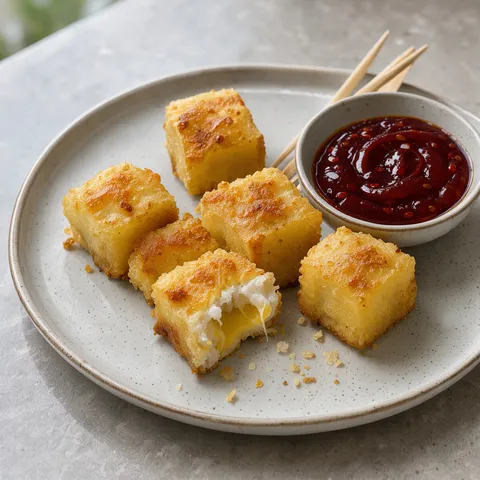 Brazilian Fried Tapioca Cheese Cubes1 hr 5 min · Meze
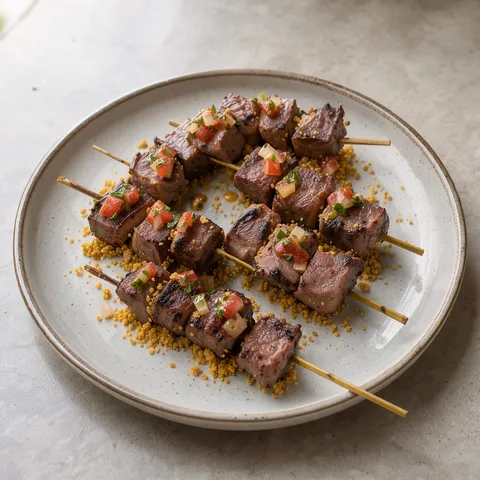 Brazilian Street Picanha Skewers1 hr 2 min · Meze
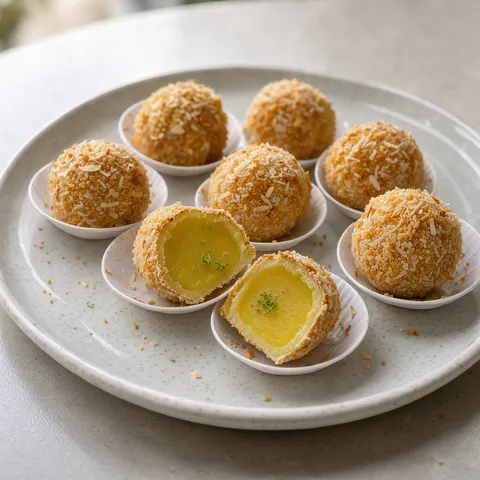 Brazilian Coconut Condensed Milk Balls1 hr 19 min · Meze
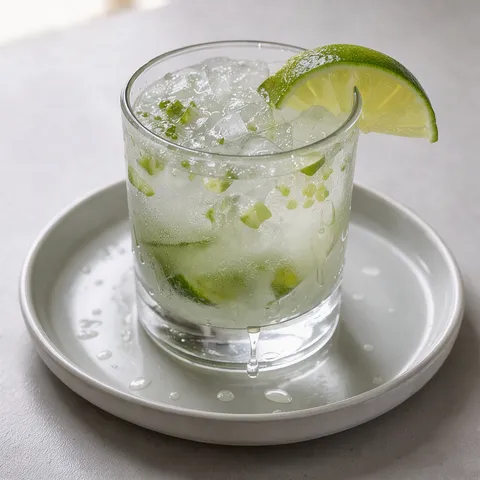 Brazilian Cachaça and Lime Cocktail12 min · Drink
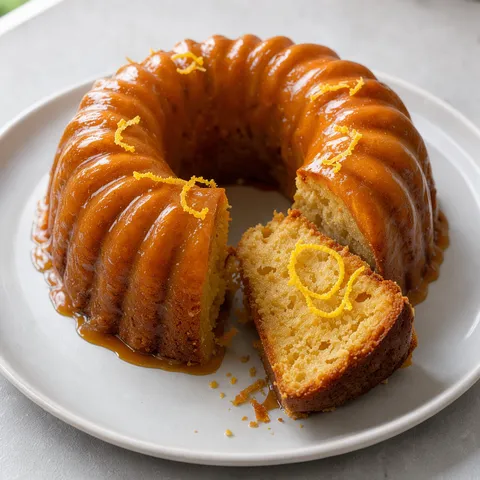 Bolo de Laranja1 hr 10 min · Patisserie
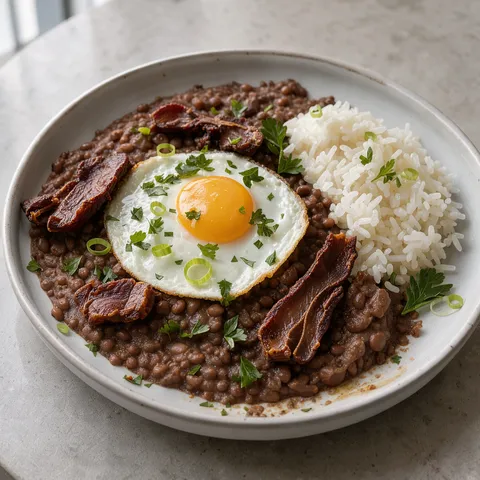 Tutu de Feijão1 hr 5 min · Main course