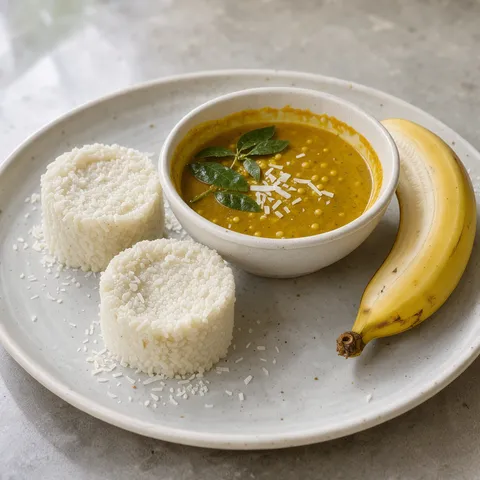
Puttu and Cherupayar Curry Kerala Rice Cylinders with Moong
An Indian main course. Takes 40 min, 4 servings (8 silindir). Difficulty: easy.
At a glance
- Total time
- 40 min
- Serves
- 4 servings (8 silindir)
- Difficulty
- Easy
- Cuisine
- Indian cuisine
- Dish type
- Main course
- Diet
- Gluten-free
- Allergens
- Tree nuts, Mustard, Sulphites
Ingredients
Puttu
- 300 g fine rice flour
- 100 g freshly grated coconut (frozen works too)
- 1/2 tsp salt
- about 130 ml lukewarm water
Cherupayar
- 250 g whole green moong (cherupayar)
- 700 ml water
Curry base
- 3 tbsp coconut oil or sunflower oil
- 1 tsp mustard seeds
- 2 dried red chillies
- 10 curry leaves
- 6 shallots (1 medium onion if unavailable)
- 3 garlic cloves
- 1 tbsp grated ginger
Spices
- 1/2 tsp turmeric
- 1 tsp chilli powder
- 1 tsp coriander (ground)
- 1 tsp salt
Coconut paste
- 80 g freshly grated coconut
- 1/2 tsp cumin
- 4 tbsp water
To serve
- 2 ripe bananas (optional)
- 1 tbsp coconut oil
Equipment
- Pressure cooker
- Steamer basket
- Cake ring / food ring
- Muslin
- Frying pan
- Blender
- Mixing bowls
- Box grater
- Chopping board
- Chef's knife
- Silicone spatula (optional)
Method
- Put the moong in the pressure cooker: Wash the green moong twice in cold water and put in the pressure cooker with 700 ml water, filling the cooker no more than halfway, because the moong foams. Close the lid, and once the cooker reaches pressure over high heat, reduce the heat and cook for 10 min, then turn off the heat and let the pressure release naturally for 6 min. The moong grains should be soft enough to crush between your fingers, but the skins should not break up. The skin of green moong is thin, so no soaking is needed. Do not throw away the cooking liquid, as it goes into the curry. The preparations below run in parallel during this time. (~20 min)
- Toast the rice flour: Toast the rice flour in a wide dry pan over medium heat for 4 min, stirring constantly and keeping the colour pale. When the flour is hot and lightly fragrant, take it off the heat and spread on a plate to cool. Toasting removes the raw taste and helps the flour absorb water evenly. If the flour takes on colour, the puttu turns brown and hard.
- Make the coconut paste: Blend 80 g of the coconut, the cumin and 4 tbsp water in a blender or pestle and mortar to a smooth paste. Fresh coconut gives the curry both thickness and a sweet depth. The paste should look like an oily purée, with no separate grains left.
- Moisten the puttu mixture: Put the cooled rice flour in a large bowl and rub between your fingers while sprinkling in the salt and water a little at a time. Squeezed, the flour should hold in clumps, but crumble again when pressed in the palm. Too much water makes the puttu pasty, and too little gives a dry, crumbly cylinder. Keep the remaining 100 g of coconut ready beside you.
- Make the curry base: Heat the oil in a large pan, add the mustard seeds, and when they begin to crackle add the dried chillies and curry leaves and stir for 10 sec. Add the finely chopped shallots, garlic and ginger and cook for 5 min, until the shallots turn golden. Add the turmeric, chilli powder and coriander and toast for 30 sec, so that the spices wake up in the oil and release their smell. If the bottom of the pan catches, add 2 tbsp water.
- Combine the curry: Add the cooked moong and 250 ml of the cooking liquid to the curry base, stir in the coconut paste and salt, reduce the heat and cook for 8 min. It is ready when the sauce thickens and the moong grains are coated in a yellowish-red sauce. It should be liquid but not run like soup. If it thickens too much, add 2-3 tbsp hot water. While the curry boils, the first batch of puttu can be steamed, so start the next step at this point. Finally drizzle over 1 tbsp coconut oil. (~8 min)
- Steam the puttu: If you have no puttu kutti (a special cylinder steamer), line a steamer basket with a damp piece of muslin and set a 6 cm open-ended pastry ring on top. Put 1 tbsp coconut at the bottom of the ring, fill to half the ring with the moistened flour, then another 1 tbsp coconut, and fill to the rim with flour, pressing lightly with the back of a spoon. Do not use a silicone cylinder, which does not let steam through and leaves the flour raw inside. The open ring on muslin lets steam pass through from below and above. Put the basket over boiling water, cover and steam for 9 min. It is cooked when steam comes out of the top end of the ring and the flour is a glossy, firm cylinder. Slide the ring onto a plate with a spatula and use a wooden spoon from behind to push the cylinder out. Make 8 cylinders in two batches with 4 rings. (~10 min)
- Plate: Put 2 cylinders of puttu on each plate with a ladleful of hot cherupayar curry alongside. If you like, add half a banana. In Kerala puttu is eaten with banana and curry. Puttu is crumbled by hand and mixed with the curry. Grated coconut can be sprinkled over the curry. (~2 min)
Chef's note
Puttu is at the centre of the Kerala breakfast, accompanied by kadala (black chickpeas), cherupayar (green moong), banana or pappadam, and it is naturally vegan. Here puttu is the centrepiece, served not with the chickpeas and roasted coconut paste of Kadala Curry (Kerala Roasted Coconut Chickpeas), but with a light green moong curry with a fresh grated coconut paste. If you have no puttu kutti, an open-ended ring on muslin and a steamer basket really do let the steam through, while silicone cylinders are not suitable. Coconut oil is the traditional oil of Kerala, and if you cannot find it, use sunflower oil.
Frequently asked questions
- Why dry-roast the rice flour for puttu?
- Roasting removes the raw taste of the flour and makes it absorb water evenly. If the flour takes on colour the puttu turns brown and hard, so keep it pale.
- How do you judge the moisture of the puttu mixture?
- The flour should hold in clumps when squeezed but crumble when rubbed in your palm. Too much water turns the puttu doughy, and too little gives a dry, crumbly cylinder.
- Can puttu be steamed in a silicone mould?
- A silicone cylinder isn't recommended, because it doesn't let steam through and the flour stays raw inside. Use an open-ended mould in a steamer basket lined with muslin.
 Indian Butter Chicken50 min · Main course
 Spinach with Homemade Paneer45 min · Main course
 Black Lentil and Kidney Bean Stew1 hr 30 min · Main course
 Chicken Dum Biryani1 hr 30 min · Main course
 Indian Potato Pastries1 hr 30 min · Bread & pastry
 Fermented Rice Crêpes with Spiced Potato50 min · Bread & pastry