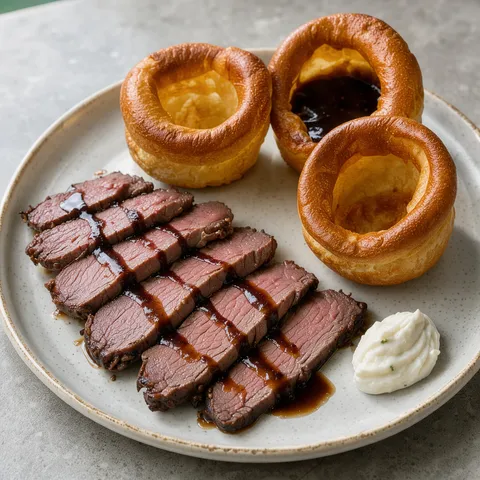
Roast Beef and Yorkshire Pudding Sunday Roast
An English main course. Takes 2 hr 20 min, Serves 4. Difficulty: medium.
At a glance
- Total time
- 2 hr 20 min
- Serves
- Serves 4
- Difficulty
- Medium
- Cuisine
- English cuisine
- Dish type
- Main course
- Allergens
- Gluten, Milk, Eggs, Fish, Soya, Celery, Mustard, Sulphites
Ingredients
Roast
- 1.1 kg beef sirloin or rib-eye (in one piece, with a thin layer of fat on top, tied with string)
- 1.5 tsp salt
- 1/2 tsp coarsely ground black pepper
- 1 tsp mustard powder
- 1 tbsp neutral oil
Trivet
- 1 onion (thick rings)
- 1 carrot (halved lengthways)
- 1 head of garlic (halved horizontally)
- 3 thyme sprigs
Yorkshire pudding
- 140 g plain flour
- 4 eggs (about 200 g)
- 200 ml milk
- 1/2 tsp salt
- 60 ml melted beef suet or clarified butter (ghee)
Gravy
- 1 tbsp plain flour
- 400 ml Brown Beef Stock (Basics)
- 1 tsp Worcestershire-Style Sauce (Basics)
Horseradish sauce
- 40 g fresh horseradish root
- 120 g Crème Fraîche (Basics)
- 1 tsp white wine vinegar
- 1/4 tsp salt
- 1/2 tsp caster sugar
Equipment
- Baking tray
- Oven
- Probe thermometer
- Cake tin
- Balloon whisk
- Mixing bowls
- Fine grater
- Potato masher
- Wooden spoon / spatula
- Fine sieve / chinois
- Saucepan
- Chef's knife
- Chopping board
- Baking paper
Method
- Bring to room temperature (0-45 min): Take the meat out of the fridge 45 min before cooking, pat dry with kitchen paper and rub the salt, pepper and mustard powder into every side. When a roast starts with a cold centre, the outside overcooks while the centre is slow to heat through
- Make the Yorkshire batter (5-15 min, alongside): Put the flour and salt in a bowl and make a well in the centre. Add the eggs and whisk from the centre outwards, adding the milk a little at a time, to a smooth batter the consistency of single cream. Pour into a jug, cover and rest at room temperature for at least 30 min. As the batter rests the flour absorbs the liquid, the starch swells and the puddings rise higher
- Horseradish sauce (15-25 min, alongside): Peel the horseradish and finely grate it on a microplane, keeping your face away so your eyes don't sting. Mix it straight away with the vinegar, which fixes the heat. Mix with the crème fraîche, salt and sugar and leave in the fridge to infuse until serving
- Roast the beef (35-95 min): At the 35-min mark, start heating the oven to 230°C. Arrange the onion, carrot, garlic and thyme in a roasting tin. Rub the meat with the oil and place it fat side up on the vegetables: they lift the meat off the tin and roast for the gravy. At the 45-min mark, put the tin in the oven and roast at 230°C for 20 min, then lower the oven to 170°C. Insert a thermometer into the thickest part of the meat and roast until the internal temperature reaches 52°C for rare, which at 8 cm thick takes about 25-30 min. For medium, take it out at 58°C
- Rest (95-125 min): Transfer the meat to a carving board, cover loosely with baking paper and rest for 30 min. As it rests, the internal temperature rises by 3-5°C and the juices redistribute through the fibres. Meat carved straight away bleeds onto the board
- Bake the Yorkshire puddings (95-130 min): As soon as the meat comes out, raise the oven to 230°C. Put 1 tsp suet into each hole of a 12-hole muffin tin and heat the tin in the oven for 10 min until the fat is just smoking. Take the tin out, give the batter one more whisk and quickly fill each hole a third full: the fat should sizzle. Return to the oven straight away and bake for 20-25 min without opening the door at all. The puddings should have doubled in size, with deep golden, crisp edges and hollow centres. If the door is opened too early, they collapse
- Make the gravy (100-120 min, alongside): Spoon off the fat from the roasting tin, leaving 1 tbsp. Set the tin on the hob over medium heat, lightly crush the vegetables with a potato masher, sprinkle over the flour and cook for 2 min. Add the stock a little at a time, scraping up the caramelised residue with a wooden spoon, and simmer for 8-10 min until it coats the back of a spoon. Strain through a fine sieve into a small saucepan, add the Worcestershire sauce and the juices released by the resting meat, season to taste and keep warm
- Carve (125-130 min): Cut the strings and carve the meat across the grain into 5 mm slices with a sharp chef's knife. Cutting across the grain makes every slice tender. The cut surface should show a thin brown crust at the edge and an even pink inside
- Plate (130-140 min): Fan out 3-4 slices of meat, slightly overlapping, on a warm flat plate. Place three Yorkshire puddings alongside and pour a spoonful of gravy into the hollow of one. Drizzle gravy over the meat and serve the rest in a gravy boat. Put a spoonful of horseradish sauce at the edge of the plate
Chef's note
The Sunday roast is the weekend tradition of the English table and usually comes with roast potatoes and boiled green vegetables. The secret of the puddings is very hot fat and a rested batter. Beef dripping is traditionally used; here beef suet or clarified butter is suggested. In a whole muscle, bacteria sit on the surface and a surface seared at high heat is safe, so the roast can be served pink. The batter makes 12 puddings, three per person.
Frequently asked questions
- Why do Yorkshire puddings rise high or sink?
- Rest the batter for at least 30 minutes, heat the tin in the oven until the fat is smoking, and pour the batter into the sizzling fat. Keep the oven door shut while they bake and they will double in height. Open it too early and they collapse.
- Why is the roast beef rested after cooking?
- During the 30-minute rest the core temperature rises by 3-5°C and the juices redistribute through the meat. Beef carved straight away leaves its juices on the board.
- What temperature should the roast beef reach?
- Take it out of the oven at a core temperature of 52°C for rare or 58°C for medium. Push the thermometer into the thickest part of the meat.
 Deconstructed Carrot Cake1 hr 30 min · Dessert
 Fish and Chips1 hr 10 min · Main course
 Shepherd's Pie1 hr 55 min · Main course
 Cornish Pasty2 hr · Bread & pastry
 Welsh Rarebit35 min · Starter
 Scones with Clotted Cream and Strawberry Jam50 min · Patisserie