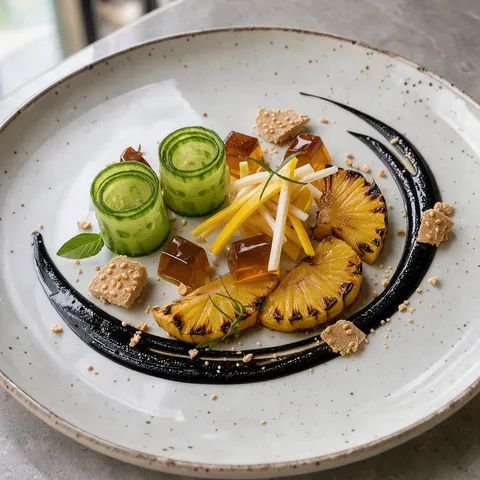
Rojak 2.0
A Malaysian starter. Takes 1 hr 10 min, Serves 4. Difficulty: challenging.
At a glance
- Total time
- 1 hr 10 min
- Serves
- Serves 4
- Difficulty
- Challenging
- Cuisine
- Malaysian cuisine
- Dish type
- Starter
- Diet
- Gluten-free
- Allergens
- Milk, Crustaceans, Peanuts, Tree nuts, Sesame
Ingredients
Hae ko caramel
- 25 g tamarind block (with seeds)
- 60 ml hot water
- 60 g palm sugar (gula melaka, grated)
- 40 g sugar
- 30 ml water
- 2 tbsp black shrimp paste (hae ko)
- 1 tsp lime juice
Tamarind-chilli jelly
- 15 g tamarind block (with seeds)
- 200 ml hot water
- 30 g sugar
- a pinch of salt
- 2 g agar powder
- 1 fresh red chilli (deseeded, very finely chopped)
Peanut-sesame praline
- 80 g raw shelled peanuts
- 1 tbsp white sesame seeds
- 70 g sugar
- a pinch of flaky salt
Caramelised pineapple
- 1/2 pineapple (about 350 g peeled)
- 10 g butter
- 1 tbsp grated palm sugar
- 1/4 tsp chilli flakes
Pandan cucumber
- 1 cucumber (about 200 g)
- 40 ml rice vinegar
- 1 tbsp sugar
- 1/4 tsp salt
- 1 pandan leaf (finely chopped)
Mango and jicama
- 1 sour green mango (about 250 g)
- 150 g jicama (or sour green apple if unavailable)
- 1 tbsp lime juice
To finish
- 12 Thai basil or mint sprigs
- 4 makrut lime leaves
- flaky salt
Equipment
- Saucepan
- Sugar thermometer
- Fine sieve / chinois
- Baking tray
- Cling film
- Balloon whisk
- Frying pan
- Baking paper
- Food processor
- Zip-lock freezer bag
- Mandoline
- Vegetable peeler
- Cast-iron frying pan
- Chef's knife
- Chopping board
- Squeezy bottle
- Mixing bowls
Method
- Make the jelly: The jelly comes first, because it takes time to set. The workflow is: jelly, caramel, praline, cucumber, mango and jicama, pineapple, cutting and plating, 70 min in total. Soak the 15 g tamarind in the 200 ml hot water for 5 min, mash and pass through a fine sieve: about 170 ml of thin pulp remains. In a small saucepan, whisk together the pulp, sugar, salt and agar, bring to the boil and boil for 2 min, whisking: agar only sets once it has boiled. Take off the heat, stir in the chilli and pour into a small tray of about 12×15 cm lined with cling film, 1 cm deep. Chill in the fridge for 20 min, until firm enough to slice
- Hae ko caramel: Soak the 25 g tamarind in the 60 ml hot water for 5 min, mash and strain, setting aside about 40 ml of pulp. In a second small saucepan, melt the palm sugar, sugar and 30 ml water over medium heat and bring to the boil, then cook without stirring until a sugar thermometer reads 110°C: it becomes a thick, honey-like syrup. Take off the heat, carefully add the tamarind pulp (it spits) and whisk. Leave to cool slightly for 5 min and, once it drops below 60°C, whisk in the shrimp paste and lime juice. If the shrimp paste cooks in the heat, its smell turns harsh. It makes about 180 g of glossy, almost black caramel that runs like honey once cool: transfer it to a squeezy bottle
- Make the praline: Toast the peanuts in a dry frying pan over medium-low heat for 6-8 min, until flecked with gold, adding the sesame for the last 1 min. Wash and dry the first saucepan, spread the sugar in it and melt over medium heat without stirring, swirling the pan. When a sugar thermometer reads 170-175°C and it turns deep amber, stir in the peanuts, sesame and flaky salt and spread thinly on baking paper at once. Leave for 10 min to cool and set hard as glass. Pulse half in a food processor with 5-6 short pulses into coarse crumbs and break the other half by hand into large shards
- Compress the cucumber: Peel the cucumber lengthways into long 2 mm ribbons with a peeler, leaving out the seedy core. Stir the vinegar, sugar, salt and pandan in a bowl until the sugar dissolves. Put the ribbons and liquid in a resealable bag, push out the air by lowering the bag into a bowl of water and seal it. Leave for 20 min: the cucumber turns translucent, deep green and pandan-scented
- Cut the mango and jicama: Peel the mango and jicama with a peeler, slice them 1.5 mm thick on a mandoline and cut into fine matchsticks with a knife. Toss with the lime juice and keep in the fridge. The raw, sour crunch of the classic lives on in these fine matchsticks
- Caramelise the pineapple: Cut the pineapple into four rings 1.5 cm thick, remove the tough core and cut each ring into three. Pat dry with kitchen paper. Heat a cast-iron frying pan over high heat and, when the butter foams, add the pineapple and cook for 2-3 min on each side, until the edges are deeply caramelised. For the last 30 sec, sprinkle over the palm sugar, turn and add the chilli flakes. The pineapple should be caramelised outside, juicy and hot inside
- Cut the jelly: Lift the set jelly out of the tray with the cling film and cut into 1 cm cubes. Agar does not melt at room temperature, so it sits happily on the plate. Remove the midribs from the lime leaves and shred them hair-thin
- Plate: Pipe a line of caramel from the squeezy bottle in the centre of a large flat plate and drag it with the back of a spoon into a half-moon in a single movement. Arrange three hot pineapple pieces inside the half-moon at a slight angle. Stand two cucumber ribbons, loosely rolled, between them and make a small nest of mango and jicama matchsticks. Dot five or six jelly cubes into the gaps
- Finish: Scatter the praline crumbs generously over half the plate and lean two large praline shards against the pineapple. Add 4-5 more small dots of caramel. Add the basil sprigs, lime leaf threads and a pinch of flaky salt. Serve immediately so the contrast between the hot pineapple and the cold fruit is not lost
Chef's note
The four cornerstones of the classic rojak are kept here: the salty-sweet depth of hae ko, the sourness of tamarind, roasted peanuts and the crunch of raw, sour fruit. The novelty is in the texture: the dressing becomes a glossy caramel, the tamarind a wobbly jelly and the peanuts a glassy praline, while the pineapple arrives hot and caramelised. Hae ko, gula melaka, tamarind block and agar are bought ready-made. If hae ko is unavailable, mix 2 tbsp dark grape molasses (or light brown sugar), 1 tsp fish sauce and 1/2 tsp tamarind pulp and use the same amount: it gives an approximate flavour, not the same one. You can make the praline in advance and keep it in an airtight container: if it absorbs moisture, it turns sticky.
Frequently asked questions
- When is the shrimp paste added to the caramel?
- Add it once the caramel has dropped below 60°C. If shrimp paste is cooked with heat, its smell turns harsh.
- Does the tamarind jelly melt at room temperature?
- No, agar doesn't melt at room temperature and the jelly sits happily on the plate. Agar only sets once it has boiled, so the mixture is brought to the boil while whisking.
- What can I use if I can't find jicama?
- Sour green apple can be used. Cut it into matchsticks together with the mango and toss with lime juice.
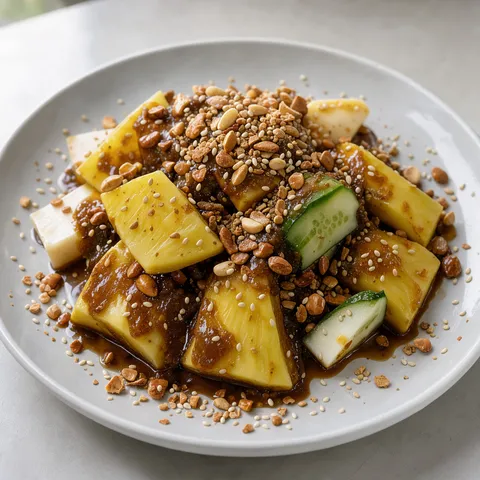 Malaysian Fruit Salad with Shrimp Paste35 min · Meze
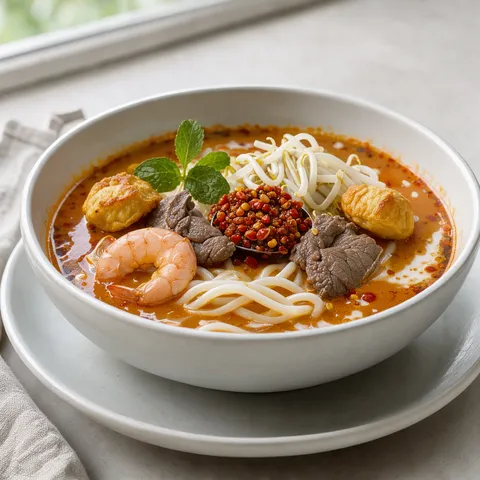 Laksa Lemak1 hr · Soup
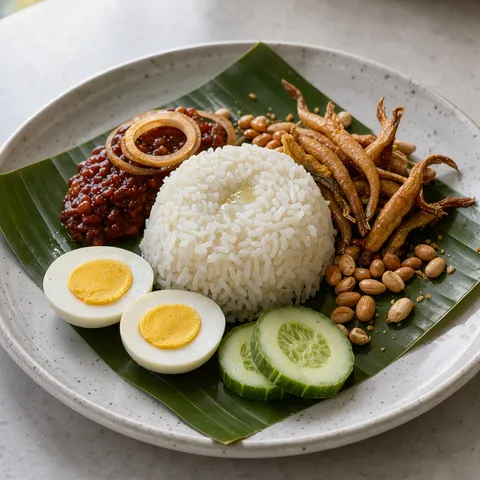 Pandan Coconut Rice with Sambal1 hr 25 min · Main course
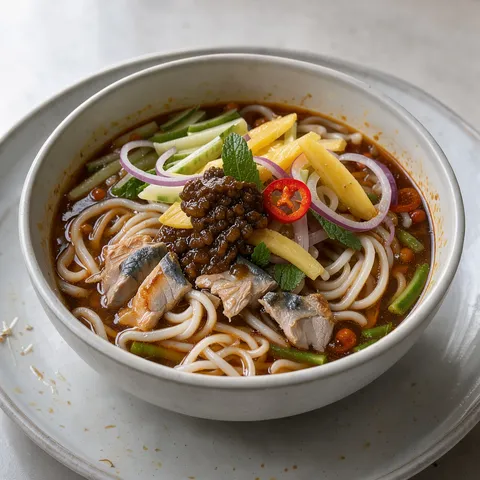 Penang Sour Mackerel Noodle Soup with Tamarind1 hr 15 min · Soup
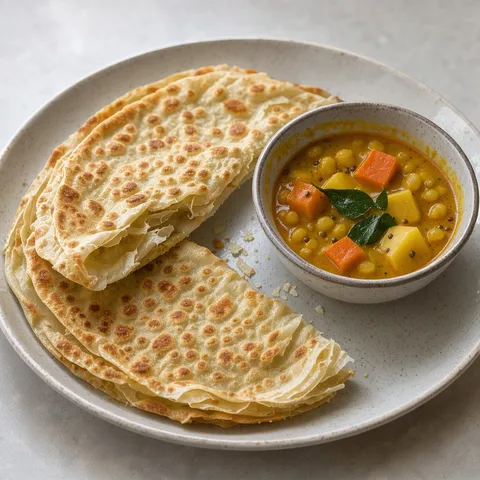 Folded Pan Flatbread with Lentil Curry1 hr 20 min · Bread & pastry
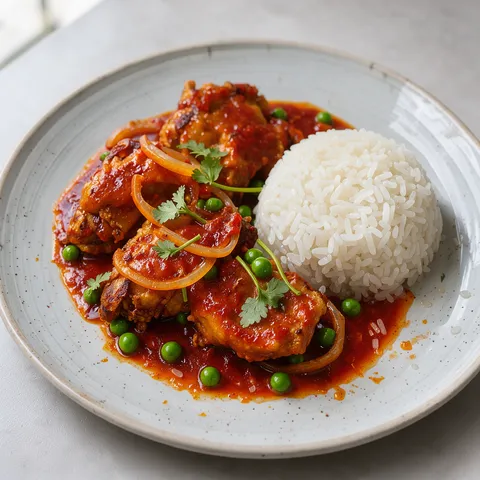 Chicken in Red Chilli and Tomato Sauce1 hr 15 min · Main course
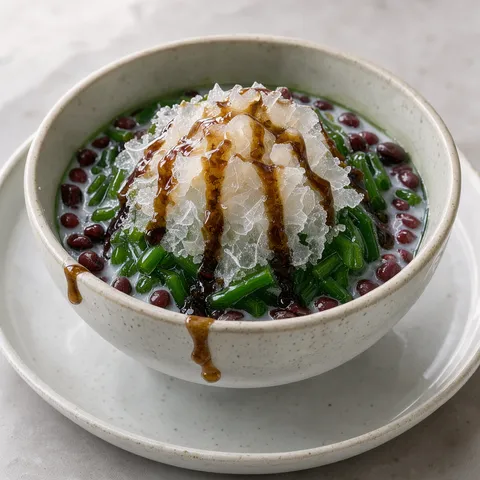 Iced Coconut Dessert with Pandan Jelly1 hr 15 min · Dessert