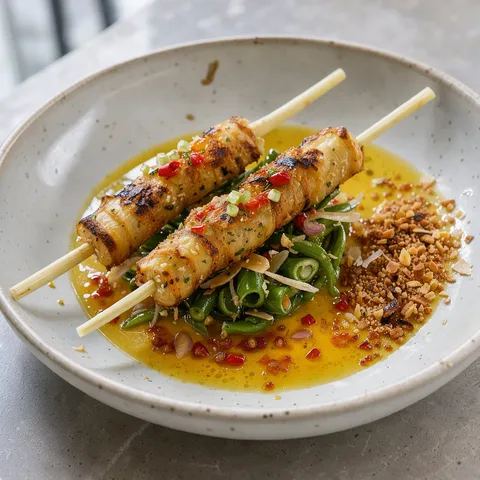
Sate Lilit 2.0
An Indonesian starter. Takes 1 hr 25 min, Serves 4. Difficulty: challenging.
At a glance
- Total time
- 1 hr 25 min
- Serves
- Serves 4
- Difficulty
- Challenging
- Cuisine
- Indonesian cuisine
- Dish type
- Starter
- Diet
- Gluten-free
- Allergens
- Milk, Fish, Crustaceans, Tree nuts
Ingredients
Prawns and shell stock
- 300 g large shell-on prawns (about 200 g once peeled)
- 1 tbsp coconut oil
- 300 ml water
Base genep paste
- 4 shallots (about 60 g)
- 3 garlic cloves
- 1 long red chilli (deseeded)
- 2 cm piece of ginger
- 2 cm galangal (or ginger if unavailable)
- 2 cm fresh turmeric or 1 tsp ground turmeric
- 3 raw macadamias
- 1 tsp coriander seeds
- 1/2 tsp shrimp paste (terasi)
- 2 tbsp coconut oil
Lilit
- 300 g skinless sea bass fillet
- the peeled prawns (from above)
- 40 g desiccated coconut
- 30 ml hot water
- 1 makrut lime leaf (finely shredded)
- 1 tsp palm sugar or light brown sugar
- 1/2 tsp salt
- 8 lemongrass stalks (20 cm, outer leaves removed)
- 1 tbsp coconut oil (for griddling)
Turmeric kuah
- the prawn shell stock (from above, about 200 ml)
- a third of the base genep paste
- 250 ml unsweetened coconut milk
- 1 makrut lime leaf
- juice of 1/2 lime
- 1/4 tsp salt
Serundeng crumb
- 40 g desiccated coconut
- 1 tsp palm sugar
- 1/4 tsp ground coriander
- 1/4 tsp salt
Urap beans
- 150 g fine green beans (thinly sliced on the diagonal)
- 500 ml boiling water (boiled in a kettle)
- 1/2 tsp salt (for blanching)
- 1 tsp lime juice
Sambal matah oil
- 3 shallots (very finely diced)
- 1 lemongrass stalk (white part only, sliced into very thin rings)
- 1 hot red chilli (deseeded, finely diced)
- 1 makrut lime leaf (shredded hair-thin)
- juice of 1/2 lime
- 1/4 tsp salt
- 3 tbsp coconut oil
Equipment
- Saucepan
- Fine sieve / chinois
- Food processor
- Frying pan
- Mixing bowls
- Chef's knife
- Silicone spatula
- Baking tray
- Baking paper
- Griddle pan
- Probe thermometer
- Colander
Method
- Make the prawn shell stock: Peel the prawns, setting aside the shells and heads, remove the black vein along the back and put the prawns in the fridge. Heat the 1 tbsp coconut oil in a 20 cm saucepan and fry the shells over high heat for 3-4 min, until pinkish-orange and fragrant. Add the 300 ml water, simmer over low heat for 10 min and strain through a fine sieve, pressing down. Move on to the next step while the stock cooks. About 200 ml of rich stock that smells of the sea remains. This stock is the body of the kuah and adds a second layer of the sea that the classic sate lilit does not have
- Make and divide the base genep: Blitz the shallots, garlic, chilli, ginger, galangal, turmeric, macadamias, coriander seeds and shrimp paste in a food processor for 1-2 min. Heat the 2 tbsp coconut oil in a 24 cm frying pan and fry the paste over medium heat for 6 min, until the oil separates and it turns bright orange. Set a third aside in a bowl for the kuah and spread the other two-thirds on a plate to cool for 10 min. Hot paste would cook the fish protein too early and the lilit mixture would crumble
- Blitz the lilit mixture: Moisten the coconut with the 30 ml hot water. Cut the sea bass into 3 cm pieces, put it in the cleaned food processor with half the peeled prawns and blitz for 20-30 sec to a sticky paste. Add the cooled spice paste, moistened coconut, lime leaf, sugar and salt and blitz for 10 sec. Chop the remaining prawns into 5 mm pieces with a knife and fold them into the mixture with a spatula. The smooth paste clings to the stalk, while the larger prawn pieces give a juicy texture to each bite, a layer the classic does not have
- Wrap onto the stalks and chill: Lightly crush the thick ends of the lemongrass stalks with the back of a knife. Wet your hands and divide the mixture into 8 equal pieces (about 75 g), wrapping each one tightly around the thick end of a stalk to form a cylinder 10 cm long and 3 cm in diameter. Arrange on a tray lined with baking paper and chill in the fridge for 15 min to firm up
- Cook the kuah: Start while the lilit chill in the fridge. The kuah (5 min boiling, 8 min cooking and straining) runs a little over these 15 min, and you prepare the beans in the remaining minutes. Rinse the pan you used for the shell stock and, in this 20 cm saucepan, heat the reserved paste for 1 min, then add the prawn stock and lime leaf and boil for 5 min. Add the coconut milk and salt and cook over the lowest heat, without bubbling, for 8 min. Pass through a fine sieve, return to the pan and add the lime juice. The kuah should be pale golden, runny and glossy. Keep it warm on the lowest burner until serving. Hob 1: kuah
- Toast the serundeng crumb: Toast the coconut, palm sugar, ground coriander and salt in a dry 24 cm frying pan over medium-low heat for 5-6 min, stirring constantly, until evenly golden brown. The sugar caramelises slightly and crisps the crumb into clusters. Spread it on a plate at once: left in the pan, it burns. Hob 2
- Prepare the urap beans: Put the beans in a colander set over a heatproof bowl. Mix the 500 ml water boiled in the kettle with the 1/2 tsp salt, pour it over the beans and leave for 60 sec, then lift out the colander and transfer the beans to iced water. There is no need to boil a separate pan. Drain, pat dry and toss with the lime juice and half the serundeng. Keep the remaining serundeng for the plate. Finish the beans before griddling: no more than three burners should be on at the same time
- Make the sambal matah oil: In a small bowl, mix the shallots, lemongrass, chilli and lime leaf with the salt and lime juice. Heat the coconut oil in a small frying pan until it just begins to smoke and pour it over. Stir once the sizzling stops. The chunky sambal matah of the classic is cut very finely here and turned into an oil-sauce, used drop by drop on the plate
- Griddle the lilit: Heat a cast-iron griddle pan (28 cm) over high heat for 4-5 min and brush with coconut oil. Lay all 8 lilit on it diagonally and cook in a single batch, turning, for 2 min on each side, 8 min in total, until the outside is dark-striped and caramelised in places and the internal temperature reaches 63°C. Hob 3
- Plate: Place a small nest of urap beans in the centre of each wide, shallow bowl. Lean two lilit skewers across the nest. Spoon a teaspoon of sambal matah oil over each lilit and scatter a pinch of serundeng at the side. Pour the kuah into a small jug and, at the table, pour it in from the edge of the bowl, under the lilit, so the tops of the skewers stay crisp
Chef's note
The Balinese identity of sate lilit is kept while it becomes a starter: a turmeric kuah made with stock drawn from prawn shells and base genep is poured at the table, the classic sambal matah is cut very finely into an oil-sauce, and serundeng (toasted coconut) adds a crunchy layer. Shrimp paste, lemongrass, galangal and makrut lime leaves are found in Asian supermarkets. If there are no lemongrass stalks, use flat wooden skewers and add 1 finely chopped lemongrass stalk to the mixture. For anyone who does not want shrimp paste, increase the salt by 1/4 tsp.
Frequently asked questions
- Why does the lilit mixture crumble?
- Hot paste cooks the protein of the fish too early and the mixture crumbles. Cool the paste before adding it.
- Do the green beans need a separate pan?
- No. Blanch the beans in a sieve with salted water just boiled in the kettle for 60 seconds, then move them to iced water.
- What does the prawn shell stock add to the kuah?
- The shells are fried in coconut oil, cooked with water and strained. This liquid forms the body of the kuah and adds a layer of the sea that classic sate lilit doesn't have.
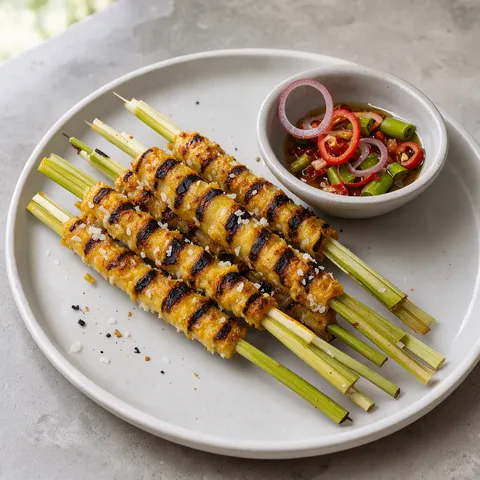 Balinese Coconut Fish Skewers1 hr 25 min · Meze
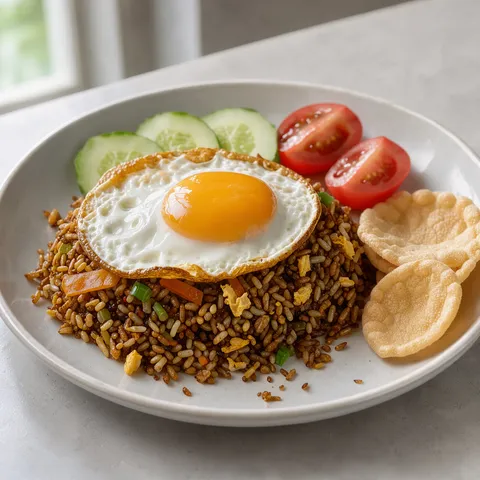 Nasi Goreng25 min · Main course
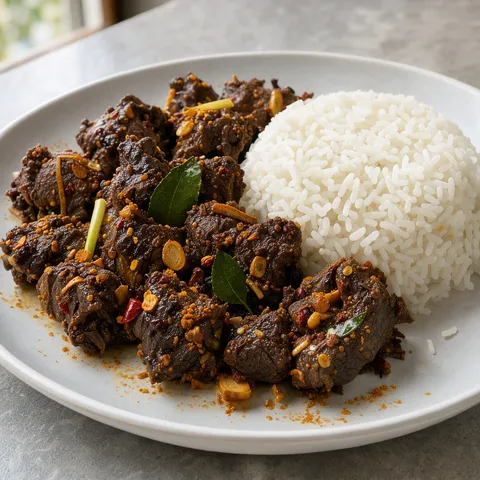 Beef Rendang1 hr 45 min · Main course
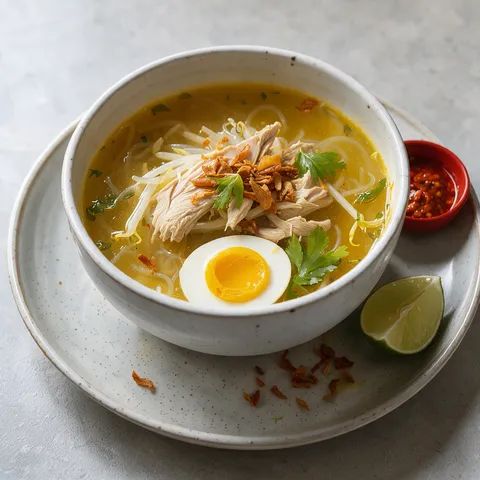 Indonesian Yellow Chicken Soup1 hr · Soup
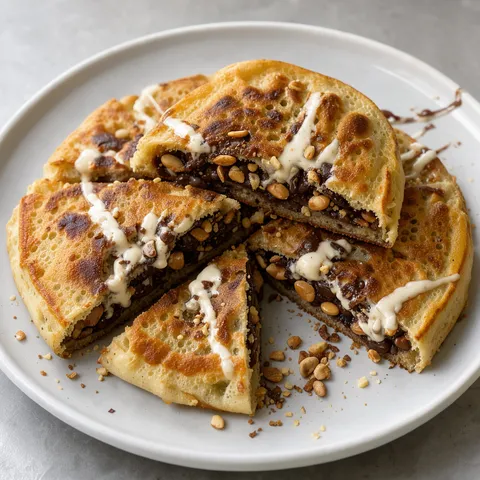 Indonesian Sweet Honeycomb Pancake35 min · Bread & pastry
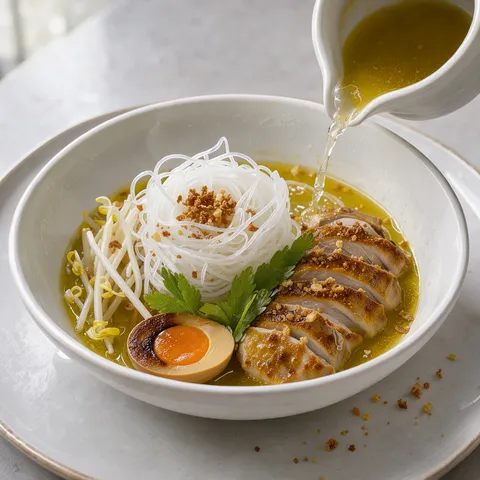 Soto Ayam 2.01 hr 20 min · Soup
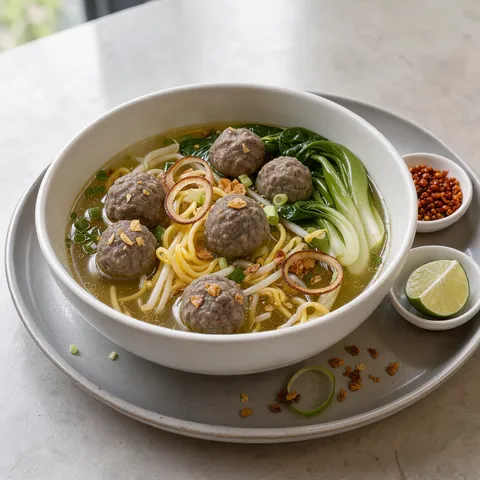 Indonesian Beef Meatball Soup2 hr 50 min · Soup