
Seekh Kebab Lavash Bowl, Mint Yoghurt Foam, Sumac Onions Seekh Kebab Lavas Kasesi
An Indian meze. Takes 1 hr 21 min, Makes 24. Difficulty: challenging.
At a glance
- Total time
- 1 hr 21 min
- Serves
- Makes 24
- Difficulty
- Challenging
- Cuisine
- Indian cuisine
- Dish type
- Meze
- Allergens
- Gluten, Milk
Ingredients
- Lavash bowls (24, 8 cm circles, 4 cm, 2 cm deep): Lavash (Basics)
- 2 sheets (35×45 cm; 20 circles come from one sheet, and 4 more are cut from the second sheet for 24 circles)
- 2 tbsp melted butter
- 1/4 tsp salt. Seekh (24 × 14 g, 3.5×2.2 cm, about 340 g): 270 g fatty lamb mince (20% fat)
- 30 g onion (grated and squeezed dry)
- 1 tsp ginger and garlic paste (5 g ginger, 1 garlic clove)
- 1 green chilli (8 g, finely chopped)
- 15 g mint and coriander leaves (finely chopped)
- 1 tsp Garam Masala (Basics, the second mix in the Five-Spice and Garam Masala recipe)
- 1/2 tsp toasted cumin (ground)
- 3/4 tsp salt
- 1 tbsp sunflower oil (for cooking). Mint yoghurt foam (24 × 6 g, about 150 g): 150 g Strained Yoghurt (Basics)
- 100 ml cold milk
- 1 tbsp mint leaves (finely chopped)
- 1/2 tsp salt
Garnish
- Sumac Onions (Basics, 24 × 3 g, about 72 g)
- 72 pomegranate seeds (about 15 g)
- 24 small mint leaves
- Urfa Chilli Flakes and Aleppo Pepper Oil (Basics, 24 drops)
Equipment
- Cake ring / food ring
- Pastry brush
- Oven
- Baking tray
- Mixing bowls
- Stick blender
- Frying pan
- Probe thermometer
- Precision scales
- Box grater
Method
- Cut the lavash circles: Lay the lavash sheets on the worktop and, with an 8 cm pastry ring, cut 20 circles from the first sheet (4 × 5 in a square grid) and 4 circles from the second sheet, 24 circles in total. The lavash trimmings and what is left of the second sheet come to about 150-200 g (depending on the thickness of the lavash). Set aside and use as croutons. Brush the circles thinly with the mix of melted butter and salt. The butter makes the lavash crisp and keeps it pliable when pressed into the tin in the oven, while dry lavash cracks when bent (~6 min)
- Press the bowls: Press one lavash circle into each hollow of a 24-hole mini muffin tin (hole 4 cm across, 2.5 cm deep), with the middle of the circle on the base of the hole and the edges gathering up in their own folds. As the circle is 8 cm and the hole is 4 cm, the edges fold gently and the bowl sits on a high base. Put the tin on a baking tray (~6 min)
- Dry the bowls: Preheat the oven to 180°C. Put the tin on the middle shelf and bake the bowls for 9 min, until the edges are golden and the bases crisp. The bowls are taken out after resting in the tin for 2 min. They are soft when hot and turn hard when they cool. (~10 min)
- Knead the seekh mixture: Grate the onion and squeeze in a cloth to extract the juice. Knead the lamb mince, grated onion, ginger and garlic paste, chilli, mint and coriander, garam masala, cumin and salt in a bowl for 4 min, until the mixture is a sticky paste. Fatty mince keeps the seekh moist, while lean mince is dry and crumbly. The onion juice must be squeezed out, since excess water makes the mixture fall apart in the pan. The mixture comes to about 340 g (~8 min)
- Chill and make the foam: Chill the mixture in the fridge for 15 min, so that the fat firms up and the spices work into the mince. Meanwhile mix the yoghurt, cold milk, mint and salt in a tall glass and froth for 1 min with a stick blender held at the surface of the glass. The milk thins the yoghurt, air is trapped and the foam lasts 10 min. If the foam settles, blitz again for 20 sec before serving. For 252 bowls the foam is made with a cream whipper (~15 min)
- Shape: With wet hands, pinch off 14 g pieces and roll in your palm into small cylinders 3.5 cm long and 2.2 cm thick, weighing the first three. The cylinder must fit the 4 cm bowl along its long edge, so the length should not exceed 3.5 cm. Arrange 24 pieces on a plate lined with baking paper (~10 min)
- Fry: Heat 1 tbsp oil in a large pan over medium-high heat for 4 min. Cook the seekh pieces in two batches of 12, turning, 2 min on each side, until a deep brown crust forms. The internal temperature should reach 71°C, so check with a thermometer in the first batch. Wipe the pan between batches. At a high heat the small kebabs burn outside and stay raw inside (~12 min)
- Prepare the garnishes: Pick over the pomegranate seeds, wash the mint leaves and pour the Urfa Chilli Flakes and Aleppo Pepper Oil into a small bottle. Blitz the foam again at this point. With the garnishes ready separately, plating is quick and the kebab does not cool (~6 min)
- Plate: Put 1 hot seekh in each lavash bowl and add 6 g of mint yoghurt foam on top. Over the foam put 3 g of sumac onions, 3 pomegranate seeds, 1 drop of Urfa chilli flakes oil and a mint leaf. Arrange the bowls on a flat ceramic plate. The foam covers the hot kebab and carries the aroma, and the bowl stays crisp while the kebab stays juicy. Until serving, the bowls and kebabs wait separately, and the assembled bowl should be eaten within 5 min (~8 min)
Chef's note
Serve hot. 3 per person, 80 people × 3 = 240 pieces. As the recipe makes 24, the multiplier is 240/24 = 10, or 10.5 with 5% allowed for waste (13 lavash sheets, 20 circles from each sheet, 2.85 kg fatty lamb mince, 315 g onion, 1.6 kg strained yoghurt, 1.05 litres milk, 760 g sumac onions, 760 pomegranate seeds (about 160 g). 24-hole tin, 11 rounds, 9 min per round, about 65 min with 2 tins and 2 oven shelves. Seekh in 21 batches, about 125 min in a single pan, about 65 min in 2 pans). The spice character of seekh kebab is preserved, and the bowl and foam bring together Anatolian and Indian cooking. The lavash bowls can be made 3 days ahead and kept in an airtight container, the kebabs are cooked on the day of service, and the foam is blitzed just before serving. Cooked seekh stay hot in a 70°C oven for 10 min at most.
Frequently asked questions
- Why are the lavash bowls brushed with butter?
- Butter makes the lavash crisp and keeps it pliable when pressed into the mould in the oven. Dry lavash cracks as it is shaped.
- Why is fatty lamb mince used for the seekh?
- Mince with 20% fat keeps the seekh moist, while lean mince turns dry and crumbly. Squeeze the juice out of the grated onion too, as extra water makes the mixture fall apart in the pan.
- What if the mint yoghurt foam settles?
- The foam holds for about 10 minutes. If it settles, blitz it again with a hand blender for 20 seconds before serving.
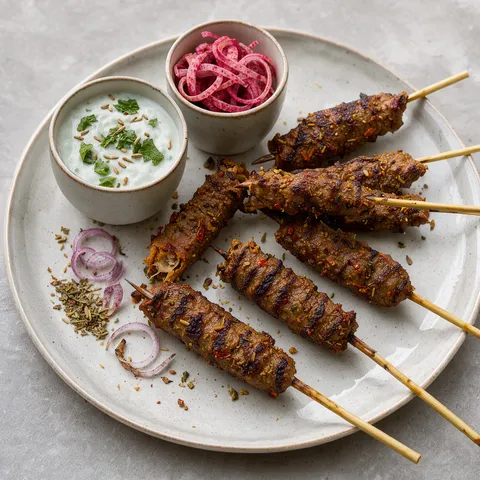 Punjabi Mini Lamb Mince Skewers1 hr 18 min · Meze
 Indian Butter Chicken50 min · Main course
 Spinach with Homemade Paneer45 min · Main course
 Black Lentil and Kidney Bean Stew1 hr 30 min · Main course
 Chicken Dum Biryani1 hr 30 min · Main course
 Indian Potato Pastries1 hr 30 min · Bread & pastry
 Fermented Rice Crêpes with Spiced Potato50 min · Bread & pastry