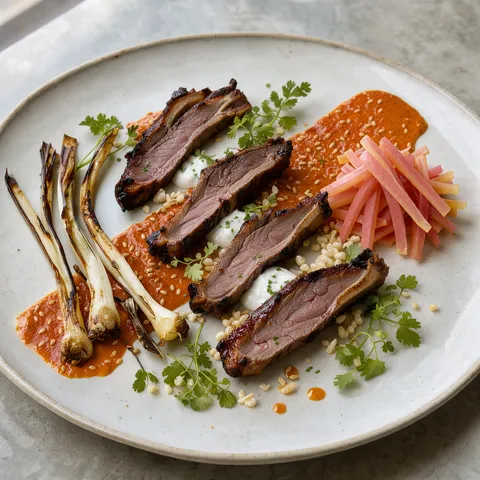
Sekuwa 2.0
A Nepalese main course. Takes 1 hr 10 min, Serves 4. Difficulty: challenging.
At a glance
- Total time
- 1 hr 10 min
- Serves
- Serves 4
- Difficulty
- Challenging
- Cuisine
- Nepalese cuisine
- Dish type
- Main course
- Diet
- Gluten-free
- Allergens
- Milk, Sesame, Mustard, Sulphites
Ingredients
Lamb
- 2 boneless lamb loin fillets (600 g in total)
- 1 tsp salt
Quick marinade
- 2 tbsp mustard oil
- 10 g ginger and 2 garlic cloves (finely grated on a microplane)
- 1 tsp timur (Sichuan pepper, ground)
- 1 tsp ground cumin
- 1 tsp ground coriander
- 1/2 tsp chilli powder
- 1/4 tsp turmeric
Charred tomato and sesame emulsion
- 4 ripe tomatoes
- 2 red chillies
- 3 garlic cloves (unpeeled)
- 30 g white sesame seeds (toasted)
- 1/2 tsp timur
- 1 tbsp lemon juice
- 2 tbsp mustard oil
- 1/2 tsp salt
Timur yoghurt
- 200 g strained (Greek-style) yoghurt
- 1/4 tsp timur
- 1 tsp honey
- a pinch of salt
Radish achar
- 150 g radishes (in matchsticks)
- 1/4 tsp fenugreek seeds
- 1/4 tsp turmeric
- 1 tsp mustard oil
- 1 tbsp lemon juice
- 1/2 tsp salt
Crispy chiura
- 40 g beaten rice (chiura, dry)
- 400 ml sunflower oil in an 18 cm saucepan (about 1.5 cm deep)
- a pinch of salt
- a pinch of chilli powder
Charred spring onions
- 8 spring onions
- 1 tsp oil
To finish
- coriander cress
- flaky salt
Equipment
- Chef's knife
- Chopping board
- Mixing bowls
- Cast-iron frying pan
- Blender
- Fine sieve / chinois
- Frying pan
- Squeezy bottle
- Saucepan
- Probe thermometer
- Colander
- Fine grater
Method
- Marinate the lamb: Trim the membrane and sinew from the fillets and pat dry with kitchen paper. Mix the mustard oil, ginger, garlic and spices in a bowl, rub over the fillets and season with salt. Leave at room temperature for 30 min. The 4-hr marinade of the classic is cut to half an hour here thanks to a tender cut and finely grated aromatics
- Char the tomatoes (hob ring 1): While the lamb marinates, heat a cast-iron frying pan over high heat. Char the tomatoes, chillies and unpeeled garlic for 10 min, turning, until the skins are blackened all over. Transfer to a bowl and leave to sweat for 3 min
- Blend the emulsion: Discard half the tomato skins, the chilli stalks and the garlic skins. Blend the charred vegetables with the sesame, timur, lemon juice and salt for 1 min. With the motor running, add the mustard oil in a thin stream. Press through a fine sieve. The result is a glossy, orange-red sauce that runs slowly off a spoon. It is a smooth take on the coarse achar served with classic sekuwa
- Radish achar: Leave the radishes with the salt for 5 min, then squeeze out the liquid. Heat the mustard oil in a small frying pan until smoking, take off the heat, stir in the fenugreek for 20 sec and the turmeric for 5 sec, then pour over the radishes. Mix in the lemon juice. The radish should stay pinkish yellow, crunchy and sharp: it cuts the richness of the lamb
- Timur yoghurt: Whisk the yoghurt with the timur, honey and salt, transfer to a squeeze bottle and keep in the fridge
- Puff the chiura (hob ring 2): Bring the oil to 190°C in the 18 cm saucepan, checking with a thermometer. Add the beaten rice to the oil in 3 batches: it puffs up and turns white within 5-8 sec, so lift it out straight away with a slotted spoon. Spread on kitchen paper and sprinkle with salt and chilli powder. Chiura, eaten dry in Nepal, is turned here into a crisp texture like puffed rice
- Char the spring onions: After the tomatoes come out, char the spring onions with the oil in the same cast-iron pan for 4 min, until charred in places and soft. Cut into 6 cm pieces
- Sear the lamb (hob ring 1): Wipe out the cast-iron pan and heat over high heat for 3 min. Put the fillets in the pan and cook for 8 min, turning every 2 min, until deep brown and slightly charred on every side. At high heat the timur and cumin mimic the smoke of the embers. For medium-rare the internal temperature should be 57°C: check with a thermometer
- Rest: Transfer the fillets to a wire rack and rest for 6 min. Meanwhile, warm the emulsion over low heat for 1 min without boiling
- Slice: Slice the fillets across the grain 1.5 cm thick, 4-5 slices per plate. The cut faces should be pink: sprinkle flaky salt over them
- Plate: Put 2 tbsp emulsion in the centre of a flat plate and draw a long stripe with the back of the spoon. Lean the lamb slices on the stripe, slightly overlapping. Squeeze 4-5 dots of timur yoghurt alongside. Lay the charred spring onions diagonally between the slices
- Finish: Drain the radish achar and place a small cluster at the edge of the slices. Scatter the crispy chiura over the slices and the empty spaces on the plate and finish with coriander cress. Serve immediately: the longer it waits, the more moisture the chiura draws from the sauce
Chef's note
The timur, mustard oil and charred tomato achar of classic sekuwa are kept. Instead of skewers, whole fillets are seared, the achar is turned into a silky emulsion and the chiura into a crisp texture. The radish achar is a quick take on mula ko achar from the Nepali table. No more than two hob rings are used at the same time.
Frequently asked questions
- Why has the Sekuwa marinade been shortened?
- The long marinade of the classic comes down to half an hour here, thanks to a tender cut and finely grated aromatics. Marinate the fillets at room temperature.
- Why are timur and cumin used?
- Timur and cumin imitate the smokiness of the embers over high heat. The lamb is seared in a very hot pan until every side is dark brown and lightly charred.
- Why must the crispy chiura be served straight away?
- Chiura draws moisture from the sauce as it sits. The grains puff up and turn white in the oil in a few seconds, and are scattered over the plate at the last moment.
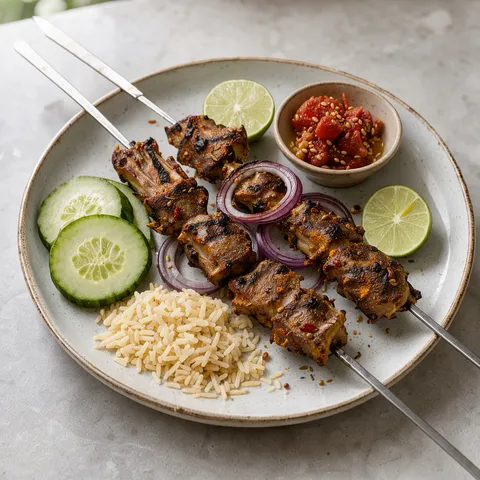 Nepali Chargrilled Lamb Skewers1 hr 5 min · Main course
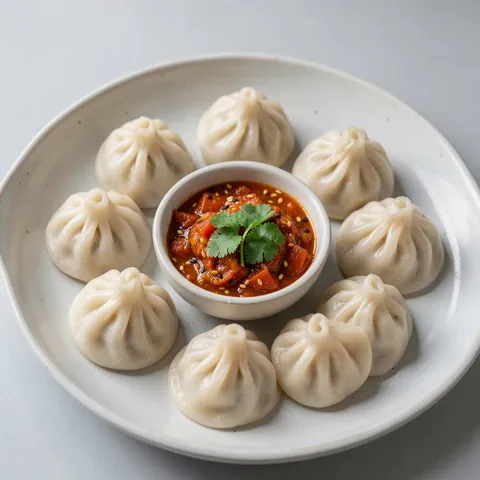 Nepali Chicken Dumplings with Tomato Achar1 hr 15 min · Bread & pastry
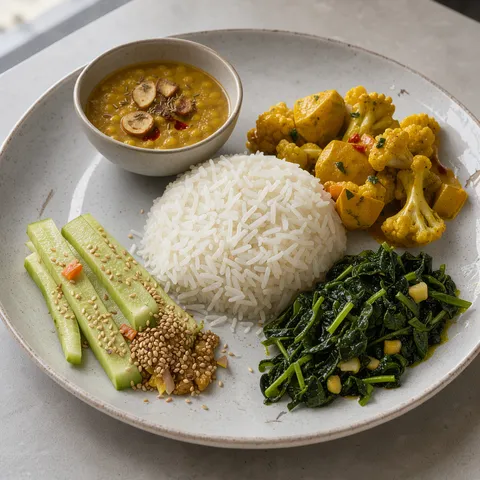 Dal Bhat Tarkari1 hr · Main course
 Nepali Ring-Shaped Rice Bread1 hr 5 min · Bread & pastry
 Newar-Style Charred Spiced Beef50 min · Meze
 Momo 2.01 hr 25 min · Bread & pastry
 Newar-Style Urad Dal Pancakes with Egg45 min · Bread & pastry