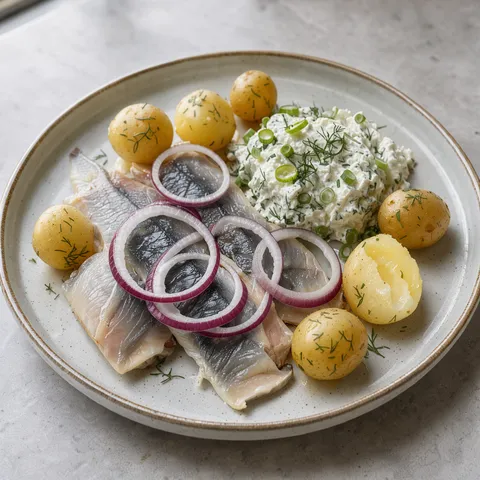
Latvian Herring with Curd Cheese Siļķe ar Biezpienu
A Latvian main course. Takes 45 min · +30 min soaking, Serves 4. Difficulty: medium.
At a glance
- Total time
- 45 min · +30 min soaking
- Serves
- Serves 4
- Difficulty
- Medium
- Cuisine
- Latvian cuisine
- Dish type
- Main course
- Diet
- Vegetarian, Gluten-free
- Allergens
- Milk
Ingredients
Herring
- 4 salted herring fillets (about 400 g)
- 400 ml milk (for soaking)
- 1 small red onion
Curd cheese
- 400 g full-fat curd cheese
- 150 g soured cream
- 4 spring onions
- 1/2 bunch dill
- 1/4 tsp salt
- 1/4 tsp black pepper
Potatoes
- 1 kg small potatoes (unpeeled)
- 1 tsp salt
- 30 g butter
- 1/2 bunch dill (for the potatoes)
Equipment
- Mixing bowls
- Saucepan
- Colander
- Chef's knife
- Chopping board
- Plating tweezers
Method
- Soak the herring: Put the herring fillets in a bowl, cover with the milk and leave for 30 min. The milk softens the herring's sharp saltiness and oily smell. If the fillets are not very salty, 15 min is enough
- Boil the potatoes: Scrub the potatoes well with a brush and put them in a saucepan with their skins on. Cover with cold water by 2 cm and add 1 tsp salt. Bring to the boil, lower the heat to medium-low and cook for 18-20 min, until a knife slides in without resistance
- Prepare the curd cheese: While the potatoes cook, on a chopping board slice the spring onions into thin rings and finely chop the dill with a chef's knife. In a bowl, mash the curd cheese with a fork and mix with the soured cream. It should be the consistency of cream but slightly grainy. Add the spring onions, dill, salt and pepper. Because the herring is salty, go easy on the salt in the curd cheese
- Prepare the herring: Take the herring out of the milk and pat dry with kitchen paper. Pull out any remaining fine bones with tweezers. Cut the fillets diagonally into 2 cm pieces
- Cut the onion: Cut the red onion into very thin rings and leave in cold water for 5 min, then drain and pat dry. The water takes away the onion's harsh bitterness and keeps it crisp
- Toss the potatoes: Drain the potatoes in a colander and leave to steam for 1 min. Return to the pan, add the butter and chopped dill and shake the pan to coat the potatoes. Peel them if you like. In Latvia they are mostly served unpeeled or freshly peeled
- Plate: Put a few pieces of hot potato on each plate, with two spoonfuls of dill curd cheese and 4-5 pieces of herring beside them. Lay the red onion rings over the herring
- Serve: Serve the hot potatoes with the cold curd cheese and herring at the same time. The character of this dish is the contrast of hot and cold and of salty and sour. As the curd cheese melts, it acts as a sauce over the potatoes
Chef's note
Siļķe ar biezpienu un kartupeļiem is a simple lunch with real character, eaten often in Latvia. If you buy whole salted herring, first remove the head, guts and backbone and cut into fillets. Salted herring is cured and matured but not cooked, and it is eaten raw. It may not be suitable for pregnant women, children and people with weakened immunity, so choose a product labelled as safe to eat raw. Full-fat curd cheese is used in place of biezpiens. Some households also add grated cucumber to the curd cheese mixture.
Frequently asked questions
- Why is the salted herring soaked in milk?
- Milk softens the sharp saltiness and oily smell of the herring. If the fillet isn't very salty, 15 minutes is enough.
- Why is the curd cheese kept lightly salted?
- Because the herring is salty, go easy on the salt in the curd cheese.
- How do I take the bitterness out of red onion?
- Slice the red onion into very thin rings and soak in cold water for 5 minutes. The water removes the harsh bite and the crispness stays.
 Latvian Bacon and Onion Buns1 hr 35 min · Bread & pastry
 Latvian Meatball and Potato Soup55 min · Soup
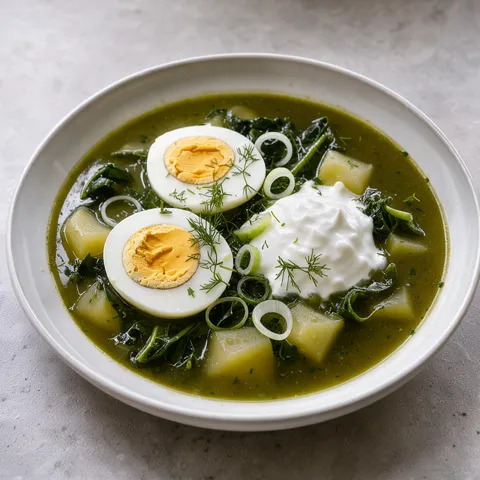 Latvian Sorrel Soup with Egg50 min · Soup
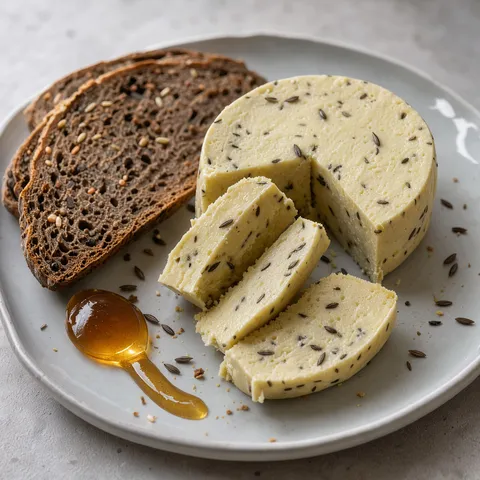 Latvian Caraway Curd Cheese55 min · Meze
 Latvian Marinated Fried Anchovies55 min · Meze
 Latvian Carrot and Potato Tart1 hr 45 min · Bread & pastry