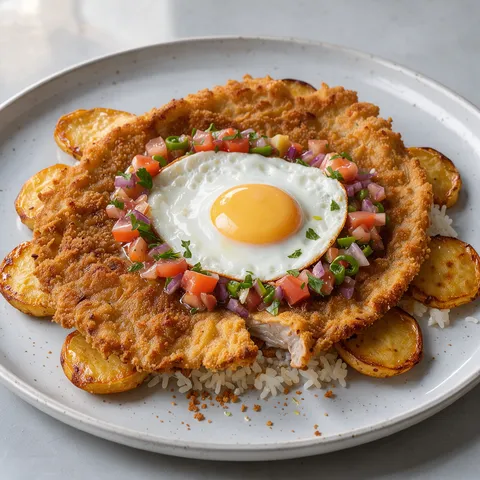
Cochabamba Breaded Beef Plate Silpancho
A Bolivian main course. Takes 1 hr 10 min, Serves 4. Difficulty: medium.
At a glance
- Total time
- 1 hr 10 min
- Serves
- Serves 4
- Difficulty
- Medium
- Cuisine
- Bolivian cuisine
- Dish type
- Main course
- Allergens
- Gluten, Milk, Eggs
Ingredients
Meat
- 4 slices beef sirloin or topside (about 150 g each, 1 cm thick)
- 1 tsp salt
- 1/2 tsp black pepper
- 1/2 tsp cumin
Breadcrumbs
- 200 g day-old white bread
Rice
- 1 tbsp sunflower oil
- 300 g long-grain rice (washed)
- 600 ml hot water
- 1 tsp salt
Potatoes
- 600 g potatoes (4 medium, unpeeled)
- 3 tbsp sunflower oil
- 1/2 tsp salt
For frying the meat
- 6 tbsp sunflower oil (1.5 tbsp per batch)
Eggs
- 4 eggs
- 1 tbsp sunflower oil
Salsa
- 2 tomatoes (5 mm dice)
- 1 red onion (5 mm dice)
- 1 hot red or green chilli (in place of locoto, a Bolivian chilli, finely chopped)
- 2 tbsp chopped flat-leaf parsley
- 1 tbsp white vinegar
- 1 tbsp sunflower oil
- 1/2 tsp salt
Equipment
- Oven
- Baking tray
- Food processor
- Saucepan
- Mixing bowls
- Cling film
- Frying pan
- Cast-iron frying pan
- Chef's knife
- Chopping board
- Rolling pin / oklava (optional)
Method
- Make the breadcrumbs: Preheat the oven to 150°C. Tear the stale bread into pieces, blitz in a food processor to fine crumbs, spread on a baking tray and bake for 10-12 min, until dry and very lightly coloured. When cool, blitz once more to a fine crumb in the processor, giving about 150 g of fine crumbs. Dry, fine crumbs stick well to the meat and absorb little oil
- Start the potatoes and rice: While the crumbs bake, boil the unpeeled potatoes in salted water for 15 min after it comes to the boil, until the centre is still slightly firm, then drain and leave to cool. In a separate saucepan, heat the oil, toast the rice for 2 min, add the hot water and salt, bring to the boil, cover and cook on the lowest heat for 18 min, then turn off the heat and leave to steam for 5 min
- Mix the salsa: Combine the tomatoes, onion, chilli, parsley, vinegar, oil and salt in a bowl and leave until serving. In Bolivia this salsa is the fresh counterpart of silpancho
- Pound the meat: Place each slice of meat between layers of cling film, doubled over. With the flat side of a meat mallet (or, if you do not have one, pressing with a rolling pin), pound from the centre outwards to a wide sheet 3-4 mm thick and about 25 cm across. Overlap and press together any tears. Season both sides with salt, black pepper and cumin
- Press into the crumbs: Divide the crumbs into 4 equal portions (about 37 g for each piece of meat). Spread half of one portion (about 18 g) on a tray, lay a meat sheet on top, sprinkle over the other half and press firmly over the whole surface with your palms. The meat thins to 2-3 mm together with the crumbs. In the Bolivian way, the meat is not dipped in egg for the breadcrumb coating, as the moisture of the meat holds the crumbs. Stack the prepared sheets with cling film between them and chill in the fridge for 10 min
- Fry the potatoes: Peel the potatoes and cut into 1 cm slices. Heat 3 tbsp of oil in a frying pan over medium-high heat and fry the slices for 4-5 min on each side, until golden, season with salt and keep warm
- Fry the meat: Meanwhile, in a second, wide (30 cm) cast-iron frying pan, heat 1.5 tbsp of oil over medium-high heat. Fry one silpancho at a time for 2 min on each side, until golden brown. Meat this thin cooks through in this time. Add fresh oil to the pan for each batch and keep the cooked ones warm in a 90°C oven. Four batches take about 16 min
- Cook the eggs: Wipe out the potato pan and fry the 4 eggs in 1 tbsp of oil over medium heat for 3 min, until the whites are set, the edges are crisp and the yolks stay runny
- Plate: Put the rice on one half and the potato slices on the other half of a large flat plate. Lay the silpancho sheet over them so that it almost completely covers both. Put the fried egg in the centre, spoon plenty of salsa around it and serve immediately
Chef's note
Silpancho is Cochabamba's most famous dish, recognisable by the giant sheet of meat covering the plate. In the original recipe the heat in the salsa comes from locoto (rocoto) chilli, and an easily found hot chilli is used here. Making the crumbs at home gives a coarser, crisper and more aromatic crust than packet breadcrumbs. If you do not have a meat mallet, you can also thin the meat between cling film with a heavy, flat-bottomed pan.
Frequently asked questions
- Why isn't the meat dipped in egg for silpancho?
- In the Bolivian style the meat is not dipped in egg before crumbing, as the moisture of the meat holds the crumbs on. Press the crumbs onto the meat by hand and flatten it with the crumbs to 2-3 mm.
- Why are the breadcrumbs blitzed twice and baked?
- Dry, fine crumbs stick well to the meat and soak up little oil. Blitz day-old bread in a processor and dry it in the oven, then blitz it finely once more when cool.
- How do you keep silpancho warm?
- As the four batches take about 16 minutes, keep the cooked ones warm in a 90°C oven. Add fresh oil to the pan for each batch.
 Bolivian Corn Drink and Pastries1 hr 3 min · Breakfast
 Bolivian Juicy Beef Pasties1 hr 50 min · Bread & pastry
 Bolivian Peanut and Beef Soup2 hr 25 min · Soup
 Sopa de Maní 2.01 hr 15 min · Main course
 Bolivian Quinoa and Beef Soup1 hr 30 min · Soup
 Cochabamba Beef and Sausage Platter1 hr · Main course