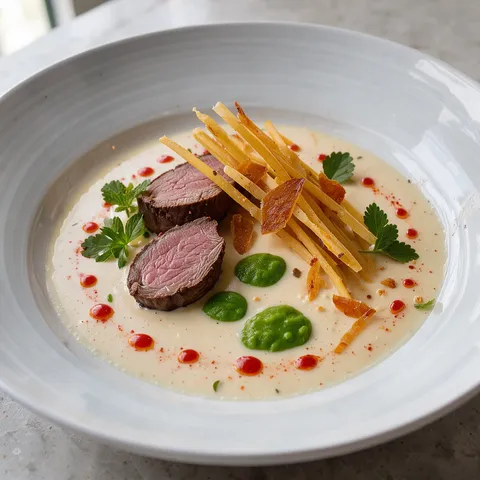
Sopa de Maní 2.0
A Bolivian main course. Takes 1 hr 15 min, Serves 4. Difficulty: challenging.
At a glance
- Total time
- 1 hr 15 min
- Serves
- Serves 4
- Difficulty
- Challenging
- Cuisine
- Bolivian cuisine
- Dish type
- Main course
- Diet
- Gluten-free
- Allergens
- Milk, Peanuts, Tree nuts, Celery
Ingredients
Beef
- 600 g beef fillet or sirloin (4 medallions, 4 cm thick)
- 1 tsp salt
- 1/2 tsp black pepper
- 1 tsp cumin (freshly ground)
- 1 tbsp sunflower oil
- 20 g butter
- 2 garlic cloves (crushed)
- 1 thyme sprig
Peanut velouté
- 150 g raw peanuts
- 1 tbsp sunflower oil
- 1 onion (thinly sliced)
- 1 garlic clove
- 1/2 tsp cumin
- 1/2 tsp sweet paprika
- 700 ml Brown Beef Stock (Basics)
- 100 ml double cream
- salt
Potato crisps
- 2 medium potatoes (300 g)
- 750 ml sunflower oil (for frying)
- flaky sea salt
Pea purée
- 200 g peas
- 20 g butter
- 3 mint leaves
- salt
Red pepper oil
- 60 ml sunflower oil
- 2 tsp sweet paprika
- 1/2 tsp hot paprika
Peanut brittle
- 40 g peanuts
- 1 tbsp sugar
- a pinch of salt
- 1/4 tsp hot paprika
To finish
- parsley and mint shoots
- flaky sea salt
Equipment
- Frying pan
- Baking paper
- Chef's knife
- Chopping board
- Saucepan
- Blender
- Fine sieve / chinois
- Probe thermometer
- Piping bag
- Mandoline
- Heavy-based saucepan
- Cast-iron frying pan
Method
- Prepare: Take the meat out of the fridge and leave on the worktop to come to room temperature, as cold meat cooks through more slowly in the centre after searing. Slice the onion, peel the potatoes and keep in cold water. Takes 10 min in total
- Toast the peanuts: Toast 150 g of the peanuts for the velouté in a dry pan over medium heat for 4 min, only until they are a pale ivory. Stir the 40 g set aside for the brittle in the same pan with the sugar, salt and hot paprika for 4 min, until the sugar melts and coats the peanuts like glass. Spread on baking paper and, when cool, break into coarse pieces with a knife. The classic uses raw peanuts. Here a light toasting gives the velouté depth and the sugared brittle gives crunch
- Cook the velouté: Heat the oil in a saucepan and soften the onion for 6 min, then fry the garlic, cumin and paprika for 1 min. Add the toasted peanuts and stock, bring to the boil and cook on low heat for 15 min. The peanuts soften and absorb the stock during this time
- Blend until smooth: Blend the mixture in a powerful blender for 2 min until silky, add the cream and press through a fine sieve. Adjust the seasoning and keep warm on low heat without boiling. The consistency should coat the back of a spoon in a thin layer. The body that the potato and peas give the classic is provided here by the peanut itself. Takes 5 min in total
- Steep the red pepper oil: Warm the oil in a small frying pan to 60°C, checking with a thermometer, take off the heat, add the sweet and hot paprika, steep for 10 min and pass through a fine sieve. If the oil gets too hot, the paprika blackens and turns bitter
- Make the pea purée: Boil the peas in boiling salted water for 3 min, transfer to iced water and drain. Blend with the butter, mint, salt and 2 tbsp of the cooking water for 1 min, pass through a fine sieve and fill a piping bag. The iced water fixes the bright green of the peas
- Fry the potato crisps: With the fine julienne blade of a mandoline, cut the potatoes into strips half as thick as a matchstick, rinse in cold water and dry thoroughly with a cloth. Heat the oil to 170°C, checking with a thermometer, and fry the potatoes in small batches for 2-3 min, until the foaming stops and they are golden. Drain on kitchen paper and sprinkle with flaky sea salt. The fried potatoes of the classic become a straw-thin nest here. Takes 12 min in total
- Sear the meat: Pat the medallions dry and season with salt, black pepper and cumin. Heat a cast-iron frying pan over high heat, add the oil and sear the medallions for 3 min on each side. Add the butter, garlic and thyme and spoon the foaming butter over the meat for 1 min. Take out of the pan when a thermometer in the centre reads 54-56°C. Takes 8 min in total
- Rest and cut: Rest the meat on a board for 5 min, so the juices redistribute through the fibres. Cut each medallion in half with a sharp knife. The cut faces should be pink
- Plate: In the centre of a warm, wide, deep plate, lean two half medallions, cut-side up, against each other. Pipe three small dots of pea purée on one side of the meat and put a handful of potato crisps as a loose nest on the other
- Finish and pour the velouté: Sprinkle a pinch of peanut brittle over the meat and add parsley and mint shoots. At the table, pour the hot velouté from a jug onto the empty side of the plate, without wetting the meat and potatoes. Drip a few drops of red pepper oil onto the velouté. They should stay as bright red spots on the creamy base. Serve immediately
Chef's note
The four identities of the classic sopa de maní are kept: the creamy soup from raw peanuts, beef, fried potatoes and peas. A seared medallion replaces meat boiled in the soup, straw-thin crisps replace fried potatoes that sink into the soup, and glossy purée dots replace peas floating in it. The velouté is poured at the table, so the potato crisps stay crisp to the last moment.
Frequently asked questions
- Why does the beef need to come to room temperature?
- Cold meat cooks unevenly and stays underdone in the middle after searing. Take the beef out of the fridge and leave it on the worktop first.
- Why does the red pepper oil turn dark?
- If the oil gets too hot, the peppers darken and turn bitter. Warm the oil to 60°C, take it off the heat, add the peppers and infuse for 10 minutes.
- Why are the peanuts roasted?
- The classic version uses raw peanuts. Here a light roast adds depth to the velouté, and a crushed sugared peanut brittle adds crunch.
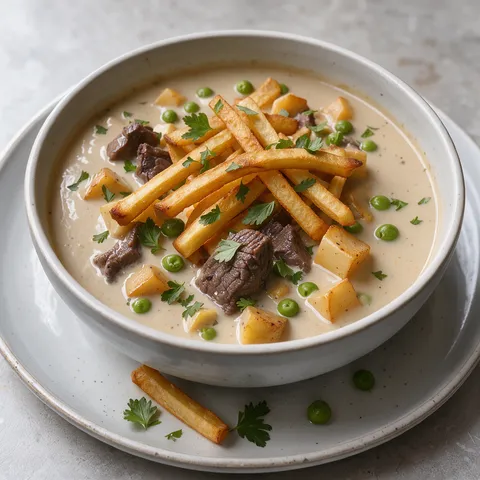 Bolivian Peanut and Beef Soup2 hr 25 min · Soup
 Bolivian Corn Drink and Pastries1 hr 3 min · Breakfast
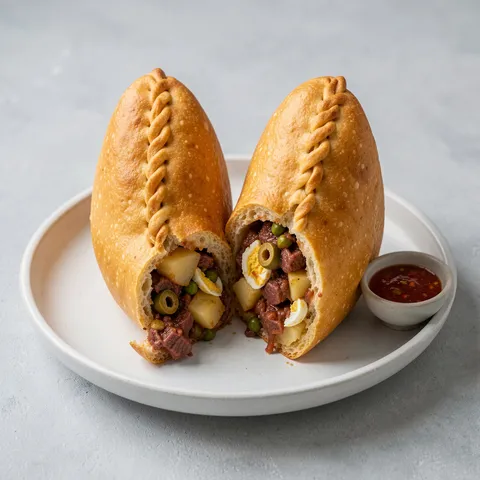 Bolivian Juicy Beef Pasties1 hr 50 min · Bread & pastry
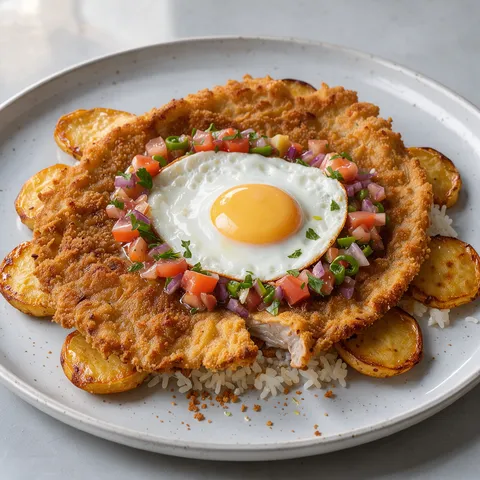 Cochabamba Breaded Beef Plate1 hr 10 min · Main course
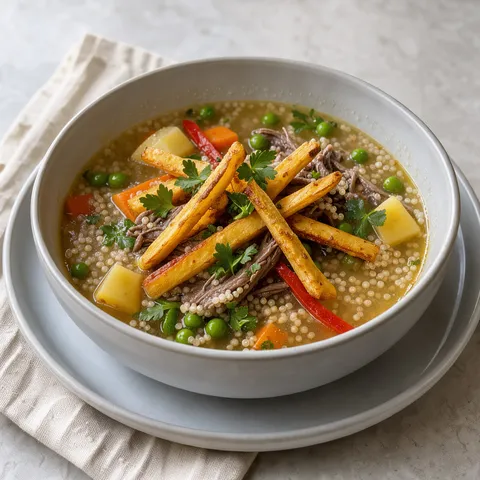 Bolivian Quinoa and Beef Soup1 hr 30 min · Soup
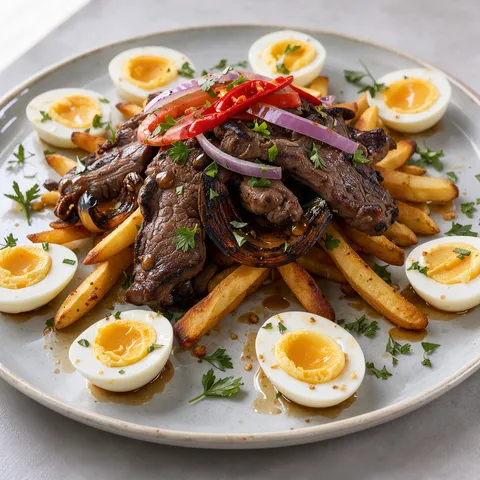 Cochabamba Beef and Sausage Platter1 hr · Main course
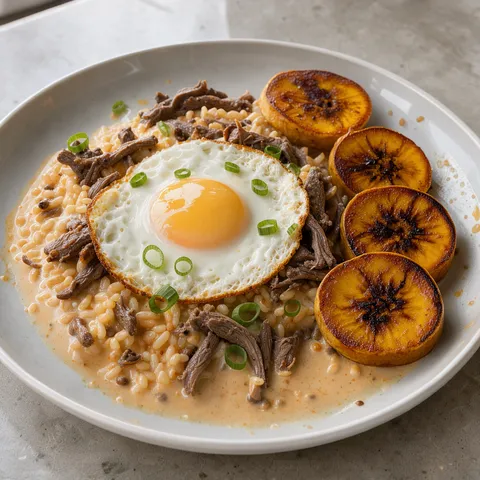 Soupy Rice with Crisp Beef1 hr 50 min · Main course