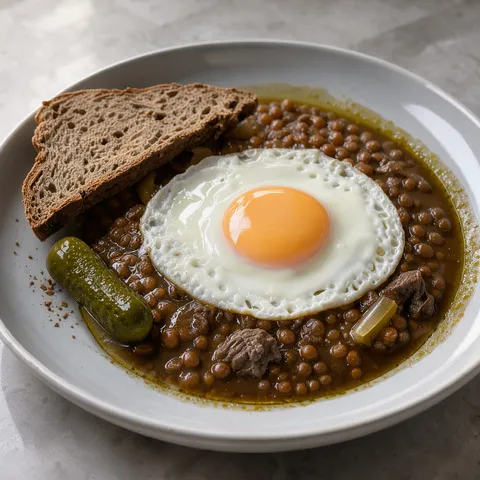
Slovak Sour Lentil Stew with a Fried Egg Šošovica na Kyslo
A Slovak main course. Takes 55 min, Serves 4. Difficulty: medium.
At a glance
- Total time
- 55 min
- Serves
- Serves 4
- Difficulty
- Medium
- Cuisine
- Slovak cuisine
- Dish type
- Main course
- Allergens
- Gluten, Milk, Eggs
Ingredients
Lentils
- 300 g green lentils
- 1.2 litres water
- 2 bay leaves
- 4 allspice berries
- 1 tsp salt
Roux
- 1 medium onion (120 g)
- 3 tbsp sunflower oil (45 ml)
- 2 tbsp plain flour (20 g)
- 1 tsp sweet paprika
- 1 garlic clove
Sourness
- 3 tbsp cider vinegar (45 ml)
- 1 tsp sugar
- 1/2 tsp black pepper
- 100 ml soured cream (20%)
To serve
- 4 eggs
- 20 g butter
- a pinch of salt
- 4 slices rye bread
- 4 small cornichons
Equipment
- Baking tray
- Colander
- Saucepan
- Ladle
- Chef's knife
- Chopping board
- Frying pan
- Balloon whisk
- Mixing bowls
Method
- Rinse the lentils: Spread the lentils out on a tray and pick out any stones and broken bits, then rinse in a colander under cold water until the water runs clear. Green lentils need no soaking, and their skins stay intact as they cook. 5 min
- Boil: Put the lentils in a 3-litre saucepan with the 1.2 litres water, bay leaves and allspice. When it boils, skim off the foam with a ladle and cook over low heat with the lid ajar for 30 min, until the lentils crush without resistance between your teeth but do not fall apart. Add the salt at the end of this time, as salting early toughens the skins. 30 min
- Cook the onion (at the same time as step 2): Finely chop the onion with a chef's knife on a chopping board and crush the garlic. Heat the oil in a small frying pan over medium heat and fry the onion for 7-8 min, until light golden
- Make the roux: Sprinkle the flour over the onion and oil and cook over low heat for 2-3 min, stirring constantly, until it is the colour of a pale biscuit. Take off the heat, add the paprika and garlic and stir for 10 sec. Toasted flour gives the stew a nutty depth. If it stays raw, it leaves a floury taste in the mouth. 3 min
- Bind: Whisk 1 ladleful of the lentil cooking liquid into the roux to make a smooth paste and pour it into the pan. Cook over low heat for 10 min, stirring now and then. It should be a thick stew that coats the back of a spoon and does not run. If it gets too thick, add a few spoonfuls of water. Remove the bay leaves. 10 min
- Sour it: Add the vinegar, sugar and pepper, cook for 2 min more and taste. It should taste slightly sour first with a soft sweetness at the end. The sugar balances the harshness of the vinegar, but the sweetness should not be noticeable. Take off the heat, temper the soured cream in a bowl with 1 ladleful of the hot stew and fold it in. 3 min
- Fry the eggs: Melt the butter in a wide frying pan over medium-low heat until foaming, crack in the eggs and cook for 3-4 min, until the whites are completely set and the edges slightly crisp but the yolks are still runny. Sprinkle with salt. 4 min
- Plate: Put two ladlefuls of lentils in a deep plate and top with a fried egg. Add a slice of rye bread and a cornichon alongside. At the table the yolk is broken and stirred into the lentils
Chef's note
Šošovica na kyslo is the dish of fasting days and the end of the month in Slovak and Czech home cooking, turning plain ingredients into a hearty plate with a roux and vinegar. What sets it apart from Greek fakes (lentil soup) is that it is eaten as a thick stew with a toasted flour roux, soured cream and an egg. Eggs with runny yolks are not recommended for pregnant women, young children or anyone with a weakened immune system. For them, turn the egg and cook the yolk through. The cornichons are traditionally shop-bought.
Frequently asked questions
- Do green lentils need soaking?
- No, green lentils do not need soaking and their skins stay intact as they cook. Just pick out any stones and broken lentils, and rinse until the water runs clear.
- When is the salt added to the lentils?
- Add the salt at the end of cooking, because early salt toughens the skins.
- Why is sugar added to the stew?
- Sugar balances the sharpness of the vinegar. The taste should be lightly sour at first and softly sweet at the end, but the sweetness should not be noticeable.
 Slovak Potato Dumplings55 min · Main course
 Slovak Sauerkraut Soup2 hr 10 min · Soup
 Bryndzové Halušky 2.01 hr 15 min · Starter
 Liptov-Style Bryndza and Potato Soup45 min · Soup
 Slovak Garlic and Potato Soup40 min · Soup
 Slovak Potato Fingers and Poppy Seeds1 hr 20 min · Dessert