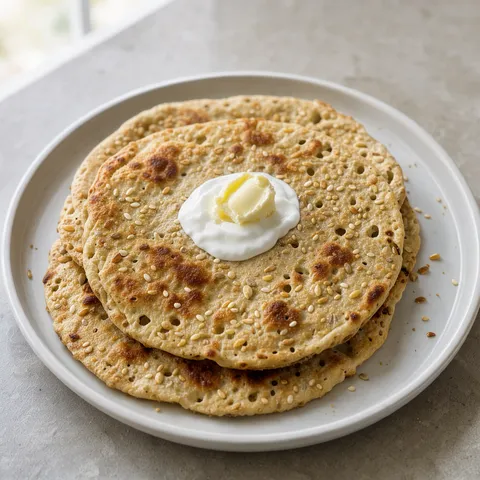
Thalipeeth Maharashtrian Multigrain Flatbread
An Indian bread & pastry. Takes 30 min, 4 pieces (4 servings). Difficulty: easy.
At a glance
- Total time
- 30 min
- Serves
- 4 pieces (4 servings)
- Difficulty
- Easy
- Cuisine
- Indian cuisine
- Dish type
- Bread & pastry
- Allergens
- Gluten, Milk
Ingredients
Flour mix
- 120 g wholemeal flour
- 100 g pearl millet flour (bajra) or cornmeal
- 80 g gram flour
- 60 g rice flour
Dough
- 1 onion
- 3 tbsp chopped fresh coriander
- 2 green chillies
- 1 tsp cumin seeds
- 1 tsp coriander seeds
- 1/2 tsp turmeric
- 1 tsp chilli powder
- 1/4 tsp asafoetida (hing)
- 1 tsp salt
- 250 ml lukewarm water
Cooking
- 4 tbsp clarified butter (ghee)
To serve
- 200 g strained yoghurt
- 2 tbsp butter
Equipment
- Frying pan
- Mixing bowls
- Pestle and mortar
- Baking paper
- Chef's knife
- Chopping board
Method
- Crush the spices: Coarsely crush the coriander seeds in a mortar and warm them with the cumin in a dry pan for 30 sec. Warmed seeds release their aroma, so take them off at once if they start to darken in the pan (~2 min)
- Mix the flours: Mix the four flours with the salt, turmeric, chilli powder, asafoetida and crushed seeds by hand in a large bowl. Aerate with your fingertips until the mixture looks a single colour (~2 min)
- Add the onion: Finely chop the onion and chillies on a board, add them with the coriander to the flour and squeeze with your hand. The onion releases its moisture and gives some of the water for the dough itself (~4 min)
- Bring the dough together: Add the lukewarm water a little at a time to form a soft dough that does not stick but is as soft as an earlobe. Cornmeal and millet are gluten-free, so the dough is fragile, and the lukewarm water binds the flours. Cover and rest for 6 min (~6 min)
- Spread the dough: Divide the dough into 4 equal pieces. Dampen baking paper with a wet hand, put a piece on it and pat it out to 18 cm in diameter and 5 mm thick. Make 4 small holes with a fingertip in the centre and near the edge, which let the ghee in (~4 min)
- Cook in the pan: Heat a large (28-30 cm) frying pan over medium heat and add a spoonful of ghee. Cook 2 pieces at a time, in two rounds. Flip the spread dough, with its paper, onto the pan and peel off the paper. Drip a few drops of ghee into each hole and cover for 3 min. Turn and cook for 2 min more. It is ready when dark brown spots appear on the surface. In the second round, cook the remaining 2 pieces the same way (~10 min)
- Serve: Serve hot with yoghurt and sliced butter. The edge should be slightly crisp and the inside soft, and it hardens as it cools (~2 min)
Chef's note
Thalipeeth is traditionally made with a roasted multigrain flour mix called bhajani; here an approximate mix was made with flours you have at home. Asafoetida (hing) is sold in the spice aisle, and if you cannot find it, add a grated garlic clove. Leftover dough keeps in the fridge for 2 days.
Frequently asked questions
- Why is thalipeeth dough crumbly?
- Millet and cornmeal contain no gluten, so the dough is fragile. Lukewarm water binds the flours, and the dough should come together soft and non-sticky.
- Why do you poke holes in thalipeeth?
- Small holes made with a fingertip let the fat seep in. Drip a few drops of ghee into each hole.
- How do I know when thalipeeth is cooked and how is it served?
- It is ready when dark brown spots appear on the surface. Serve hot with yoghurt and a slice of butter, as it hardens as it cools.
 Indian Butter Chicken50 min · Main course
 Spinach with Homemade Paneer45 min · Main course
 Black Lentil and Kidney Bean Stew1 hr 30 min · Main course
 Chicken Dum Biryani1 hr 30 min · Main course
 Indian Potato Pastries1 hr 30 min · Bread & pastry
 Fermented Rice Crêpes with Spiced Potato50 min · Bread & pastry