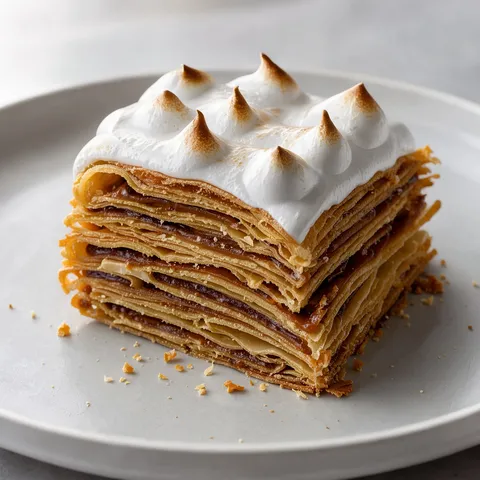
Layered Dulce de Leche Cake Torta Rogel
An Argentinian patisserie. Takes 3 hr 40 min · +2 hr resting, Serves 4. Difficulty: professional.
At a glance
- Total time
- 3 hr 40 min · +2 hr resting
- Serves
- Serves 4
- Difficulty
- Professional
- Cuisine
- Argentinian cuisine
- Dish type
- Patisserie
- Allergens
- Gluten, Milk, Eggs, Sulphites
Ingredients
Dulce de leche (about 1 kg)
- 2 litres whole milk
- 500 g sugar
- 1/2 tsp bicarbonate of soda
- 1 vanilla pod (or 1 tsp vanilla extract). Layers (8 layers, 22 cm): 300 g plain flour
- 6 egg yolks
- 50 g soft butter
- 1 tbsp brandy or cognac
- 50-60 ml cold water
- a pinch of salt
Italian meringue
- 4 egg whites (about 130 g)
- 240 g sugar
- 70 ml water
- a pinch of salt
Equipment
- Heavy-based saucepan
- Wooden spoon / spatula
- Mixing bowls
- Rolling pin / oklava
- Oven
- Baking tray
- Baking paper
- Palette knife
- Saucepan
- Sugar thermometer
- Stand mixer
- Bain-marie bowl (optional)
- Kitchen blowtorch (optional)
Method
- Start the dulce de leche: In a large heavy-based pan, bring the milk, sugar and split vanilla pod almost to the boil, stirring until the sugar dissolves. Dissolve the bicarbonate of soda in 1 tbsp cold milk and add it to the pan. It may foam. The bicarbonate neutralises the acidity of the milk, speeds up the Maillard reaction and gives the caramel colour. Start cooking over medium-low heat at a gentle bubble
- Thicken the dulce de leche: Cook for 2 hr 15 min-2 hr 30 min in total, scraping the base with a wooden spoon every 10 min for the first hr and constantly for the last half hr. The colour becomes deep caramel and the volume reduces by more than half. When a drop on a cold plate does not spread and the line drawn by a spoon does not close, the baker's consistency (repostero) is done. Remove the vanilla pod, transfer to a wide container and cool to room temperature over 30 min, stirring occasionally
- Knead the layer dough: While the dulce de leche cooks, put the flour and salt in a bowl and add the egg yolks, butter and brandy. Add the water a little at a time, mixing, and knead on the work surface for 8-10 min, until a smooth, firm dough. Slamming the dough on the work surface a few times also develops the gluten. Wrap in cling film and rest for 30 min
- Roll out the layers: Preheat the oven to 200°C. Divide the dough into 8 equal pieces (about 60 g each). Roll each piece on a floured work surface with a rolling pin as thin as 1 mm, into a circle a little wider than 24 cm. Transfer to a tray lined with baking paper, put a 22 cm plate or tin base on top and cut around it with a knife. Prick the whole surface often with a fork. Dough that is not pricked puffs up like a balloon in the oven
- Bake the layers: Bake the layers two at a time in the 200°C oven for 5-7 min, until the surface is dry and pale golden, about 30 min in total. Cool on a wire rack. The layers are very fragile and thin, so handle them carefully. If a layer breaks, put it at the bottom
- Assemble the cake: Spread a few spoonfuls of dulce de leche on a serving plate and stick the first layer on top. With a palette knife spread about 120 g of dulce de leche evenly over the layer right to the edges, put on the second layer and press lightly. Stack the 8 layers this way, spreading dulce de leche on 7 of them and leaving the top layer plain. If the dulce de leche is cold and stiff, soften it slightly in its bowl over a bain-marie for 1-2 min, stirring
- Prepare the Italian meringue: Boil the sugar and water in a small pan and put in a sugar thermometer. When the syrup reaches 110°C, start whisking the egg whites with the salt in a stand mixer on medium speed to soft peaks. When the syrup reaches 118-120°C, pour it in a thin stream down the side of the bowl while the mixer runs on high speed. Whisk for 8-10 min until the bowl has cooled to lukewarm and the meringue is glossy and holds stiff peaks. The hot syrup cooks the whites, so the meringue does not collapse or run when the cake is sliced
- Cover with meringue: Pile the meringue on the top layer and press and lift with the back of a spoon to make wavy peaks. If you like, lightly scorch the tips of the peaks with a blowtorch. If you have no blowtorch, leave it plain white
- Rest: Rest the cake for at least 2 hr in a cool place, or on the bottom shelf of the fridge, without putting it in the fridge proper. The layers take up a little of the moisture of the dulce de leche, so the knife passes through without breaking the layers. If it rests for too long the layers soften completely and lose their crispness
- Slice and plate: Dip a sharp knife in hot water and dry it, and cut the cake into 12 slices, reheating the knife after each cut. Lay each slice on its side on a flat dessert plate so the thin layers and the dark lines of dulce de leche between them show, and serve at room temperature
Chef's note
Torta Rogel is one of Argentina's best-loved birthday cakes; the story goes that its name comes from a customer who first asked for it in a patisserie, though there is no definite source. In Argentina the baker's grade of dulce de leche (repostero) is bought ready-made; here it is made at home from milk. This recipe makes about 1 kg of dulce de leche, and the cake uses 840 g. If you make the dulce de leche a day ahead, the cake-day time drops to 1 hr 30 min. No fat or yolk must touch the meringue bowl or the whisk.
Frequently asked questions
- How do you know the dulce de leche is thick enough for the cake?
- Drop a little onto a cold plate. If it does not spread and the line made by a spoon does not close up, it is ready. The colour is a dark caramel and the volume has reduced by more than half.
- Why are the layers of torta Rogel pricked with a fork?
- Thin dough that is not pricked puffs up like a balloon in the oven. Pricking it all over with a fork keeps the layers flat.
- Why does torta Rogel rest after assembling?
- The layers soak up a little moisture from the dulce de leche, so the knife cuts through without breaking them. If left too long, the layers go completely soft and lose their crispness.
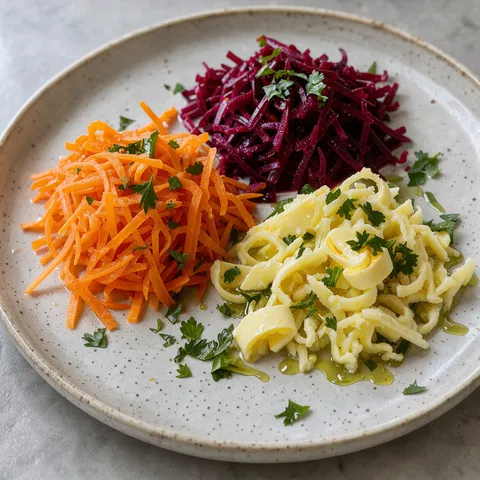 Argentine Three-Colour Grated Salad45 min · Salad
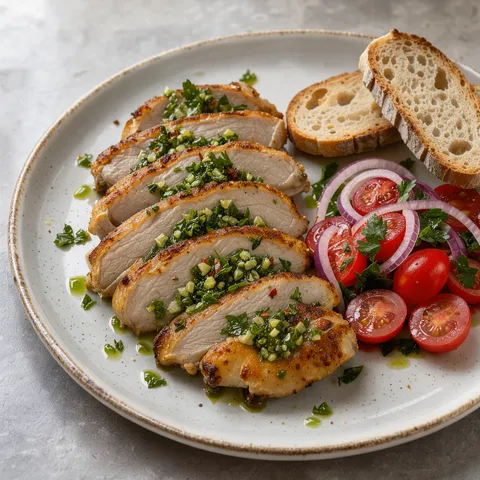 Argentine Pan-Fried Chicken with Chimichurri28 min · Main course
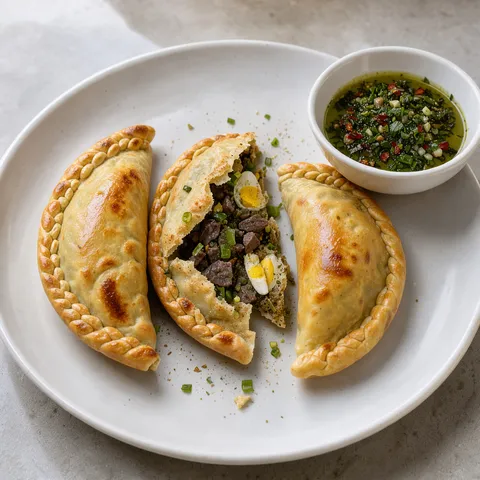 Argentine Knife-Cut Beef Empanadas1 hr 50 min · Bread & pastry
 Argentine Corn and Pumpkin Stew2 hr 45 min · Main course
 Dulce de Leche Sandwich Biscuits2 hr 15 min · Dessert
 Empanadas Tucumanas 2.01 hr 25 min · Starter