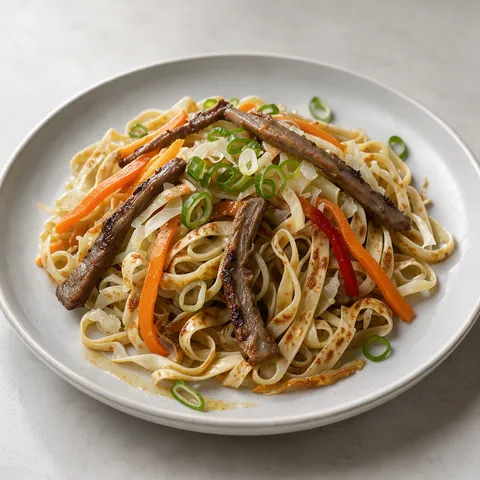
Mongolian Stir-Fried Noodles with Lamb Tsuivan
A Mongolian main course. Takes 1 hr 15 min, Serves 4. Difficulty: medium.
At a glance
- Total time
- 1 hr 15 min
- Serves
- Serves 4
- Difficulty
- Medium
- Cuisine
- Mongolian cuisine
- Dish type
- Main course
- Allergens
- Gluten
Ingredients
Dough
- 350 g plain flour
- 180 ml lukewarm water
- 1/2 tsp salt
- 2 tbsp sunflower oil (for brushing)
Meat
- 500 g boneless leg or shoulder of lamb (in thin strips 5 mm thick)
- 3 tbsp sunflower oil
Vegetables
- 1 onion (in half-moons)
- 2 carrots (in matchsticks)
- 300 g white cabbage (in thin strips)
- 1 red pepper (in thin strips)
- 3 garlic cloves (finely chopped)
Seasoning and liquid
- 1.5 tsp salt
- 1/2 tsp black pepper
- 250 ml hot water
To serve
- 2 spring onions (in thin rings)
Equipment
- Sauté pan
- Rolling pin / oklava
- Pastry brush
- Chef's knife
- Chopping board
- Wooden spoon / spatula
- Wok (optional)
Method
- Knead the dough: Mix the flour with the salt, add the lukewarm water and knead for 8-10 min until firm and smooth. Cover and leave to rest for 20 min
- Prepare the vegetables: While the dough rests, slice the onion into half-moons, cut the carrots into fine matchsticks, slice the cabbage and pepper into thin strips and chop the garlic. Cut the meat across the grain into thin strips 5 mm thick. The vegetables and meat should be the same size so they cook in the same time
- Roll out and cut the dough: Roll the dough out on a floured work surface into a large sheet 2 mm thick. Brush the surface with oil and fold the sheet loosely into a band 8 cm wide. Cut into strips 5 mm wide with a sharp knife, separate them and dust lightly with flour. The oil stops the strips sticking together in the steam
- Brown the meat: Heat the oil in a wide, heavy-based sauté pan or wok over high heat until smoking. Spread the meat in a single layer, leave it untouched for 1 min, then turn for 4-5 min until browned at the edges
- Add the vegetables: Add the onion and carrot and stir-fry for 3 min. Add the cabbage, pepper and garlic and cook for another 3 min, until the cabbage starts to wilt. Season with salt and pepper
- Steam the noodles: Pour the hot water into the pan and level the vegetables underneath. Spread the noodle strips evenly over the vegetables and meat like a blanket, without stirring. Cover tightly, lower the heat and cook for 12-15 min. The noodles cook in the steam rising from below: the water should be completely absorbed and the noodles soft but still with some bite
- Toss and fry: Uncover and raise the heat. Toss the noodles with the meat and vegetables underneath using two wooden spoons for 3-4 min: the noodles should brown slightly on the base and pick up a few crisp spots. Check the salt
- Plate: Pile the tsuivan high in warm, deep plates, with the strips of meat and vegetables showing through the noodles. Scatter over the spring onion and serve immediately
Chef's note
Tsuivan is the most common everyday dish of Mongolian homes and roadside canteens (guanz). The classic technique is to steam the noodles on top of the meat and vegetables rather than boiling them, so the noodles soak up the meat juices and fat directly. In some homes the dough is first cooked in a pan like a flatbread and then cut into strips. In the countryside vegetables are scarce, and often only meat, onion and carrot are used.
Frequently asked questions
- How do the noodles cook in Tsuivan?
- The noodle strips are laid over the vegetables and meat without stirring, the lid is closed tightly and they cook over a low heat for 12-15 minutes. The noodles cook in the steam rising from below. The water should be fully absorbed, and the noodles soft but firm to the bite.
- Why are the noodle strips oiled?
- The surface of the rolled sheet is brushed with oil, then folded and cut into 5 mm wide strips. The oil stops the strips sticking together in the steam. Separate the strips and dust them lightly with flour.
- Why are the meat and vegetables cut to the same size?
- The meat and vegetables should be the same size so that they cook in the same time. Cut the meat across the grain into 5 mm strips. The carrots are cut into matchsticks, and the cabbage and pepper into thin strips.
 Mongolian Steamed Lamb Dumplings1 hr 50 min · Bread & pastry
 Mongolian Salted Milk Tea30 min · Drink
 Mongolian Fried Lamb Pasties1 hr 40 min · Bread & pastry
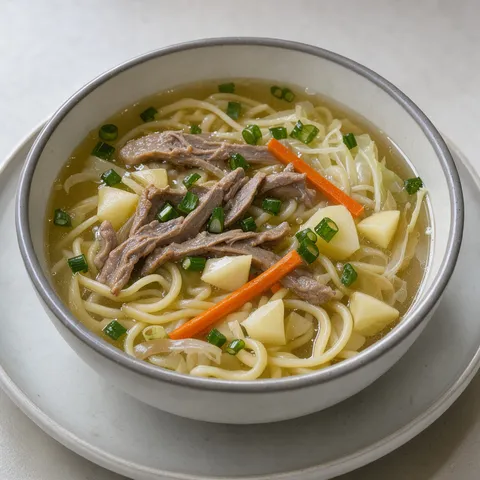 Mongolian Lamb Soup with Hand-Cut Noodles2 hr · Soup
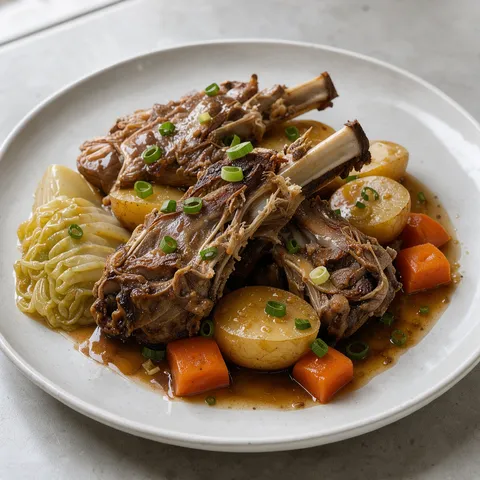 Mongolian Lamb on the Bone with Potatoes2 hr 20 min · Main course
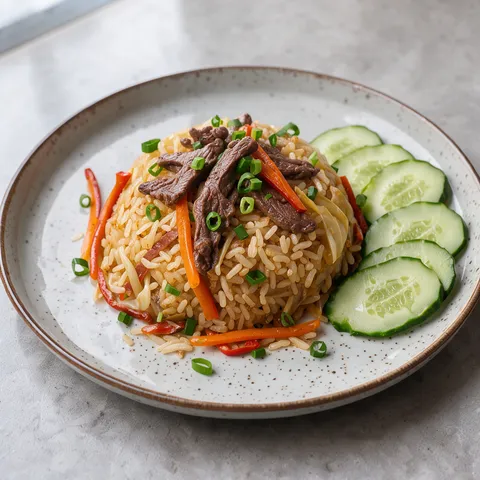 Mongolian Fried Rice with Beef1 hr 15 min · Main course