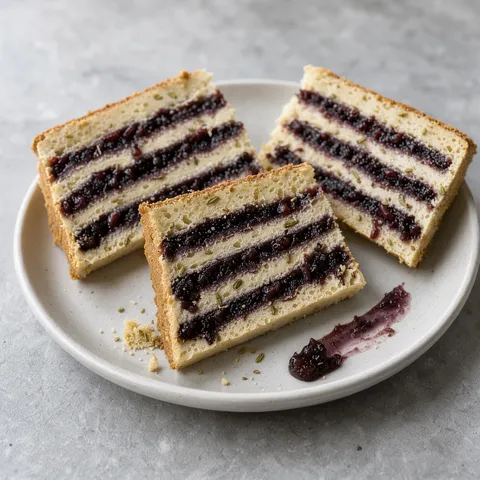
Icelandic Cardamom Layer Cake with Prunes Vínarterta
An Icelandic patisserie. Takes 1 hr 30 min · +30 min chilling · +1 day resting, Serves 4. Difficulty: medium.
At a glance
- Total time
- 1 hr 30 min · +30 min chilling · +1 day resting
- Serves
- Serves 4
- Difficulty
- Medium
- Cuisine
- Icelandic cuisine
- Dish type
- Patisserie
- Diet
- Vegetarian
- Allergens
- Gluten, Milk, Eggs
Ingredients
Biscuit dough
- 250 g butter (at room temperature)
- 250 g caster sugar
- 2 eggs
- 3 tbsp milk (45 ml)
- 550 g plain flour plus 2 tbsp for rolling
- 1 tsp baking powder
- 1.5 tsp ground cardamom
- 1 tsp Vanilla Sugar and Vanilla Extract (Basics)
Prune filling
- 500 g pitted prunes
- 300 ml water
- 150 g sugar
- 1 tsp ground cardamom
- 1/2 tsp ground cinnamon
- 1 tbsp lemon juice
Equipment
- Hand mixer
- Mixing bowls
- Dough scraper
- Fine sieve / chinois
- Cling film
- Saucepan
- Stick blender
- Oven
- Baking paper
- Rolling pin / oklava
- Baking tray
- Palette knife
- Precision scales (optional)
Method
- Make the dough: Beat the butter and sugar in a large bowl with a hand mixer for 4-5 min until pale and fluffy. Add the eggs one at a time, then the milk and vanilla. Sift in the flour, baking powder and cardamom through a fine sieve and fold in with a dough scraper until it comes together. Divide the dough into 6 equal pieces on the scales (about 200 g each), shape into flat discs, wrap in cling film and chill in the fridge for 30 min. Cold dough rolls out thinly and doesn't spread in the oven. 10 min
- Cook the filling (while chilling): Bring the prunes and water to the boil in a saucepan and simmer with the lid ajar for 15 min until completely soft. Add the sugar, cardamom and cinnamon, blitz smooth with a stick blender, then cook over low heat, stirring, for another 10 min until thick enough that a line drawn with a spoon doesn't close up. Stir in the lemon juice and leave to cool. A runny filling soaks the layers and makes them slide
- Roll out the layers: Preheat the oven to 180°C. On each of 6 sheets of baking paper, draw a circle in pencil using a 22 cm plate as a template, then turn the paper over. Roll out each disc on its paper with a rolling pin to fill the circle exactly, about 4 mm thick, and trim the edges to the circle with a knife. Prick in a few places with a fork. 14 min
- Bake: Put the layers, on their paper, one on each of two trays and bake both trays at once on the middle and top shelves for 11-12 min until the edges are pale golden and the centre matt and dry. Overbaked layers turn brittle and won't soften with the filling. 3 rounds, about 36 min in total. 36 min
- Cool: Cool the layers completely on their paper on a wire rack for 15 min. A warm layer melts the filling. 15 min
- Layer: Put the first layer on a serving plate and spread a fifth of the filling (about 160 g) thinly over it with a palette knife, to within 5 mm of the edge. Lay the second layer neatly on top and press lightly. Complete the six layers and five layers of filling this way, leaving the top layer bare. 10 min
- Rest: Wrap the cake tightly in cling film and leave in a cool place or the fridge for at least 1 day. The biscuit layers absorb moisture from the filling and turn from brittle into a soft cake that can be sliced
- Slice and serve: With a sharp knife, cut first in half, then into thin slices (about 1.5 cm): each slice should show six pale and five dark stripes. Serve with coffee. Wrapped, it keeps for 2 weeks in the fridge. 5 min
Chef's note
Vínarterta is known as the layer cake made in Iceland for Christmas and family gatherings. Although its name means Viennese torte, today it is said to live on not in Austria but in Iceland and among Icelandic immigrant communities in Canada. The number of layers varies from family to family between 5 and 7. Some households put vanilla in the filling instead of cardamom, and some cover the top with buttercream. 22 cm, 16 thin slices.
Frequently asked questions
- Why does vinarterta rest for at least 1 day?
- The biscuit layers absorb moisture from the prune filling. That turns the crumbly texture into a soft cake that can be sliced.
- What happens if the prune filling stays runny?
- Runny filling soaks the layers and makes them slide. So cook the filling until it is thick enough that the trail of a spoon does not close up.
- How long can vinarterta be kept?
- Wrapped in cling film, it keeps in the fridge for 2 weeks.
 Icelandic Lamb and Root Vegetable Soup1 hr 25 min · Soup
 Icelandic Buttery Cod and Potato Gratin55 min · Main course
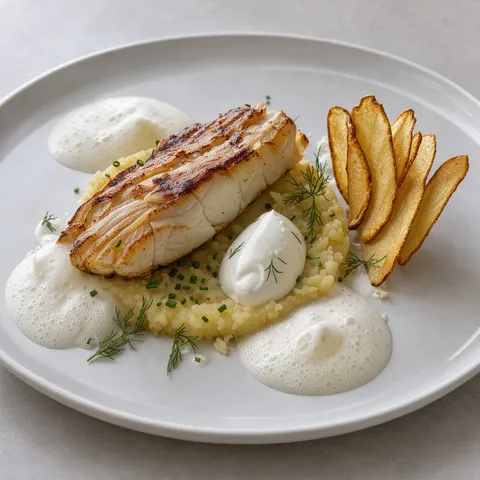 Plokkfiskur 2.01 hr 10 min · Main course
 South Icelandic Creamy Langoustine Soup1 hr 28 min · Soup
 Icelandic Lamb and Split Pea Soup1 hr 35 min · Soup
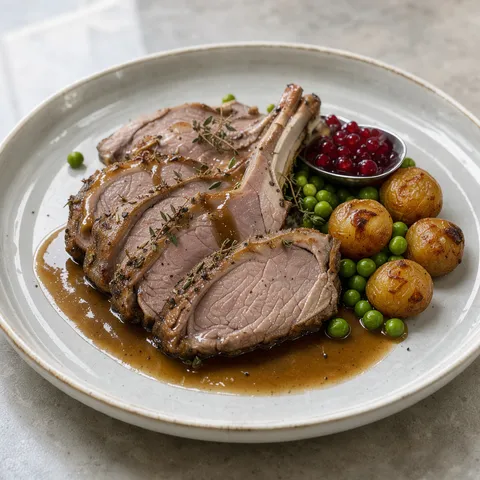 Icelandic Roast Leg of Lamb with Thyme2 hr 10 min · Main course