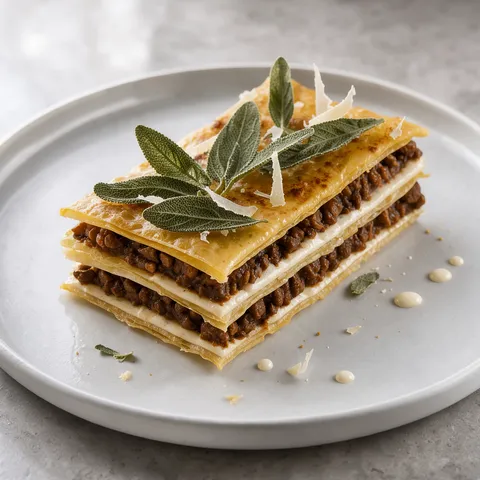
Vincisgrassi 2.0
An Italian main course. Takes 1 hr 27 min, Serves 4. Difficulty: challenging.
At a glance
- Total time
- 1 hr 27 min
- Serves
- Serves 4
- Difficulty
- Challenging
- Cuisine
- Italian cuisine
- Dish type
- Main course
- Allergens
- Gluten, Milk, Eggs, Sulphites
Ingredients
Pasta sheets
- 200 g plain flour
- 2 eggs
- 1 tbsp Marsala
- 1/2 tsp salt
- 1 tbsp olive oil
Beef ragù (pressure cooker)
- 350 g beef mince
- 100 g chicken livers (finely chopped)
- 1 small onion
- 1 small carrot (finely chopped)
- 2 tbsp olive oil
- 1 tbsp butter
- 80 ml white wine
- 1 tbsp tomato paste
- 150 ml hot water
- 1 bay leaf
- 1 tsp salt
- black pepper
Parmesan cream
- 40 g butter
- 40 g plain flour
- 500 ml milk
- 80 g Parmigiano Reggiano (finely grated)
- 1/4 tsp nutmeg
- 1/2 tsp salt
Crisp sage
- 12 sage leaves
- 3 tbsp neutral oil
To finish
- 20 g Parmigiano shavings
- 2 tbsp olive oil
- salt
Equipment
- Pressure cooker
- Oven
- Baking tray
- Baking paper
- Rolling pin / oklava
- Blender
- Fine sieve / chinois
- Saucepan
- Frying pan
- Balloon whisk
- Mixing bowls
- Box grater
Method
- Knead and rest the dough: Knead the flour, eggs, Marsala, olive oil and salt for 6 min until firm and smooth. Wrap in cling film and rest for 10 min. Marsala gives the dough the sweetish aroma of Marche, and the olive oil makes crisping in the oven easier. Move on to the ragù in the meantime (~15 min)
- Start the ragù: Heat the olive oil and butter in a pressure cooker and soften the onion and carrot for 3 min. Add the mince and crumble it with a spoon, stirring over high heat for 3 min until the liquid has been absorbed and it changes colour. Add the livers and stir for 1 more min. The liver gives the ragù its classic depth, and if cooked for long it toughens (~8 min)
- Pressure-cook: Add the tomato paste and stir for 30 sec, pour in the wine and hot water and add the bay and salt. Close the lid and cook over low heat for 15 min once the cooker reaches pressure. Let the pressure release naturally and open the lid. The ragù should stay thick and moist, and if it turns watery, reduce it uncovered over high heat for 2-3 min. The 45 min of low simmering in the classic recipe drops to this time in a pressure cooker (~22 min)
- Cook the Parmesan cream: Melt the butter, add the flour and whisk for 1 min. Add the milk in a thin stream, whisking, and cook over low heat for 6 min until it coats the spoon. Take off the heat and add the Parmigiano, salt and nutmeg. It should be slightly fluid, like cream (~10 min)
- Roll out and cut the dough: Preheat the oven to 200°C. Roll out the dough with a rolling pin to 1 mm thick and cut 12 rectangles of 8×12 cm. If it is not thin it comes out hard rather than crisp in the oven. Lay the sheets on two trays lined with baking paper (~10 min)
- Crisp up the sheets: Put another layer of baking paper and a second tray on top of each tray and bake the sheets in the 200°C oven for 10-12 min until flat and golden. Pressing from above stops them puffing up and gives glass-thin crisp sheets. Take out of the oven and cool (~12 min)
- Blend the Parmesan cream until smooth: Blend the cream with a blender for 20 sec and pass through a fine sieve, keeping it warm. Straining removes all lumps and leaves a silky, flowing texture (~3 min)
- Fry the sage: Heat the neutral oil in a small pan over medium heat and fry the sage leaves for 20-30 sec until the bubbles subside and they are crisp. Lift onto kitchen paper and salt at once. If overfried they turn bitter (~3 min)
- Plate and serve: Put a spoonful of the Parmesan cream in the centre of a warmed flat plate and spread it lightly over the base. Place a crisp pasta sheet on top, then 2 tbsp ragù, then again cream, sheet, ragù and cream, making 3 layers. On the top put drops of cream, crisp sage and Parmigiano shavings and drizzle with olive oil. The layers should stay separate. Serve immediately, before the crisp sheet gets wet (~4 min)
Chef's note
Classic vincisgrassi is a baked dish of layered soft pasta. Here the same components were separated into crisp sheets, ragù and béchamel and stacked like a mille-feuille, and the ragù was cooked in a pressure cooker. The original recipe uses pork prosciutto; here it is made with beef and chicken livers. The crisp sheets soften within 5 min on the plate, so the layers should be built last.
Frequently asked questions
- How is Vincisgrassi 2.0 different from the classic?
- In the classic, the pasta is soft and layered in the oven. Here thin sheets are crisped and the layers are stacked on the plate. The ragù cooks quickly in a pressure cooker.
- How do I make the crisp pasta sheets?
- Roll the dough to 1 mm, press it between two sheets of baking paper with a second tray on top and bake at 200°C for 10-12 minutes. This keeps them flat and crisp.
- How long can the plate wait?
- The crisp sheets soften within 5 minutes once they touch the ragù and cream. Stack them at the last moment and serve straight away.
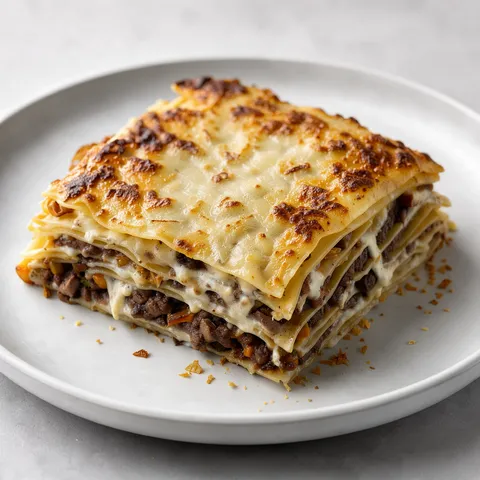 Vincisgrassi3 hr 11 min · Main course
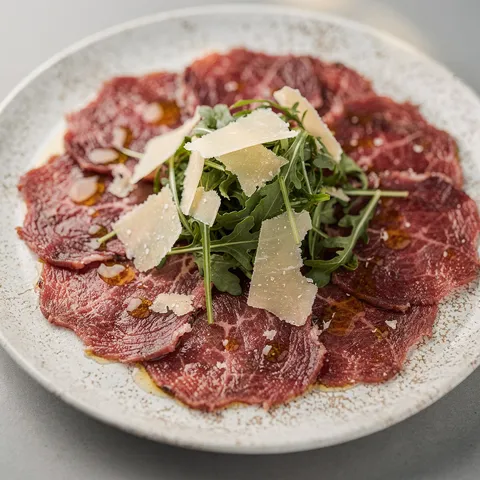 Beef Carpaccio, Mini Hunkar Begendi Croquettes, Parmesan Cream1 hr 30 min · Starter
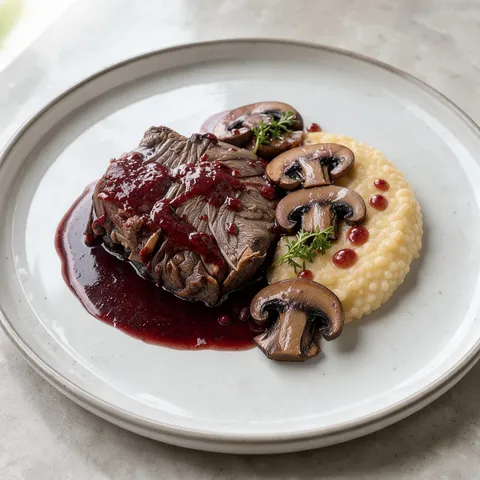 Beef Cheeks, Red Wine, Mushrooms, Polenta2 hr · Main course
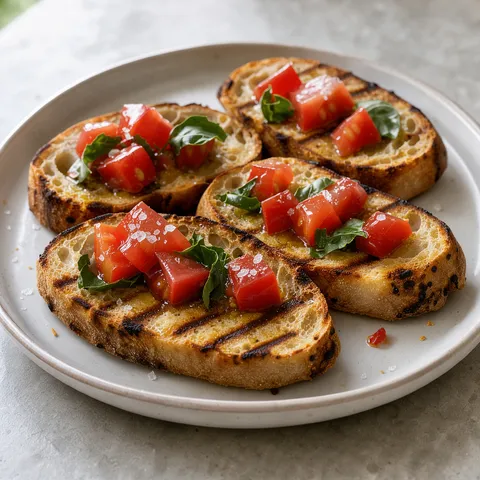 Bruschetta al Pomodoro25 min · Starter
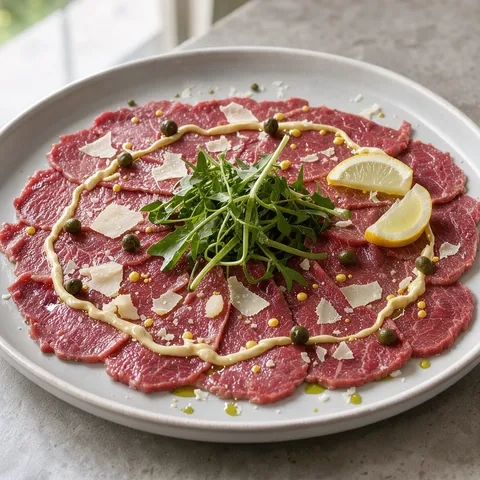 Carpaccio di Manzo30 min · Starter
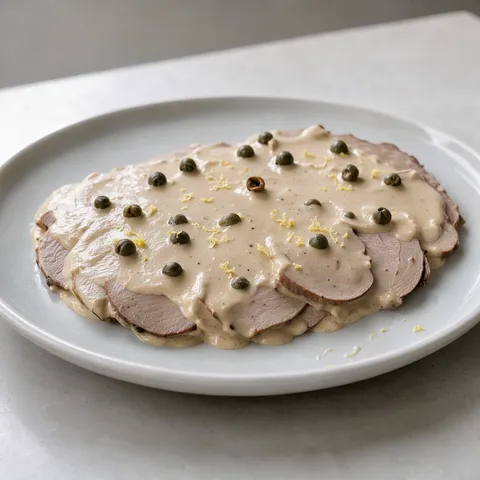 Vitello Tonnato1 hr 30 min · Starter
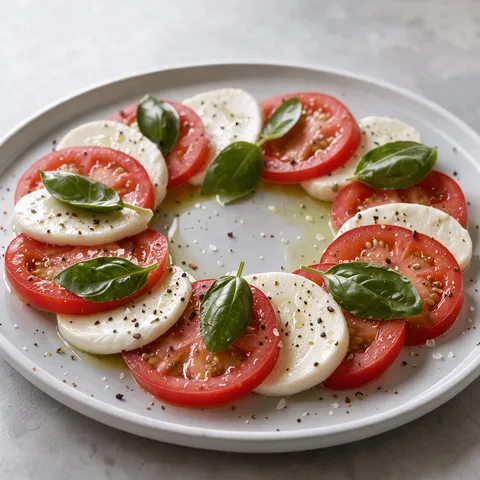 Insalata Caprese10 min · Starter