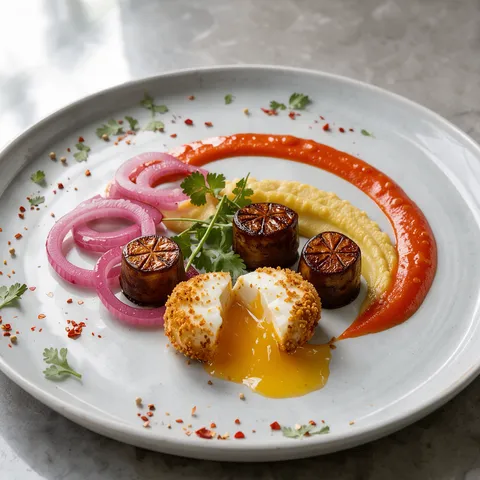
Alloco 2.0
An Ivorian starter. Takes 1 hr 10 min, Serves 4. Difficulty: challenging.
At a glance
- Total time
- 1 hr 10 min
- Serves
- Serves 4
- Difficulty
- Challenging
- Cuisine
- Ivorian cuisine
- Dish type
- Starter
- Allergens
- Gluten, Milk, Eggs
Ingredients
Plantain purée
- 2 ripe plantains (peeled, about 450 g)
- 250 ml water
- 1/2 tsp salt
- 30 g butter
- 1 tbsp lemon juice
Caramelised plantain
- 2 ripe but firm plantains (peeled, about 450 g)
- 2 tbsp sunflower oil
- 20 g butter
- a pinch of flaky sea salt
Sauce piment emulsion
- 3 medium tomatoes
- 1 red romano pepper
- 1/2 onion
- 1 red chilli
- 2 garlic cloves
- 4 tbsp sunflower oil
- 1/2 tsp salt
Crisp soft-boiled eggs
- 4 eggs (to soft-boil)
- 1 egg (for coating)
- 30 g plain flour
- 60 g fine cornmeal
- a pinch of salt
- 400 ml sunflower oil (for frying)
Pickled onion
- 1/2 red onion
- 2 tbsp lemon juice
- a pinch of salt
To finish
- 12 coriander leaves
- a pinch of chilli flakes
Equipment
- Blender
- Saucepan
- Fine sieve / chinois
- Balloon whisk
- Probe thermometer
- Frying pan
- Mixing bowls
- Chef's knife
- Chopping board
Method
- Prep and plan the hob: Chop all the vegetables and peel the plantains. No more than three hob rings will be in use at once: first the purée pan, the sauce pan and the egg pan, which are then replaced by the caramelising pan and the frying pan. The three elements of classic alloco, fried plantain, chilli sauce and boiled egg, are split here into separate textures
- Cook the sauce: Blitz the tomatoes, romano pepper, onion, chilli and garlic in a blender until smooth. Heat 1 tbsp oil in a medium saucepan, add the purée and salt and cook over a medium heat, stirring often, for 15-18 min until reduced by about half and thickened. Press through a fine sieve with a spoon, leaving the skins and seeds behind. Whisk in the remaining 3 tbsp oil in a thin stream to make a glossy, slightly creamy sauce. Keep warm, covered
- Cook the purée: While the sauce cooks, cut the plantains for the purée into 2 cm slices and bring to the boil with the water and salt in a small saucepan, then cover and cook over a low heat for 12 min until a fork slides in easily. Reserve 60 ml of the cooking water and drain off the rest. Put the plantain in a blender with the butter, lemon juice and reserved water and blitz for 1 min until smooth. It should be a thick purée that drops slowly from the spoon. Return to the pan and keep warm, covered
- Soft-boil the eggs: On the third hob ring, bring water to the boil in a small saucepan, gently lower in the 4 eggs with a spoon and cook for exactly 6 min 15 sec. Transfer immediately to iced water and cool for 5 min. The yolk should be runny and the white set. Peel carefully under the water, starting from the wide end
- Make the pickle: Separate the red onion into thin rings, mix with the lemon juice and salt and leave for at least 15 min. The rings turn pink and bring the fresh onion sharpness of the classic sauce
- Coat the eggs: Put the flour on a plate, beat the coating egg with the salt in a bowl and put the cornmeal on another plate. Pat the peeled eggs dry with kitchen paper and roll them in turn in the flour, egg and cornmeal, pressing the cornmeal on gently with your palms. A thin, even crust protects the soft white without tearing it. Leave the coated eggs on the plate
- Cook the caramelised plantain: Cut the remaining plantains into 12 cylinders 4 cm long and score one face of each in a crosshatch with a knife. On the hob ring freed up by the egg pan, heat the oil and butter in a 28 cm frying pan over a medium heat until foaming. Put in the cylinders scored side down and cook for 3-4 min on each side, turning, until deep caramel and soft in the centre. Sprinkle with flaky salt and pull the pan to the side of the hob
- Fry the eggs: Take the sauce pan off the heat and in its place put 400 ml oil in a small, deep 14 cm saucepan (about 2.6 cm deep). Bring it to 180°C, checking with a thermometer. Fry the eggs in 4 batches, one at a time, for 1.5-2 min, spooning oil over and turning them until the crust is golden, and let the oil come back to 180°C between batches. Any longer and the yolk sets. Transfer to kitchen paper
- Adjust the purée: The plantain purée thickens as it stands, so if needed loosen it with a spoonful of hot water until it runs off the spoon, and check the salt
- Plate: Pour 2 tbsp sauce piment into the centre of a warm plate and draw a 10 cm ring with the back of a spoon. Put 2 tbsp plantain purée on one side of the ring and drag it into a long teardrop with the spoon. Arrange three caramelised cylinders, scored side up, between the purée and the sauce. Halve a crisp egg with a sharp knife and place it beside the cylinders so the runny yolk shows. Finish with a few rings of pickled onion, the coriander leaves and a pinch of chilli flakes
- Serve: Serve immediately: on the plate the egg yolk mixes with the sauce and becomes a third sauce. The coating begins to lose its crispness within 5 min
Chef's note
Every element of alloco from the street stall is kept, but each is taken into a different texture: the plantain as both caramelised cylinders and a lemony purée, the sauce piment as a strained, glossy emulsion, and the boiled egg as a crisp soft-boiled egg with a runny yolk. A cornmeal coating gives a crisper, slightly sweeter crust than dried breadcrumbs. If you can't find plantain, don't make this dish: banana falls apart when cooked.
Frequently asked questions
- How many minutes for a soft-boiled egg?
- Lower the egg into boiling water and cook for exactly 6 minutes 15 seconds, then put it straight into iced water and cool for 5 minutes. The yolk is runny and the white is set.
- Why does the crispy egg coating lose its crunch quickly?
- The coating on the fried egg starts to lose its crunch within 5 minutes, so serve at once. If left longer in the oil the yolk cooks, and the recipe recommends frying for 1.5-2 minutes.
- What if the plantain purée thickens?
- The purée thickens as it stands. Add a spoonful of hot water to loosen it to a consistency that flows from the spoon, and check the salt.
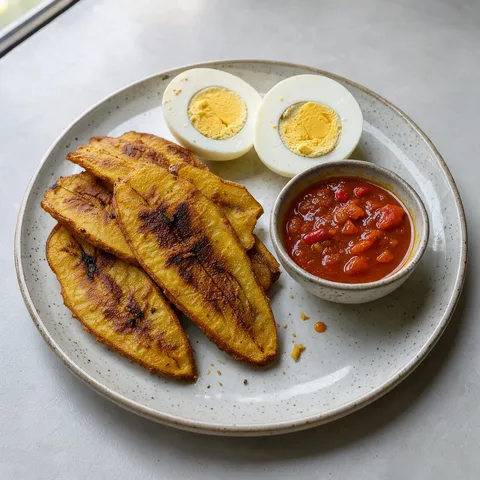 Ivorian Fried Plantain with Chilli Sauce50 min · Starter
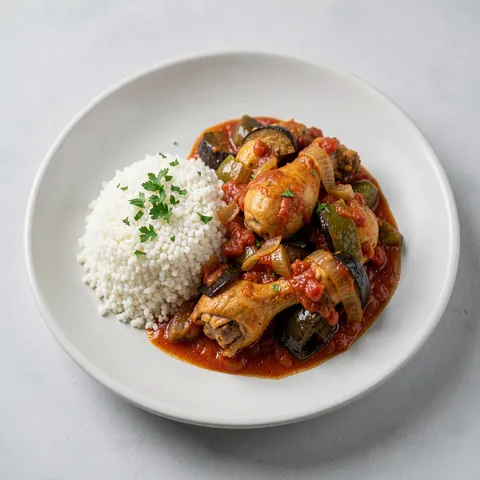 Ivorian Sealed-Pot Chicken Stew1 hr 15 min · Main course
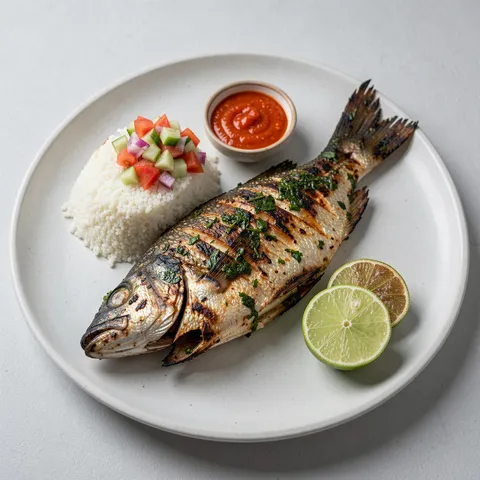 Attiéké and Poisson Braisé1 hr 10 min · Main course
 Ivorian Millet and Yoghurt Pudding1 hr · Dessert
 Kedjenou 2.01 hr 25 min · Main course
 Ivorian Spiced Chargrilled Lamb50 min · Main course
 Ivorian Tuna and Cassava Couscous36 min · Main course