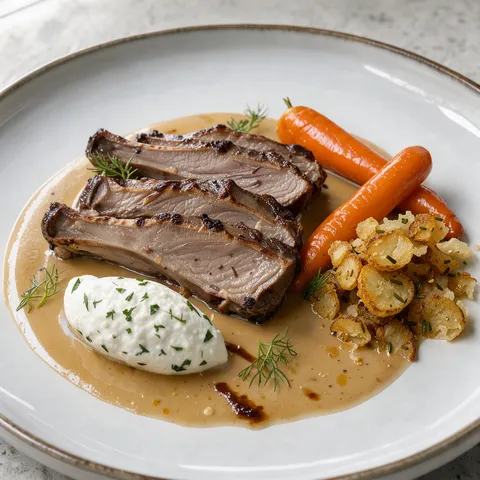
Brav u Mlijeku 2.0
A Montenegrin main course. Takes 1 hr 25 min, Serves 4. Difficulty: challenging.
At a glance
- Total time
- 1 hr 25 min
- Serves
- Serves 4
- Difficulty
- Challenging
- Cuisine
- Montenegrin cuisine
- Dish type
- Main course
- Diet
- Gluten-free
- Allergens
- Milk
Ingredients
Lamb
- 2 lamb loin fillets (trimmed of silverskin, about 600 g in total)
- 1 tsp salt
- 1/2 tsp black pepper
- 1 tbsp sunflower oil
- 20 g butter
Milk for poaching
- 500 ml whole milk
- 3 garlic cloves (crushed)
- 1 tsp fennel seeds
- 1 rosemary sprig
- 1 bay leaf
Caramelised milk sauce
- the milk used to poach the lamb (from above)
- 40 g butter
- 1/4 tsp salt
Fresh milk curd
- 500 ml whole milk
- 2 tbsp lemon juice
- 1/4 tsp salt
- 1 tbsp parsley (very finely chopped)
- 1 tsp extra virgin olive oil
Potatoes
- 500 g small potatoes
- 1 litre water
- 1 tsp salt
- 3 tbsp olive oil
- 1 tsp fennel seeds (coarsely pounded)
- 1/2 tsp salt
Carrots
- 8 small carrots (about 300 g)
- 20 g butter
- 1 tsp caster sugar
- 100 ml water
- a pinch of salt
To finish
- dill or fennel sprigs
- a pinch of coarse salt
Equipment
- Oven
- Saucepan
- Colander
- Baking tray
- Probe thermometer
- Muslin
- Fine sieve / chinois
- Sauté pan
- Balloon whisk
- Frying pan
- Cast-iron frying pan
- Chopping board
- Chef's knife
- Mixing bowls
- Pestle and mortar (optional)
Method
- Boil the potatoes and preheat the oven: Preheat the oven to 220°C. Put the potatoes in their skins in 1 litre of salted cold water, and once it boils, cook for 12 min, until half tender, then drain in a colander. Par-boiling makes the inside creamy and the oven crisps the outside
- Roast the potatoes: Coarsely pound the fennel seeds in a mortar (or with the back of a knife). Press the potatoes lightly with your palm on a tray to crack the skins and toss with the olive oil, crushed fennel and salt. Roast in the 220°C oven for 30 min, until the edges are crisp and deep golden, turning at 15 min
- Make the fresh milk curd: Heat the milk with the salt in a pan to 85-90°C (steam and small bubbles at the edges), turn off the heat, add the lemon juice and stir slowly once. Leave undisturbed for 5 min, as the milk separates into curds and yellowish whey. Strain through a fine sieve lined with muslin and leave to drain for 10 min. The curds that form when milk curdles during cooking in the classic become a controlled fresh curd cheese here
- Poach the lamb in milk: Rub the lamb fillets with salt and pepper. Put the milk, garlic, fennel seeds, rosemary and bay leaf in a sauté pan and heat to 75°C with a thermometer. Lay the fillets in the milk, turning them if the liquid does not cover the meat. Keeping the temperature at 70-75°C, cook for 12-15 min, until the internal temperature at the thickest point reaches 52°C. If the milk boils the meat toughens and the milk catches on the bottom. Take out the fillets and pat dry with kitchen paper
- Glaze the carrots: Peel the carrots and halve the thick ones lengthways. In a small sauté pan, cook with the butter, sugar, salt and water with the lid ajar for 8 min, then uncovered for 4-5 min, until the water has evaporated and the carrots are coated in a glossy glaze
- Reduce the milk sauce: Strain the milk used to poach the lamb through a fine sieve into a small pan. Reduce over medium heat for 12-15 min, whisking now and then, to about 150 ml. The milk sugar caramelises lightly at the edges, so scrape the bottom of the pan often. Let the sauce boil for at least 1 min, which makes milk that touched raw meat safe
- Thicken with brown butter: In a small pan, cook the butter over medium heat for 3-4 min, until nutty brown sediment forms on the bottom, and whisk it with its sediment into the milk sauce. Season with salt. The sauce should be light caramel in colour, smell of nuts and coat a spoon. The golden sauce of the long-cooked milk in the classic is achieved in these two steps
- Sear the lamb: Heat a cast-iron pan over high heat until smoking and add the oil. Sear the fillets for 1 min on each side, add the butter and spoon the foaming butter over them for 30 sec. The internal temperature should reach 57-58°C (pink). Transfer to a plate and rest for 5 min. Poached meat is evenly cooked through, and searing is only for crust and colour
- Season the curd: Gently mix the drained curd with the parsley and olive oil in a bowl with a fork, leaving it grainy
- Slice the lamb: Cut the fillets into 12 slices 2 cm thick on a chopping board with a chef's knife and sprinkle a pinch of coarse salt on the cut sides
- Plate: Spread 2 tbsp of the caramelised milk sauce on a warmed plate. In the centre, arrange 3 lamb slices, cut side up and slightly overlapping, and put 2 glazed carrots and 3-4 crisp potatoes alongside. Using two teaspoons, shape a quenelle of fresh curd next to the lamb, finish with dill or fennel sprigs and serve immediately
Chef's note
The classic counterpart is Brav u Mlijeku (Montenegrin Lamb Braised in Milk): the lamb, milk, garlic, fennel, potatoes and carrots are kept. Instead of bone-in lamb cooked for hours in milk, a loin fillet is poached in milk at 75°C and seared. Instead of milk that curdles by itself, there is a controlled fresh curd, and instead of long-cooked milk, a reduced sauce thickened with brown butter. Doneness of the loin is a matter of taste: 54°C for medium-rare, 58°C for pink, 65°C for well done. Order of work: potatoes and curd first, lamb and carrots in parallel, sauce and searing last. Use no more than three hob rings at once.
Frequently asked questions
- What internal temperature should the poached lamb reach?
- Poach it in milk until the thickest part reaches 52°C. Then sear it, and for pink lamb the internal temperature should be 57-58°C.
- Why does the sauce made from the poaching milk boil for at least 1 minute?
- Milk that has touched raw meat is made safe this way. While the sauce reduces over a medium heat for 12-15 minutes, it should boil for at least 1 minute.
- How is the fresh milk curd made?
- Heat the milk with salt to 85-90°C, take it off the heat, add the lemon juice and leave for 5 minutes without touching it. The milk separates into curds. Drain in a muslin-lined sieve for 10 minutes.
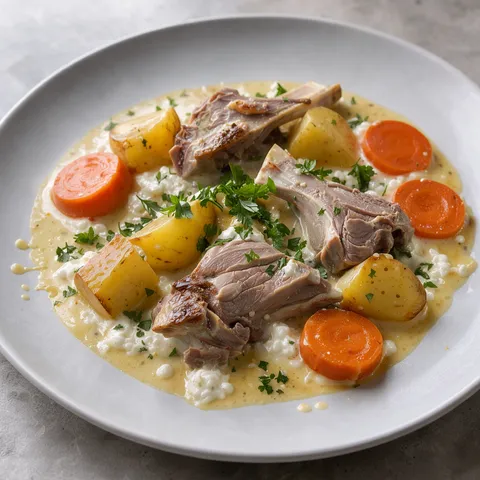 Montenegrin Lamb Braised in Milk2 hr 30 min · Main course
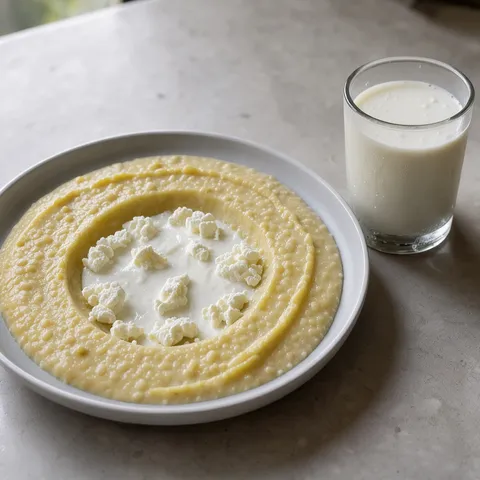 Montenegrin Potato Cornmeal Porridge1 hr 5 min · Main course
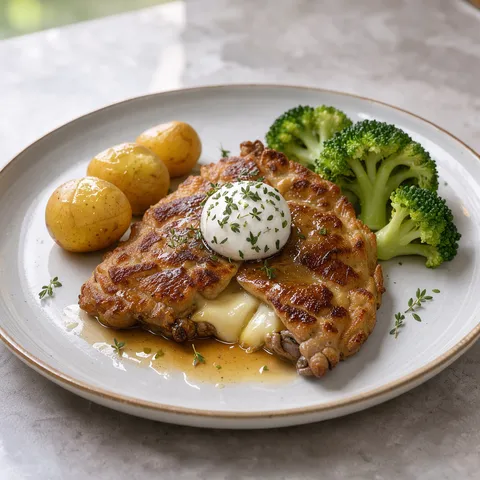 Montenegrin Stuffed Beef Steak1 hr · Main course
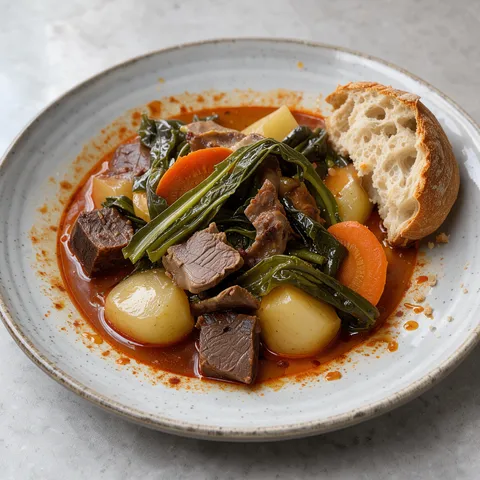 Montenegrin Kale and Lamb Stew1 hr 40 min · Main course
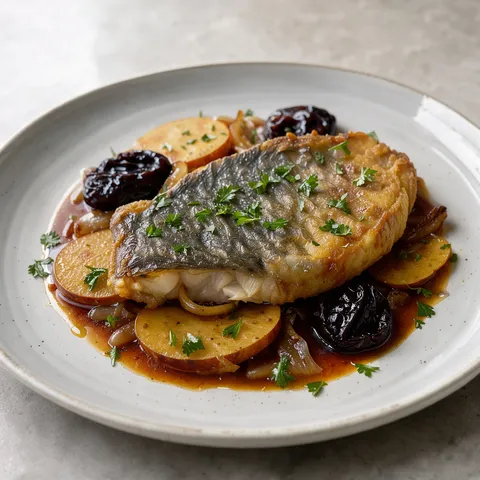 Baked Carp from Lake Skadar1 hr 40 min · Main course
 Skewer-Rolled Montenegrin Pasta1 hr 30 min · Main course
 Perast Almond Meringue Lattice Tart1 hr 35 min · Dessert