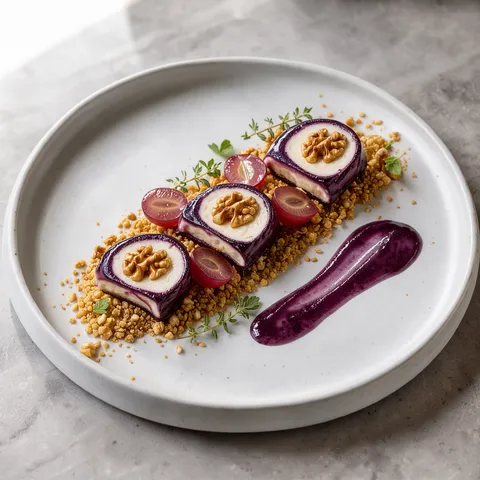
Churchkhela 2.0
A Georgian dessert. Takes 1 hr 30 min, 4 servings (2 rolls, 12 slices). Difficulty: professional.
At a glance
- Total time
- 1 hr 30 min
- Serves
- 4 servings (2 rolls, 12 slices)
- Difficulty
- Professional
- Cuisine
- Georgian cuisine
- Dish type
- Dessert
- Diet
- Vegetarian
- Allergens
- Gluten, Milk, Tree nuts
Ingredients
Grape must
- 1.5 kg sweet
- ripe black grapes (gives about 800 ml of must)
Must sheet
- 350 ml must (from above)
- 3 g agar agar
- 1 tbsp sugar (only if the must is not very sweet)
Hot tatara sauce
- 250 ml must (from above)
- 15 g plain flour
- 1/4 tsp cinnamon
Caramelised walnuts
- 100 g whole walnut halves
- 60 g sugar
- 20 ml water
- a pinch of salt
Walnut cream
- 120 g walnuts (shelled)
- 50 g caster sugar
- a pinch of salt
- 300 ml whipping cream (35% fat, cold)
- 1/4 tsp cinnamon
Walnut crumble
- 40 g plain flour
- 30 g light brown sugar
- 30 g walnuts (finely ground)
- 30 g butter (cold)
- a pinch of salt
Grape salad
- 12 seedless red grapes (halved)
- 1 tsp lemon juice
- a few fresh thyme leaves or micro mint
Equipment
- Blender
- Muslin
- Oven
- Baking tray
- Frying pan
- Sugar thermometer
- Baking paper
- Balloon whisk
- Acetate strip
- Food processor
- Hand mixer
- Silicone spatula
- Piping bag
- Chef's knife
- Saucepan
- Piping nozzles
Method
- Extract the must (0-12 min): Wash the grapes and remove the stalks. Blitz in a blender for 10-15 sec, roughly, without breaking the seeds. Pass the purée through a sieve lined with muslin and twist the muslin to squeeze it: you should get about 800 ml of must. Broken seeds make the must bitter, so blend only briefly
- Start the oven and crumble (12-30 min): Set the oven to 170°C. Rub the flour, brown sugar, ground walnuts, salt and cold butter together with your fingertips into crumbs, spread on a tray and bake for 12-14 min, until golden. Toast the 120 g walnuts for the walnut cream on a separate tray in the same oven for 8 min
- Caramelise the walnuts (15-25 min): Boil the sugar and water in a frying pan. At 118°C, add the walnut halves and stir constantly until the sugar crystallises and then melts again, turning amber. Add the salt and pour onto baking paper, separating the walnuts one by one. These walnuts will be lined up in the centre of the roll and recreate, in cross-section, the walnuts threaded on string in the classic
- Reduce the must (15-35 min, in parallel): For the sheet, boil the 350 ml must in a wide frying pan over high heat for 15 min, until about 250 ml remains. Boiling concentrates the sugar and colour, and the sheet turns deep purple and glossy
- Pour the must sheet (35-50 min): Whisk the agar, and the sugar if needed, into the reduced must and hold at the boil for 2 min: agar only dissolves when boiled. Pour quickly onto a flat 30×40 cm tray lined with acetate and tilt the tray to spread it evenly 2 mm thick. As agar starts to set at 35-40°C, the pouring must be done while hot, within a few seconds. Leave the tray on a flat surface at room temperature for 10 min, then in the fridge for 5 min. It should be a flexible sheet that does not stick when touched. The floury tatara dipped layer by layer in the classic becomes a single thin must sheet here
- Make the walnut cream (30-45 min): Blitz the hot toasted walnuts with the sugar and salt in a food processor for 4-5 min, first to sand, then to a runny walnut paste (praline). Whip the cold cream with the cinnamon to soft peaks. Stir a third of the paste into the cream to loosen it, then fold in the rest with a spatula. The cream should hold stiff peaks. Transfer to a piping bag (1.5 cm plain nozzle) and firm up in the fridge for 10 min
- Cook the hot tatara sauce (50-58 min): Mix the flour smoothly with a little of the cold must, then add the remaining must and the cinnamon. Cook over low heat, whisking constantly, for 6-8 min, until it becomes a glossy, thick sauce that coats the back of a spoon. This is the tatara of classic churchkhela itself, and it comes to the plate hot
- Roll up (58-72 min): Transfer the must sheet with its acetate to the worktop and cut it into two equal long strips (about 30×12 cm). Pipe a 3 cm thick line of walnut cream along each strip, 2 cm in from a long edge. Press the caramelised walnuts end to end along the very centre of the cream, touching each other, and cover with a thin line of cream. Using the acetate, lift the sheet over the cream and roll it up, so that the edges overlap by 1 cm underneath. Firm up the rolls, wrapped in the acetate, in the fridge for 10 min
- Grape salad (72-75 min): Mix the grape halves with the lemon juice and thyme leaves
- Cut (75-80 min): Trim the ends of the rolls and, with a thin knife dipped in hot water and wiped dry, cut each roll diagonally into 6 slices. The cross-section should show the deep purple must shell, the white walnut cream and the caramelised walnut in the centre
- Plate (80-88 min): Sprinkle a spoonful of walnut crumble in a diagonal line across a cold, matt white plate. Arrange three slices of roll on the crumble, cut faces up and facing forward, with 2 cm between them
- Finish: Pour a spoonful of hot tatara sauce onto the plate beside the slices and drag it into a short teardrop with the back of the spoon. Put a few grape halves from the salad between the slices, set a caramelised walnut at the end of the crumble and finish with thyme or micro mint leaves. Serve immediately to keep the contrast between the hot sauce and the cold cream
Chef's note
The identity of the classic is kept: walnuts in a row, a grape must shell and a light cinnamon spice. The novelty lies in texture and temperature: a thin agar must sheet that sets in minutes instead of tatara layers that dry for days, a light walnut cream around the walnuts, and the classic tatara itself as a hot sauce. The cross-section of the slices is designed to imitate the classic cross-section of walnuts threaded on string. Agar starts to set at 35-40°C, so pour the must boiling hot and fast: if it waits in the pan, it turns lumpy. If the sheet cracks when rolled, reduce the agar to 2.5 g next time. If the roll stands for more than 2 hr, the sheet draws water from the cream and softens, so serve it the same day. Serves 4.
Frequently asked questions
- Why are the grapes blended briefly for the must in Churchkhela 2.0?
- Blend the grapes for 10-15 seconds, until roughly crushed but with the pips left whole. Broken pips make the must bitter. The purée is strained through muslin and squeezed to give about 800 ml of must.
- Why must the must sheet be poured quickly?
- Agar starts to set at 35-40°C, so the reduced must is poured hot onto a tray lined with acetate and spread to 2 mm thick. This has to be done within seconds. After 10 minutes at room temperature or 5 in the fridge, the sheet becomes non-sticky and flexible.
- How do you slice the roll cleanly?
- Wrapped in acetate, the rolls are firmed up in the fridge for 10 minutes. Then the ends are trimmed and the roll is cut into 6 diagonal slices with a thin knife dipped in hot water and wiped dry. The cross-section shows a purple must shell, white cream and a caramelised walnut in the middle.
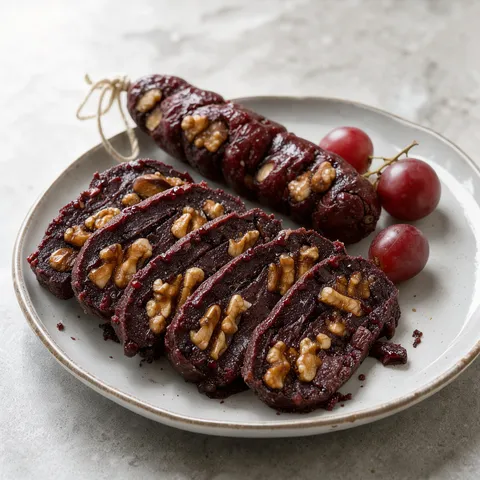 Churchkhela3 hr · Dessert
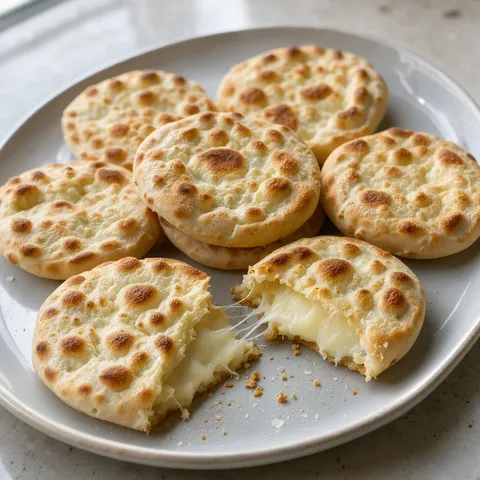 Mini Imeruli Khachapuri1 hr · Meze
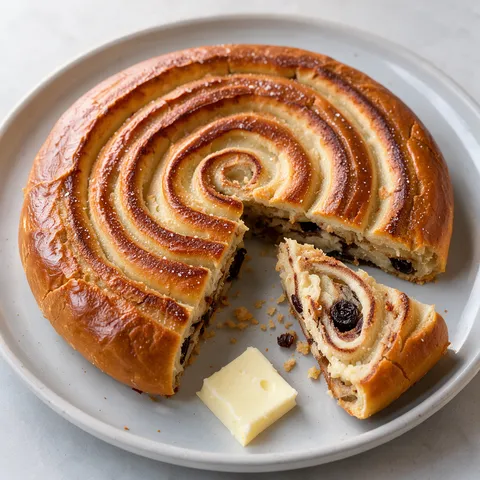 Georgian Cinnamon Raisin Bread1 hr 7 min · Breakfast
 Georgian Sour Plum Sauce52 min · Sauce
 Abkhazian Chilli Garlic Paste26 min · Sauce
 Svan Lamb and Beef Pastries 5.5 cm1 hr 37 min · Meze
 Khachapuri Adjaruli2 hr 15 min · Bread & pastry