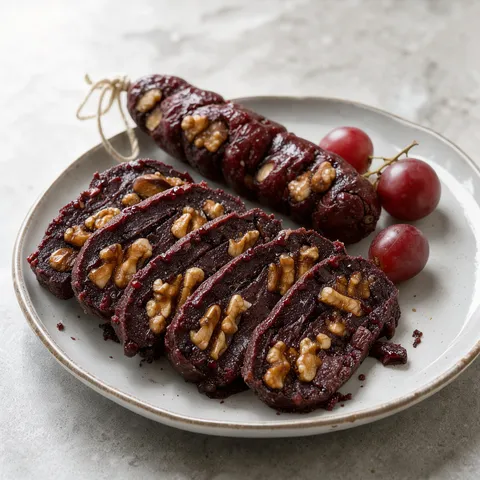
Churchkhela Georgian Walnut and Grape Must Sweet
A Georgian dessert. Takes 3 hr · +7-10 days drying, 4 pieces (about 35 cm). Difficulty: challenging.
At a glance
- Total time
- 3 hr · +7-10 days drying
- Serves
- 4 pieces (about 35 cm)
- Difficulty
- Challenging
- Cuisine
- Georgian cuisine
- Dish type
- Dessert
- Diet
- Vegetarian, Vegan
- Allergens
- Gluten, Tree nuts, Sulphites
Ingredients
Walnut strings
- 300 g whole shelled walnuts (in unbroken halves)
- thick cotton string (4 lengths of 60 cm)
- a thick sewing needle
Grape must
- 3.5 kg sweet
- ripe black or white wine grapes (gives about 2 litres of must)
Tatara (thick grape must jelly)
- 2 litres fresh must (from above)
- 180 g plain flour (sifted)
- 1 tbsp caster sugar (only if the must is not very sweet)
- 1 tsp cinnamon (optional). Makes 4 churchkhela of about 35 cm
Equipment
- Blender
- Muslin
- Saucepan
- Mixing bowls
- Balloon whisk
- Wooden spoon / spatula
- Baking tray
- Fine sieve / chinois (optional)
Method
- Thread the walnuts: Tie a large knot at one end of the string. Pass the needle through the centre of each walnut half from its soft side and thread the walnuts tightly together along about 25-30 cm. Leave 10 cm free, with a loop at the top end for hanging. The walnuts must be threaded without gaps: if gaps are left, the churchkhela breaks
- Extract the must: Wash the grapes and remove the stalks. Blitz in batches in a blender for 10-15 sec, roughly, without breaking the seeds. Broken seeds make the must bitter. Pass the purée through a sieve lined with muslin and twist the muslin to squeeze it: you should get about 2 litres of cloudy, sweet must. Leave to settle for 15 min, then take the must off the top, leaving the sediment behind
- Prepare the must: Put the must in a wide saucepan. Set aside a glassful and leave it cold. Bring the rest to the boil, skim off the foam that rises and boil over medium heat for 25-30 min, until the volume of must has reduced by about a quarter. Boiling raises the sugar concentration and makes the jelly set faster
- Dissolve the flour: Gradually whisk the flour into the reserved cold must to make a lump-free, smooth slurry. Pass through a fine sieve if needed. Dry flour added to hot must turns lumpy
- Cook the tatara: Lower the heat. Add the flour slurry to the hot must in a thin stream, whisking constantly. Cook over low heat for 20-25 min, scraping the base with a wooden spoon. The jelly is ready when it has thickened and turned glossy, coats the back of a spoon in a thick layer and a line drawn with the spoon does not close immediately. Add the cinnamon now, if using
- Let cool slightly: Take the tatara off the heat and let it cool for 10 min, to about 60-70°C. Jelly that is too hot does not cling to the walnuts and runs off, while jelly that is too cold turns lumpy
- First dip: Hold the walnut string by its loop, dip it completely into the jelly and pull it out slowly. Hold it over the pan for a few seconds so that the excess drips off, then hang it by its loop from a stick. Put a tray underneath to catch the drips
- Coat in layers: When the surface of each layer is firm enough not to stick to your hand (about 15-20 min), dip again. Repeat 3-4 times: the final thickness should be about 1 cm. The shapes of the walnuts should show faintly on the surface, but no walnut should be left exposed
- Dry: Hang the churchkhela in a cool, airy, shady place for 7-10 days. They are ready when the surface has dried and turned matt and gives slightly when pressed with a finger without sticking. The inside should still be soft and chewy. If dried somewhere humid, mould may form on the surface
- Store: Wrap the dried churchkhela in paper bags or cotton cloth: they keep for months in a cool, dry place. Over time a fine white sugar bloom forms on them, which is natural
- Plate: Pull the string out of a churchkhela and slice it diagonally 1.5 cm thick. Fan the slices out on a white plate, cut faces up, so that the cross-section of walnut shows inside the dark grape-coloured coating. Put a whole churchkhela and a few grapes alongside
Chef's note
Churchkhela is the sweet of the autumn grape harvest (rtveli) in Georgia, and it is also known as the provision soldiers carried with them. In Kakheti it is made pale with white must, and in Imereti it is also made with hazelnuts. The sweeter the must, the glossier the jelly, so choose wine grapes or very ripe grapes rather than sour table grapes. It takes patience: the more even the layers, the more beautiful the cross-section.
Frequently asked questions
- How is churchkhela dried?
- Hang it in a cool, airy, shady place for 7-10 days. If dried in a damp place, mould can form on the surface.
- How do I know the tatara jelly is ready?
- The jelly thickens and turns glossy, coating the back of the spoon in a thick layer. A trail drawn with the spoon shouldn't close at once.
- Is the white powder on churchkhela mould?
- No. The thin white sugar dust that forms on it over time is natural.
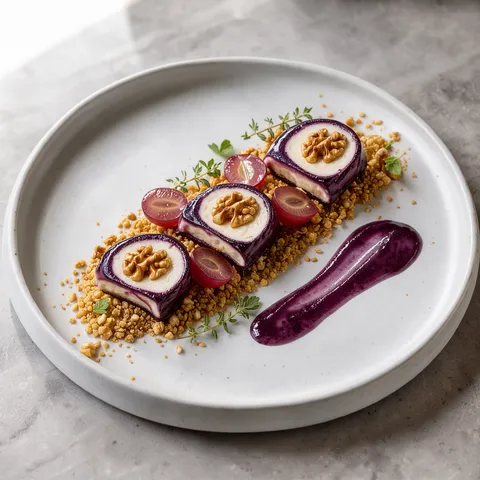 Churchkhela 2.01 hr 30 min · Dessert
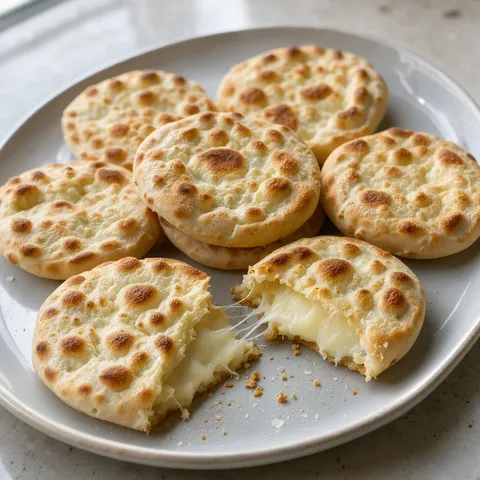 Mini Imeruli Khachapuri1 hr · Meze
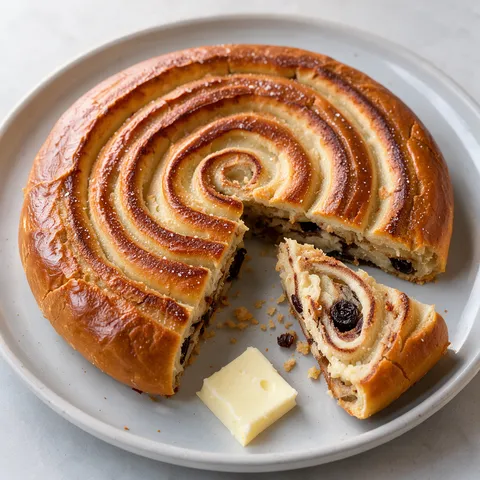 Georgian Cinnamon Raisin Bread1 hr 7 min · Breakfast
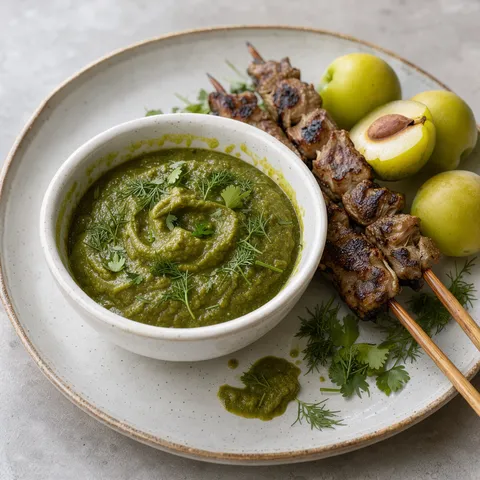 Georgian Sour Plum Sauce52 min · Sauce
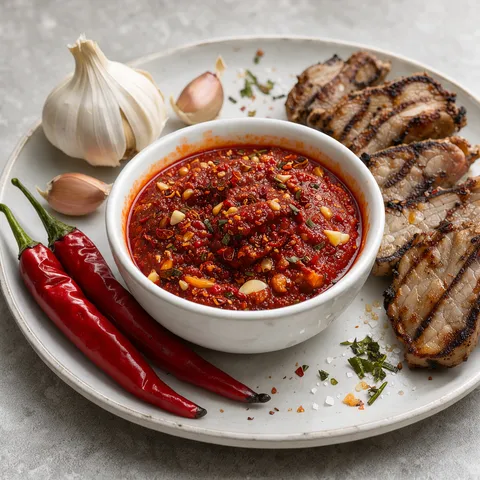 Abkhazian Chilli Garlic Paste26 min · Sauce
 Svan Lamb and Beef Pastries 5.5 cm1 hr 37 min · Meze
 Khachapuri Adjaruli2 hr 15 min · Bread & pastry