
Tiny Lamb Dumpling Soup Dusbere
An Azerbaijani soup. Takes 1 hr 50 min (pressure cooker: ~1 hr 25 min), Serves 4. Difficulty: challenging.
At a glance
- Total time
- 1 hr 50 min (pressure cooker: ~1 hr 25 min)
- Serves
- Serves 4
- Difficulty
- Challenging
- Cuisine
- Azerbaijani cuisine
- Dish type
- Soup
- Allergens
- Gluten, Milk, Eggs
Ingredients
Lamb stock
- 800 g lamb bones (neck and ribs, with meat on)
- 2.2 litres cold water
- 1 onion (halved)
- 2 bay leaves
- 6 black peppercorns
- 1 tsp salt
Dough
- 300 g plain flour
- 1 egg
- 110 ml cold water
- 1/2 tsp salt
- 3-4 tbsp plain flour for rolling
Filling
- 300 g fatty lamb mince (leg and breast mixed, minced twice)
- 1 small onion (80 g)
- 1/2 tsp salt
- 1/2 tsp black pepper
- 1/2 tsp dried mint
To serve
- 2 tsp dried mint
- 4 garlic cloves
- 80 ml grape vinegar
- 1/2 bunch coriander (optional)
Equipment
- Saucepan
- Ladle
- Box grater
- Mixing bowls
- Muslin
- Fine sieve / chinois
- Cling film
- Rolling pin / oklava
- Chef's knife
- Chopping board
- Baking tray
- Pestle and mortar
- Pressure cooker (optional)
Method
- Make the stock: Put the bones in a saucepan, add the cold water and bring to the boil over medium heat. Skim off the grey foam that rises to the surface constantly for 10 min: if foam remains, the soup turns cloudy and the fine dough of the dushbere cannot be seen. Add the onion, bay leaves, peppercorns and salt, lower the heat and simmer gently for 1 hr with the lid ajar. In a pressure cooker this drops to 30 min. The stock is ready when the meat comes away from the bones easily
- Knead the dough: While the stock cooks, combine the flour, egg, salt and water in a bowl. Knead for 8 min, until smooth, firm but elastic. Dushbere dough is slightly firmer than manti dough: a soft dough sticks when rolled and falls apart when cooked. Wrap in cling film and rest at room temperature for 30 min: once the gluten relaxes, the dough rolls out to 1 mm without tearing
- Make the filling: Grate the onion, put it in muslin and squeeze out the juice thoroughly. Wet onion makes the filling soggy and the tiny parcels will not seal. Knead the mince with the onion, salt, pepper and dried mint for 2 min: the mixture should be sticky and hold together. Keep in the fridge until needed
- Strain the stock: Strain the cooked stock through a fine sieve into a clean saucepan and check the seasoning. If you want to pick the meat off the bones, shred it and keep it separate. Keep the stock hot over low heat while you roll out the dough
- Roll out and cut: Divide the dough into four and roll each piece out on a floured surface with a rolling pin to 1 mm: the pattern of the work surface should almost show through. Cut into 2.5 cm squares with a sharp knife. Cover the rolled dough with a damp cloth so it does not dry out
- Shape the ears: Put a piece of filling the size of half a chickpea in the centre of each square. Fold the square into a triangle and press the edges with your fingertip to seal without trapping air. Wrap the two end corners of the triangle around your index finger and press them together, one over the other, to form a tiny ear shape. Traditionally 8-10 dushbere should fit on a tablespoon. Arrange the finished dushbere on a floured tray, not touching. With two people this takes 25-30 min
- Cook: Bring the stock back to the boil and add the dushbere all at once, stirring so they do not stick to the bottom. Once they rise to the surface, cook for another 3-4 min, 6-7 min in total. Cut one open to check: the filling should be grey and firm and the edge of the dough soft. The internal temperature of the mince should exceed 72°C: with dushbere this size, this is reached 3 min after they float
- Garlic vinegar: Crush the garlic with a pinch of salt in a mortar and mix with the vinegar. This mixture balances the rich stock of the dushbere: at the table a few drops are added to each spoonful
- Plate: Divide plenty of dushbere and hot stock between deep bowls: the stock should only just cover the dushbere. Crush the dried mint between your fingertips over the top and add a few coriander leaves if you like. Serve the garlic vinegar in a small bowl alongside and serve immediately
Chef's note
In Baku and Ganja the skill of a dushbere maker is measured by size: the smaller, the more prized. Do not skip resting the dough before rolling, or it will not roll thin. You can freeze extra uncooked dushbere on a tray and transfer them to a bag: they go straight into boiling water from frozen and need 2 min longer.
Frequently asked questions
- Why does the Dusbere stock turn cloudy?
- If the grey foam rising to the surface of the bones as they come to the boil isn't skimmed constantly for 10 minutes, the soup turns cloudy. Cloudy stock hides the thin dough of the dusbere. Then add the onion, bay leaves, peppercorns and salt and simmer gently for 1 hour.
- Why might Dusbere not stay closed?
- A watery onion filling soaks the dough and the little parcels won't close. So squeeze the juice out of the grated onion thoroughly in muslin. Also press the edges of the triangle closed with a fingertip so no air is left inside.
- How should Dusbere dough be rolled?
- The dough is kneaded slightly firmer than dumpling dough, rested for 30 minutes and rolled to 1 mm thick. You should almost be able to see the pattern of the worktop beneath it. Then cut it into 2.5 cm squares.
 Dusbere 2.01 hr 30 min · Soup
 Shah Plov3 hr · Main course
 Azerbaijani Herb-Filled Flatbreads1 hr 20 min · Bread & pastry
 Sheki-Style, Cooked in Clay Pots4 hr 45 min · Soup
 Lankaran-Style Chicken with Walnuts2 hr · Main course
 Layered Novruz Pastries with Fennel and Turmeric2 hr 55 min · Bread & pastry
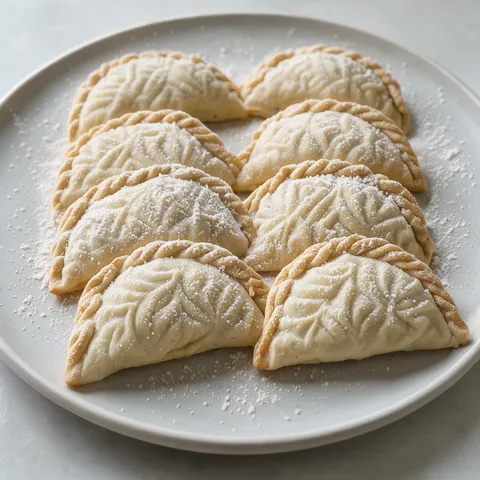 Novruz Pastries with Almonds and Cardamom2 hr 10 min · Dessert