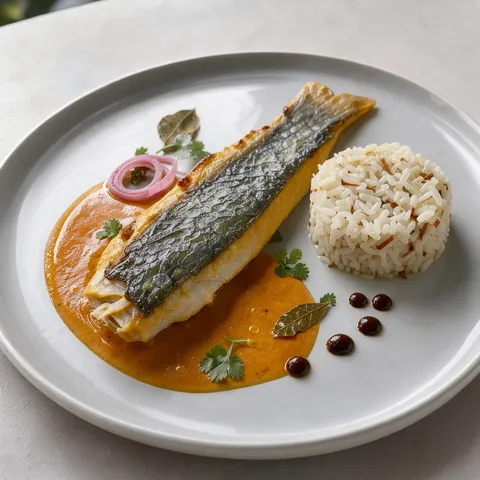
Goan Fish Curry 2.0
An Indian main course. Takes 1 hr 20 min, Serves 4. Difficulty: challenging.
At a glance
- Total time
- 1 hr 20 min
- Serves
- Serves 4
- Difficulty
- Challenging
- Cuisine
- Indian cuisine
- Dish type
- Main course
- Diet
- Gluten-free
- Allergens
- Milk, Fish, Tree nuts
Ingredients
Fish
- 4 skin-on sea bass fillets (about 140 g each)
- 1/2 tsp salt
- 1/4 tsp ground turmeric
- 1 tbsp sunflower oil
Hooman sauce
- 6 dried Kashmiri chillies (stalks removed)
- 2 tsp coriander seeds
- 1/2 tsp cumin seeds
- 4 black peppercorns
- 100 g freshly grated coconut
- 3 garlic cloves
- 2 cm piece of fresh ginger
- 1/4 tsp ground turmeric
- 350 ml water
- 1 tbsp coconut oil
- 2 shallots (finely chopped)
- 1/2 tsp salt
- 15 g cold butter
Tamarind gastrique
- 30 g tamarind
- 120 ml hot water
- 25 g palm sugar or light brown sugar
- a pinch of salt
Coconut rice
- 200 g basmati rice
- 1 litre water (for rinsing and soaking)
- 1 tbsp coconut oil
- 200 ml unsweetened coconut milk
- 120 ml water
- 1/2 tsp salt
Quick pickled shallots
- 2 shallots (sliced into very thin rings)
- 3 tbsp grape vinegar
- 1 tsp sugar
- a pinch of salt
Crispy curry leaves
- 100 ml sunflower oil
- 20 curry leaves (or 3 very thinly sliced garlic cloves if unavailable)
To finish
- 8-10 fresh coriander leaves
Equipment
- Mixing bowls
- Frying pan
- Blender
- Saucepan
- Fine sieve / chinois
- Ladle
- Squeezy bottle
- Probe thermometer
- Colander
- Chef's knife
- Cast-iron frying pan
- Palette knife
- Balloon whisk
- Cake ring / food ring
Method
- Plan the workflow and soak the rice: The order is: rice and pickle, masala, sauce, tamarind, coconut rice and curry leaves, fish, finishing the sauce and plating, 80 min in total. Rinse the rice in a bowl 3-4 times until the water runs clear and soak it in fresh water for 20 min. Mix the shallot rings with the vinegar, sugar and salt in a small bowl. Within 20 min they turn pink and soften, and their sharp tang cuts through the rich creaminess of the curry
- Grind the masala: In a dry 20 cm frying pan, toast the Kashmiri chillies, coriander seeds, cumin and peppercorns over medium-low heat for 2 min, until the coriander is a shade darker. Transfer to a blender with the coconut, garlic, ginger, turmeric and 350 ml water and blend for 3 min until completely smooth. It should be a creamy orange paste, as in the classic curry
- Cook the sauce: Heat the coconut oil in a 20 cm saucepan over medium heat and soften the shallots for 3 min. Add the masala and 1/2 tsp salt, bring to the boil and simmer over low heat for 12 min, stirring now and then. It is ready when the raw garlic smell has gone and rings of orange oil appear on the surface
- Strain the sauce: Pour the sauce through a fine sieve into a jug, pressing the pulp firmly with the back of a ladle. You will have about 300 ml silky sauce, and the pulp is discarded. Return the sauce to the pan and set aside, covered. The grainy texture of the classic curry becomes a velvety velouté here, forming the base of the plate
- Make the tamarind gastrique: Soak the tamarind in the 120 ml hot water for 10 min, mash it and push it through a fine sieve into a small saucepan. Add the palm sugar and salt and boil over medium heat for 6-8 min, until reduced by more than half and syrupy enough to coat the back of a spoon. It is ready when a drop holds its shape on a cold plate without spreading. Once it has cooled slightly, transfer to a squeeze bottle
- Cook the coconut rice: Drain the rice. Heat the coconut oil in an 18 cm saucepan over medium heat and stir the rice in it for 1 min. Add the coconut milk, 120 ml water and the salt, and once it boils, cover and cook over the lowest heat for 12 min. Take off the heat and leave to steam, without lifting the lid, for 5 min. The grains should be separate, glossy and slightly sweet
- Fry the curry leaves: When the gastrique is done, heat the 100 ml oil (about 5 mm deep) in a small 16 cm saucepan on the same burner to 170°C on a thermometer. Add the dry curry leaves and fry for 10-15 sec, until the sizzling stops and they are translucent and crisp, then lift onto kitchen paper with a slotted spoon. Strain the oil and keep it
- Crisp the fish skin: Pat the skin of the fillets completely dry with kitchen paper and make three shallow cuts in the skin, 1 cm apart, with a chef's knife. Rub the flesh side with the salt and turmeric and sprinkle just a pinch of salt on the skin. Heat the 1 tbsp oil in a 28 cm cast-iron frying pan over medium-high heat, lay the fillets in skin side down and press them with a fish slice for the first 30 sec so the skin does not curl. Cook for 5-6 min, until three-quarters of the flesh has turned opaque and the skin is golden and glassy-crisp. Turn, switch off the heat and leave for 1 min in the residual heat. The thickest part should read 63°C on a thermometer
- Finish the sauce: Heat the sauce over low heat until steaming, without letting it boil. Take off the heat and whisk in the cold butter. The butter gives the sauce a gloss and a rounded texture, but it splits if boiled
- Plate: On one side of a warm, shallow plate, press the rice into an 8 cm pastry ring to form a cylinder and lift off the ring. Pour 4 tbsp sauce into the centre of the plate. Lay the fish skin side up on the sauce, leaning against the rice. Dot five points of gastrique on the sauce, and arrange three rings of pickled shallot, a few crispy curry leaves and the coriander leaves on the fish. Serve immediately, as the skin softens the longer it touches the sauce
Chef's note
Goa's everyday hooman (fish curry) keeps its flavours intact here: toasted Kashmiri chillies, coconut and the sourness of tamarind. The innovation lies in the texture: the sauce is strained and finished with butter into a velouté, the fish is cooked with crisp skin rather than poached in the sauce, the tamarind is dotted around the plate as a separate glossy gastrique, and the rice that sits on every Goan table arrives as a cylinder cooked in coconut milk. Tamarind is used because kokum is hard to find. Coconut milk and coconut oil are traditionally bought ready-made.
Frequently asked questions
- Why is the Goan sauce strained?
- Pressing the sauce through a fine sieve and discarding the pulp gives a silky texture. The grainy texture of the classic curry becomes a velvety velouté.
- Why isn't the butter sauce boiled?
- Butter gives the sauce gloss and a round texture, but it splits if boiled. Heat the sauce, take it off the heat and whisk in the butter.
- How do you get the sea bass skin crisp?
- Dry the skin, score it three times shallowly and press it down with a spatula for 30 seconds as soon as it goes into the pan. Take the fish off at an internal temperature of 63°C.
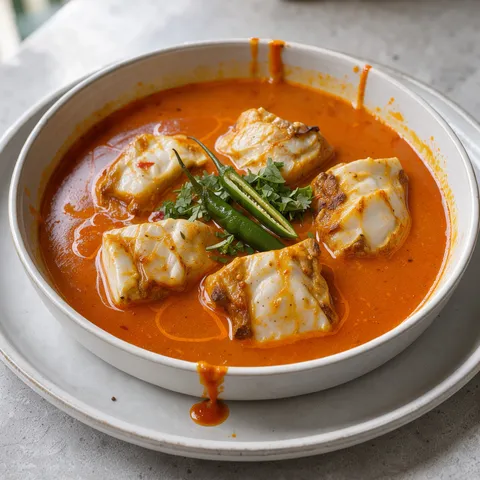 Coconut and Tamarind Fish Curry50 min · Main course
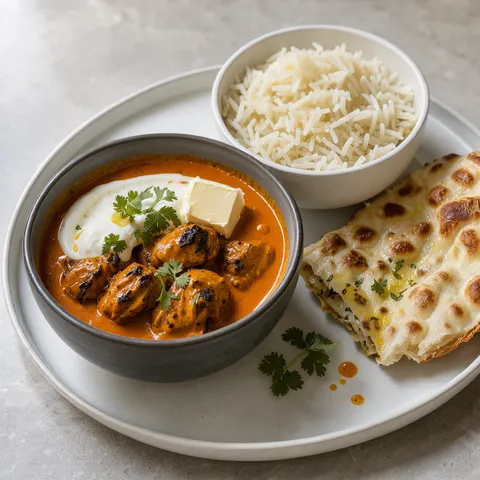 Indian Butter Chicken50 min · Main course
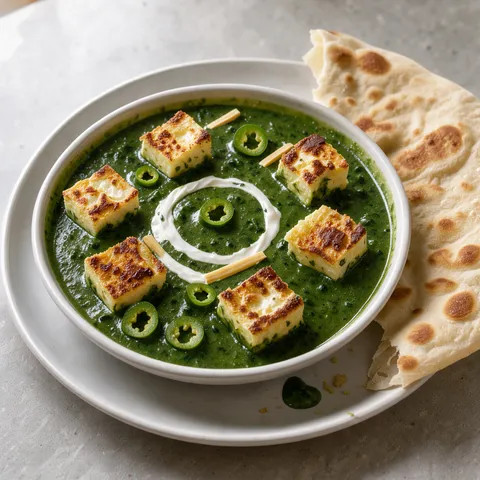 Spinach with Homemade Paneer45 min · Main course
 Black Lentil and Kidney Bean Stew1 hr 30 min · Main course
 Chicken Dum Biryani1 hr 30 min · Main course
 Indian Potato Pastries1 hr 30 min · Bread & pastry
 Fermented Rice Crêpes with Spiced Potato50 min · Bread & pastry