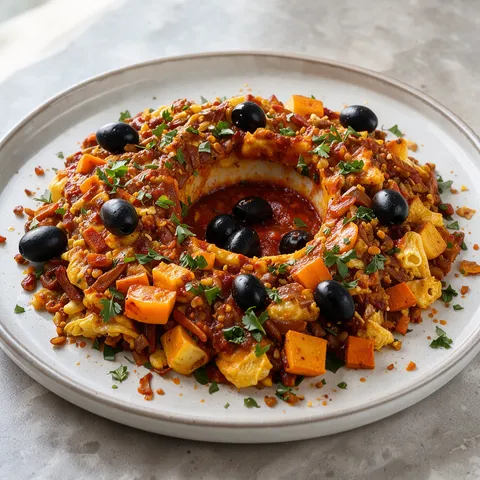
Tunisian Chopped Fried Vegetables and Eggs Kafteji
A Tunisian meze. Takes 1 hr 10 min, Serves 4. Difficulty: medium.
At a glance
- Total time
- 1 hr 10 min
- Serves
- Serves 4
- Difficulty
- Medium
- Cuisine
- Tunisian cuisine
- Dish type
- Meze
- Diet
- Gluten-free
- Allergens
- Eggs
Ingredients
Vegetables
- 400 g potatoes (1.5 cm cubes)
- 300 g pumpkin (1.5 cm cubes)
- 1 courgette (about 200 g, 1.5 cm cubes)
- 4 green Charleston or long green peppers (about 250 g)
- 1 hot green chilli
- 2 tomatoes (about 250 g, quartered)
Eggs
- 4 eggs
Sauce
- 1 tbsp harissa (Basics)
- 1/2 tsp coriander seeds and 1/2 tsp caraway seeds (for the tabil, pounded)
- 2 garlic cloves
- 1 tsp salt
- 1/2 tsp black pepper
- 2 tbsp strained warm frying oil (from the oil below)
Frying
- 1.7 litres sunflower oil (for a 22 cm pan)
To serve
- 8 black olives
- 1 tbsp finely chopped parsley
Equipment
- Saucepan
- Probe thermometer
- Colander
- Chef's knife
- Chopping board
- Mixing bowls
Method
- Cut and dry: Cut the potatoes, pumpkin and courgette into 1.5 cm cubes. Prick each pepper 2-3 times with a cocktail stick so the steam inside does not burst when frying. Dry all the vegetables thoroughly with kitchen paper, as water left on the surface splatters the hot oil and boils the vegetables instead of frying them
- Heat the oil: Put 1.7 litres oil in a 22 cm pan, giving about 4.5 cm depth. Bring to 160°C over medium heat, checking with a thermometer
- Fry the potatoes: Fry the potatoes in 2 batches for 8-9 min, until light golden and easily pierced with a knife in the middle. Lift out with a slotted spoon. 160°C stops the outside of the potato darkening before the inside has cooked
- Fry the pumpkin and courgette: Raise the oil to 170°C. Fry the pumpkin for 5-6 min, until the edges caramelise and soften, and the courgette in a separate batch for 3-4 min, until light golden. Do not leave the courgette too long, as it releases its water and falls apart
- Fry the peppers and tomatoes: Lower the whole peppers into the oil, holding the pan lid at an angle to protect against splashes. Fry for 2-3 min, until the skins blister and turn brown in places. Fry the tomato quarters for 1-2 min, until the skins wrinkle. Once the peppers have cooled slightly, peel them and remove the stalks and seeds, and discard the tomato skins
- Fry the eggs: Make sure the oil is at 170°C. Crack each egg into a small bowl first, then slide it onto the surface of the oil. Fry for 1.5-2 min, until the white is crisp at the edges and the yolk is set, turning once in the middle with a slotted spoon. Transfer to kitchen paper. Four eggs, one at a time, take about 8 min
- Chop the sauce on the board: On a large chopping board chop the peeled peppers, tomatoes, garlic, harissa, tabil, salt and pepper finely together with a chef's knife. The chopping action turns peppers and tomatoes into a sauce, and this is the binder of kafteji
- Chop everything together: Add the potatoes, pumpkin, courgette and eggs on top of the sauce. Chop them with the knife like a coarse mince, mixing with the sauce so that pieces of about 1 cm remain, not a purée. Gloss with the 2 tbsp strained warm frying oil and taste for salt
- Plate: Spread the kafteji in a gentle dome on a serving plate and make a shallow well in the middle with the back of a spoon. Scatter the olives over and sprinkle with the parsley. Serve warm
Chef's note
Kafteji is a Tunisian street-food classic: at kafteji stalls the vegetables are fried in big cauldrons and chopped with a knife in front of the customer, and it is often eaten with fried liver or in bread. The name comes from the Arabic kafta (mince) and refers to the chopping technique. You can strain the frying oil through a fine sieve and use it once more for frying vegetables. For the harissa use the recipe in Basics. In some homes part of the potato is replaced with fried aubergine.
Frequently asked questions
- Why are the vegetables dried for kafteji?
- Water left on the surface makes the hot oil spit and boils the vegetables instead of frying them. So dry the vegetables well with kitchen paper.
- Why fry the potatoes at 160°C first?
- 160°C stops the potatoes browning on the outside before they are cooked inside. Fry them in 2 batches until pale golden and easily pierced with a knife.
- Why is kafteji chopped with a knife and not mashed?
- Chop the fried vegetables and eggs coarsely, like mince, with a knife on top of the sauce, leaving pieces of about 1 cm and not turning it into a purée. The chopping action turns the pepper and tomato into the sauce.
 Kafteji 2.01 hr 20 min · Starter
 Lablabi1 hr 45 min · Soup
 Tunisian Brik with Tuna and Egg40 min · Starter
 Tunisian Roasted Pepper and Tomato Salad1 hr 10 min · Meze
 Kesksi bil Hout2 hr · Main course
 Makroud1 hr 30 min · Dessert
 Kesksi bil Hout 2.01 hr 15 min · Main course