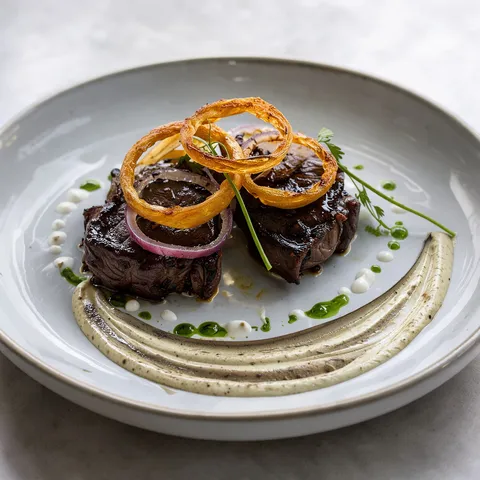
Kala Bhuna 2.0
A Bangladeshi main course. Takes 1 hr 30 min, Serves 4. Difficulty: challenging.
At a glance
- Total time
- 1 hr 30 min
- Serves
- Serves 4
- Difficulty
- Challenging
- Cuisine
- Bangladeshi cuisine
- Dish type
- Main course
- Diet
- Gluten-free
- Allergens
- Milk, Celery, Mustard, Sulphites
Ingredients
Beef cheeks
- 1 kg beef cheeks (sinew removed, 8 pieces, about 3 cm thick)
- 1.5 tsp salt
- 3 tbsp mustard oil
- 2 onions (roughly chopped)
- 2 tbsp ginger paste
- 1 tbsp garlic paste
- 1 tsp turmeric
- 600 ml Brown Beef Stock (Basics)
Kala bhuna masala
- 1 tbsp coriander seeds
- 1 tsp cumin seeds
- 1/2 tsp fennel seeds
- 1 tsp black peppercorns
- 4 green cardamom pods
- 2 black cardamom pods
- 4 cloves
- 3 cm cinnamon
- 5 dried red chillies
Black glaze
- all the cooking liquid
- 1 tsp palm sugar or light brown sugar
- 20 g cold butter
Charred aubergine cream
- 2 round aubergines (800 g)
- 2 tbsp mustard oil
- 1 garlic clove
- 1 tbsp lemon juice
- 50 g strained (Greek-style) yoghurt
- salt
Mustard yoghurt
- 150 g strained (Greek-style) yoghurt
- 1 tsp yellow mustard seeds (crushed in a mortar)
- 1 tsp mustard oil
- a pinch of salt
- 1 tsp lemon juice
Crispy onions
- 2 onions (in thin rings)
- 1 tbsp cornflour
- 300 ml neutral oil
Green oil
- 1/2 bunch coriander
- 2 green chillies
- 80 ml neutral oil
- salt
To finish
- 1 small red onion (in rings)
- 1/2 lemon (for rubbing the onion)
- coriander cress
- flaky salt
Equipment
- Frying pan
- Pestle and mortar
- Pressure cooker
- Mixing bowls
- Colander
- Blender
- Balloon whisk
- Squeezy bottle
- Muslin
- Saucepan
- Probe thermometer
Method
- Toast the masala: Toast all the whole spices in a dry frying pan over medium-low heat for 3 min, until the coriander seeds turn deep brown, then grind to a fine powder in a pestle and mortar. All the dark colour of the classic comes from this deep toasting
- Sear the cheeks: Salt the cheeks and pat them dry with kitchen paper. Heat the mustard oil in a pressure cooker until smoking, wait 1 min, then sear the cheeks for 2-3 min on each side, until a deep brown crust forms. Lift out and, in the same oil, cook the onions for 6-8 min until dark
- Pressure-cook: Add the ginger, garlic, turmeric and half the masala to the onions and fry for 1 min. Return the cheeks and pour in the hot stock. Close the lid, cook at high pressure for 28 min and quick-release the pressure. Cheek is a collagen-rich muscle: cut into 3 cm pieces and pressure-cooked, it reaches in 28 min the tenderness the classic takes hours to achieve. If a fork does not slide in without resistance, cook under pressure for another 5 min
- Char the aubergines: While the cheeks are under pressure, brush the aubergine skins with mustard oil and char directly over a flame for 12-15 min, until blackened on every side and collapsed inside. Sweat in a lidded container for 5 min, peel and drain the flesh in a colander for 5 min
- Blend the aubergine cream: Blend the drained aubergine with the garlic, lemon, yoghurt, mustard oil and salt for 1 min, to a silky, smoky cream. It should hold its shape on a spoon: if loose, cook off the liquid over low heat for 3-4 min. This carries the flavour of begun bhorta onto the plate as a smooth base
- Make the mustard yoghurt and green oil: Whisk the yoghurt with the crushed mustard seeds, mustard oil, salt and lemon and fill a squeeze bottle. Blend the coriander, green chillies, salt and the oil heated to 80°C for 1 min, then strain through muslin to leave a bright green oil
- Fry the crispy onions: Toss the onion rings in the cornflour, shake off the excess and fry in oil at 160°C for 4-5 min, until golden brown. Drain on kitchen paper and salt. The cornflour keeps the rings crisp without sticking together
- Reduce the black glaze: Carefully lift the cheeks out of the pan and keep warm. Strain the cooking liquid, skim off the fat and reduce it in a wide frying pan over high heat with the remaining masala and the palm sugar for 10-12 min, until 150 ml remains and it coats a spoon like syrup. Take off the heat and whisk in the cold butter to give it a shine
- Glaze the cheeks: Return the cheeks to the pan and turn them over medium heat for 3-4 min, constantly spooning the glaze over. The glaze should cling to the meat as an almost black, glossy coating: this stands in for the black layer scraped from the base of the pan in the classic. Leave each piece top side up and do not cut
- Plate: Spoon two spoonfuls of aubergine cream into the centre of a warm plate and draw a wide crescent with the back of the spoon. Sit two cheek pieces side by side on the crescent, glossy black side up, and spoon another spoonful of glaze from the pan over them
- Finish: Squeeze 4-5 large dots of mustard yoghurt around the cheeks and drop green oil between them. Pile the crispy onions high on top of the cheeks and arrange the lemon-rubbed red onion rings and coriander cress alongside. Sprinkle a pinch of flaky salt over the meat and serve immediately
Chef's note
The dark-toasted masala, mustard oil and meltingly tender beef of the classic are kept. Instead of the long frying, pressure-cooked cheek and a black glaze reduced from the cooking liquid are used. Begun bhorta comes onto the plate as a cream, and the onion and green chilli served alongside on the Bangladeshi table become crispy onions and green oil. The mustard yoghurt cuts the richness of the meat. In Türkiye, use mustard oil labelled for cooking; if unavailable, use sunflower oil plus 1/2 tsp mustard powder.
Frequently asked questions
- How long do beef cheeks take to soften in a pressure cooker?
- Pieces 3 cm thick soften in 28 minutes at high pressure. If a fork doesn't slide in without resistance, give them another 5 minutes under pressure.
- How is the black glaze made?
- Reduce the strained cooking liquid with the remaining masala and palm sugar in a wide pan to 150 ml, until it is a syrup that coats the back of a spoon. Take it off the heat and whisk in cold butter to make it glossy.
- Why are the crispy onion rings coated in starch?
- Starch keeps the rings crisp without them sticking together. Shake off the excess and fry them in oil at 160°C.
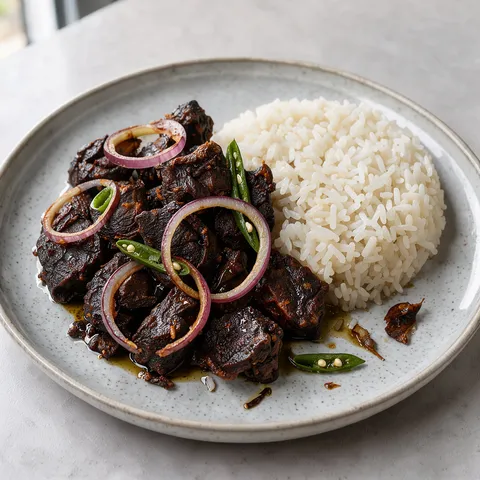 Chittagong-Style Dark-Fried Beef2 hr 30 min · Main course
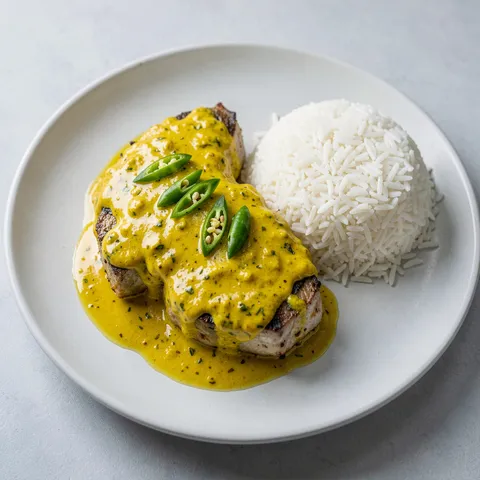 Bengali Hilsa in Mustard Sauce50 min · Main course
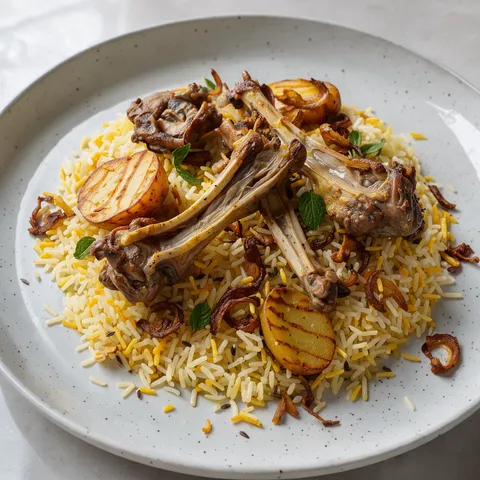 Dhaka-Style Biryani with Raw Marinated Lamb2 hr 15 min · Main course
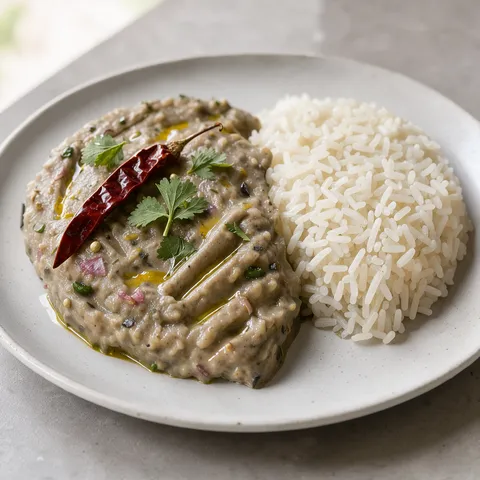 Charred Aubergine Mash with Mustard Oil35 min · Meze
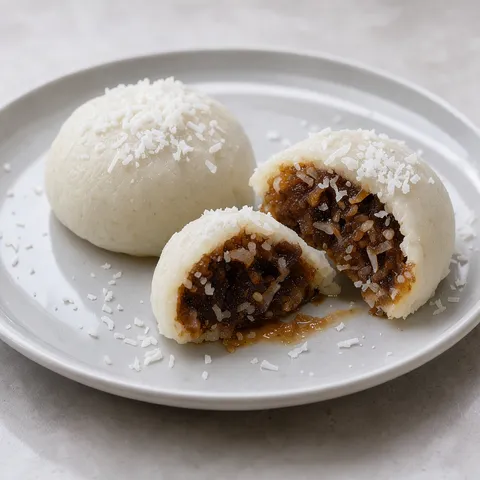 Steamed Rice Cakes with Date Palm Jaggery1 hr 5 min · Dessert
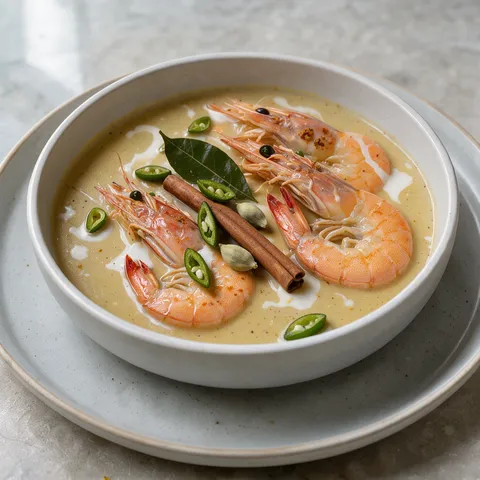 Bengali Prawn Curry with Coconut Milk45 min · Main course
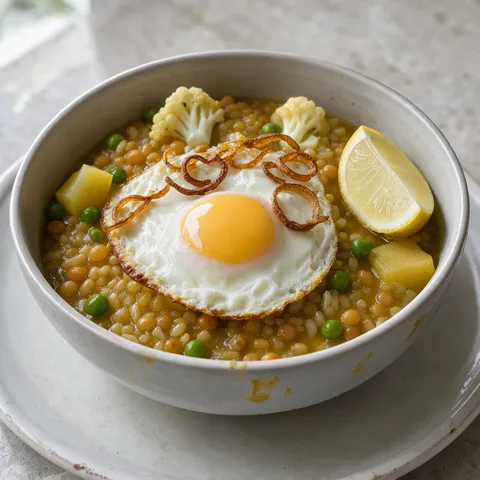 Bengali Rice and Lentil Stew46 min · Main course