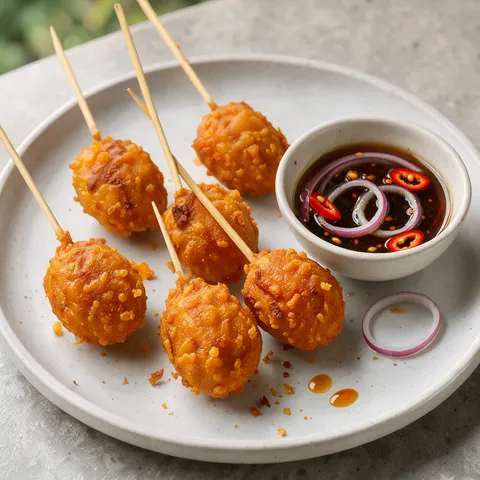
Filipino Orange-Battered Quail Eggs Kwek-Kwek
A Filipino meze. Takes 55 min, Makes 24. Difficulty: medium.
At a glance
- Total time
- 55 min
- Serves
- Makes 24
- Difficulty
- Medium
- Cuisine
- Filipino cuisine
- Dish type
- Meze
- Allergens
- Gluten, Milk, Eggs
Ingredients
- Eggs (24 pieces, about 9 g each once peeled): 24 quail's eggs
- 1 tbsp salt (for the boiling water)
- 2 tbsp cornflour (for dusting). Orange batter (about 350 g, about 12 g per piece): 100 g plain flour
- 50 g cornflour
- 1 tbsp sweet paprika (powder)
- 1/2 tsp turmeric
- 1/2 tsp fine salt
- 1/2 tsp baking powder
- 200 ml iced water
Frying
- 1 litre neutral oil. Spiced vinegar sauce (about 200 g, about 8 g per piece): 100 ml cider vinegar
- 50 ml water
- 1 small red onion (50 g, finely chopped)
- 2 garlic cloves (finely chopped)
- 1 green chilli (thinly sliced into rings)
- 1 tsp sugar
- 1/2 tsp salt
- 1/4 tsp black pepper
To finish
- 24 cocktail sticks
- 1 tbsp finely chopped spring onion (green part)
Equipment
- Saucepan
- Heavy-based saucepan
- Probe thermometer
- Mixing bowls
- Balloon whisk
- Colander
- Chef's knife
- Deep pan / deep-fat fryer (optional)
Method
- Make the vinegar sauce: Whisk the cider vinegar, water, sugar, salt and black pepper in a small bowl for 1 min, until the sugar dissolves. Add the onion, garlic and chilli and leave the sauce to stand until the frying is finished. The vinegar softens the sharpness of the onion and draws the flavour of the chilli into the liquid. Without this standing time the sauce stays flat and harsh. The sauce should be balanced between sweet and sour, and although the onion softens slightly it should keep its crunch
- Boil the eggs: Add the salt to 1 litre water in a small pan and bring to the boil. Lower in the quail's eggs gently with a spoon and boil for 3 min. This timing cooks the yolk through without making the white rubbery. Transfer to iced water and cool for 3 min, because the cold shock separates the thin membrane of the shell from the egg. Crack the shell lightly with the back of a spoon and peel it off together with the membrane. A peeled egg should be smooth and without dents, as a dent spoils the grip of the batter. Pat completely dry with kitchen paper, as moisture makes the batter slide off
- Make the batter: Mix the flour, cornflour, paprika, turmeric, salt and baking powder in a bowl. Add the iced water a little at a time, whisking until free of lumps. The batter should coat the back of a spoon in a thin layer and be glossy orange and runny, slightly thicker than crêpe batter. Cold water limits the development of gluten and makes the coating crisp. Cover the bowl and chill in the fridge until frying
- Heat the oil: Pour the oil into a heavy-based pan to a depth of at least 6 cm and heat to 175°C, using a thermometer. Deep oil fries the egg evenly on every side. If the heat is low the batter absorbs oil, and if it is high the outside burns and the batter stays raw. Set a slotted spoon and a tray lined with kitchen paper beside the pan
- Dust the eggs: Roll the eggs in the cornflour and shake off the excess. The cornflour roughens the slippery surface, so the batter does not slide off the egg. Do not leave the dusted eggs waiting to be dipped in the batter, because the cornflour turns sticky with moisture and the batter clumps
- Coat and fry: Dip each egg into the batter with a spoon, coat completely and let the excess drip off, because a thick batter stays raw on the outside. Bring it close to the surface of the oil and lower it in gently. Fry in four batches of 6 for 2 min 30 sec, turning in the oil, until the whole surface is crisp and orange-gold. Signs it is done: the coating is firm and slightly blistered, and the colour is bright orange. Lift out with a slotted spoon and put on kitchen paper. Between batches wait for the oil to return to 175°C and clear the pieces of batter left in the oil with a sieve, or they burn and give a bitter taste
- Skewer and serve with the sauce: Spear the hot kwek-kwek on cocktail sticks. Put the vinegar sauce in a small bowl in the middle of the serving plate and arrange the kwek-kwek around it. Scatter spring onion on top. The coating is at its crispest for the first 5 min, so the sauce is dipped in just before biting. Pouring it over the top softens the coating
Chef's note
Serve hot. 3 per person, for 100 people ×12.5 (300 pieces, 300 quail's eggs, about 4.4 kg batter, in 2 fryers in batches of 15, about 40 min). The boiled and peeled eggs are kept in cold water in the fridge 1 day ahead, and the vinegar sauce is made 3 days ahead. The batter is made no more than 2 hr before serving and kept cold. Frying is done no more than 10 min before serving, and if necessary the kwek-kwek can be refreshed in a 200°C oven for 4 min, but the crispness drops a little. The orange colour traditionally comes from annatto (atsuete) powder; here paprika and turmeric give the same colour. Kwek-kwek is sold on sticks in the streets of Manila, and the version made with hen's eggs is called tokneneng.
Frequently asked questions
- Why is iced water used in the Kwek-Kwek batter?
- Cold water limits gluten development and keeps the coating crisp. The batter should coat the back of a spoon in a thin layer and be bright orange and pourable.
- Why does the frying oil temperature matter?
- If the oil is too cool, the batter soaks it up, and if it is too hot, the outside burns while the batter stays raw. Heat the oil to 175°C and let it come back to that temperature between batches.
- Why are the eggs rolled in cornflour?
- The cornflour roughens the slippery surface so the batter does not slide off. Do not leave the dusted eggs to sit before dipping them in the batter.
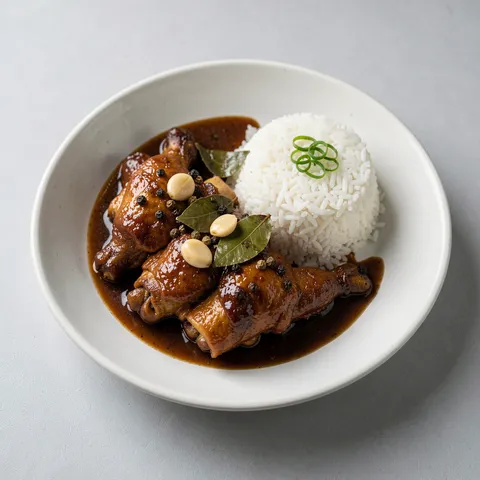 Filipino Chicken in Vinegar and Soy Sauce55 min · Main course
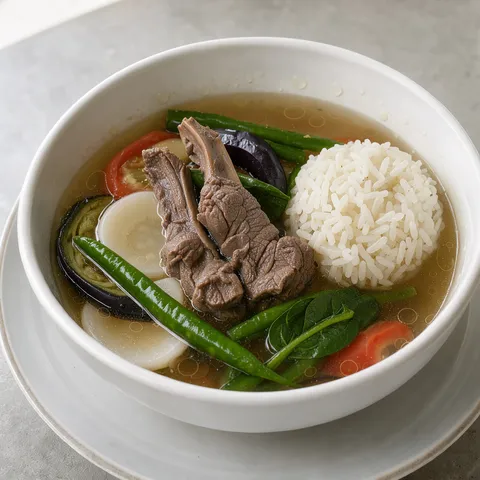 Sour Tamarind Beef Soup1 hr 20 min · Soup
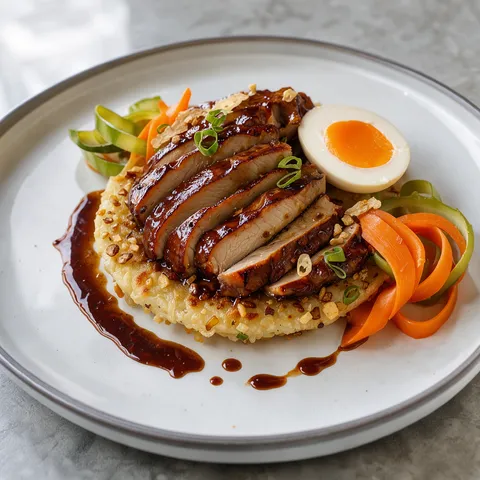 Chicken Adobo 2.01 hr 20 min · Main course
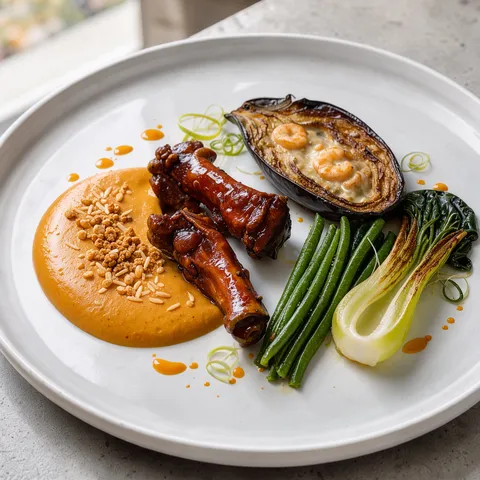 Kare-Kare 2.01 hr 30 min · Main course
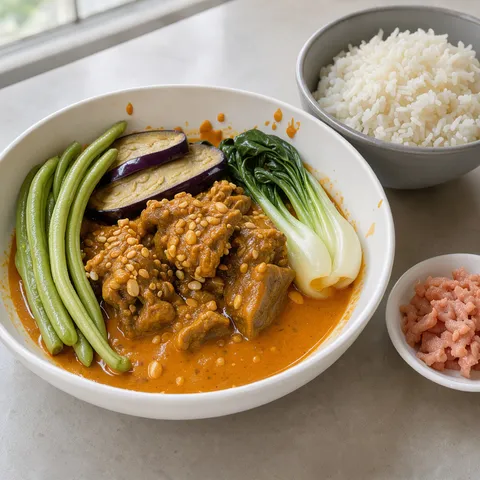 Filipino Oxtail Stew in Peanut Sauce3 hr 15 min · Main course
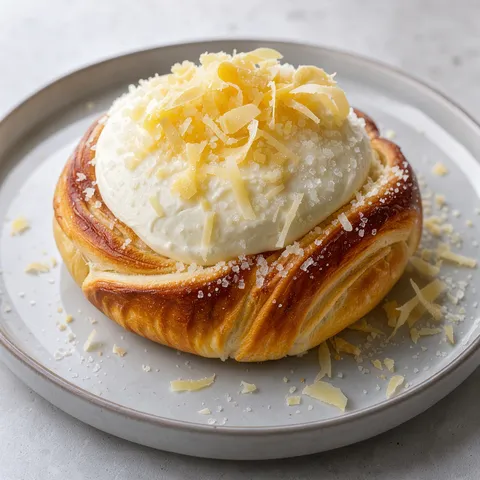 Filipino Butter and Cheese Buns4 hr 10 min · Bread & pastry