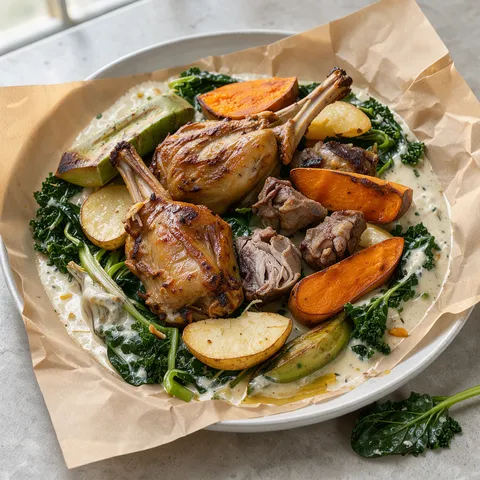
Papua New Guinean Earth-Oven Feast Mumu
A Papua New Guinean main course. Takes 2 hr 10 min, Serves 4. Difficulty: challenging.
At a glance
- Total time
- 2 hr 10 min
- Serves
- Serves 4
- Difficulty
- Challenging
- Cuisine
- Papua New Guinean cuisine
- Dish type
- Main course
- Diet
- Gluten-free
- Allergens
- Milk, Tree nuts
Ingredients
Meat
- 4 bone-in chicken thighs (about 700 g)
- 400 g boneless lamb shoulder (4 cm cubes)
- 1.5 tsp salt
- 20 g fresh ginger
Root vegetables
- 2 sweet potatoes (about 600 g, kaukau)
- 3 medium potatoes (about 450 g, in place of taro)
- 2 firm
- greenish bananas (in place of plantain)
Greens
- 6 large kale leaves
- 200 g fresh spinach
Sauce
- 400 ml coconut milk
- 1 onion (thin rings)
- 10 g fresh ginger (cut into matchsticks)
- 1/2 tsp salt
- 1 fresh red chilli (optional, split lengthways)
Wrapping
- 2 sheets baking paper (about 40×50 cm)
- foil
Equipment
- Oven
- Fine grater
- Mixing bowls
- Vegetable peeler
- Chef's knife
- Chopping board
- Colander
- Baking tray
- Baking paper
- Probe thermometer
Method
- Salt the meat: Preheat the oven to 180°C (conventional). Pat the chicken thighs and lamb dry with kitchen paper. Finely grate the 20 g ginger into a bowl using a microplane, add the 1.5 tsp salt and rub the meats with the mixture. Leave for 15 min while you prepare the vegetables, during which the salt works into the surface and the meat begins to release its juices
- Chop the root vegetables: Peel the sweet potatoes and potatoes with a peeler and cut into 5 cm chunks on a chopping board with a chef's knife. Peel the bananas and slice 4 cm thick. Large pieces soften without falling apart in 1.5 hr of steam, while small ones turn to mush at the bottom
- Prepare the greens: Thin the thick central rib of the kale leaves by laying the knife flat, leaving the leaves whole. Wash the spinach and drain it well in a colander. In an earth oven, banana leaves and wild greens form both the vessel and the vegetable, and here the kale makes the bottom layer and the spinach the top cover
- Mix the sauce: In a bowl, mix the coconut milk, onion rings, ginger matchsticks, 1/2 tsp salt and the optional chilli. The sauce goes in raw and combines with the juices released by the meat and vegetables in the oven, thickening by itself. The generous use of coconut milk reflects the island regions' interpretation of mumu
- Layer in the tin: Lay two sheets of baking paper in a cross over a 30×40 cm roasting tin at least 6 cm deep, with plenty overhanging at the sides. Cover the base with kale leaves. Place the potatoes and sweet potatoes first, then the lamb and the chicken thighs (skin side up) on top, and tuck the banana slices in between. The root vegetables and lamb, which need the longest cooking, go at the bottom, nearest the heat
- Pour on the sauce and seal: Drizzle the sauce evenly over everything and pile the spinach on top. Bring the edges of the baking paper together in the middle and twist into a parcel, then cover the tin with a double layer of foil and press the edges firmly onto the rim of the tin. No steam should escape, as the whole technique of mumu is the steam trapped in the parcel
- Bake: Place the tin on the middle shelf of the oven and bake at 180°C for 1 hr 30 min without opening the foil. A home oven does not give the fierce heat of the hot stones in the first hour, but the sealed parcel gives the same moist, slow cooking
- Check: Lift one corner of the foil on the side away from you, as the escaping steam is very hot. Measure the thickest part of a chicken thigh near the bone with a thermometer, which should read at least 74°C. The lamb should fall apart with a fork and the potato should offer no resistance to a knife. If not, reseal and cook for another 15 min
- Rest and open: Take the tin out of the oven and rest, still sealed, for 10 min. Open the foil and paper and spoon the dark, ginger-scented coconut liquid that has collected at the bottom over the vegetables and meat
- Serve: Put the tin in the middle of the table, or share between plates one chicken thigh, a few pieces of lamb, the root vegetables, banana and greens soaked in sauce. Mumu is a dish shared at a crowded table and needs nothing else alongside
Chef's note
Mumu is a feast dish cooked in Papua New Guinea in a pit dug into the ground, covered with hot stones, banana leaves and earth and steamed for hours. The original recipe uses pork; here it is made with chicken and lamb. A home oven stands in for the earth oven, and baking paper and foil for banana leaves. Potato works in place of taro, orange-fleshed sweet potato for kaukau (sweet potato) and firm, greenish bananas in place of plantain. On the islands, coconut milk is pressed from freshly grated coconut.
Frequently asked questions
- How is Mumu cooked in the oven?
- The meats, root vegetables and sauce are wrapped in parchment parcels and sealed in a double layer of foil. Bake at 180°C for 1 hour 30 minutes without opening the foil.
- Why salt the meats and leave them first?
- The salt and ginger mixture works into the meat in 15 minutes and the meat begins to release its own juices. That way it combines with the sauce in the oven.
- Which vegetables go at the bottom of the Mumu?
- The root vegetable and lamb that need the longest cooking go at the bottom, closest to the heat. The base is kale leaves, with the spinach on top.
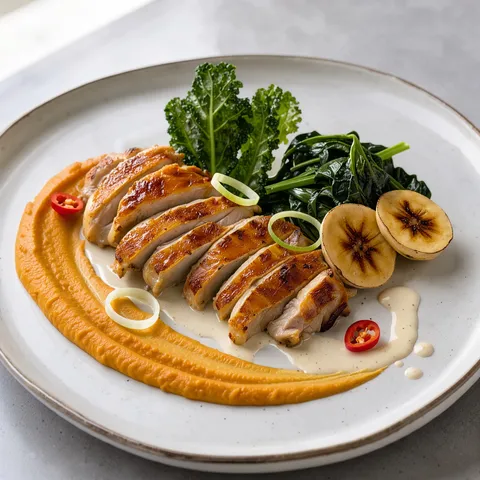 Mumu 2.01 hr 15 min · Main course
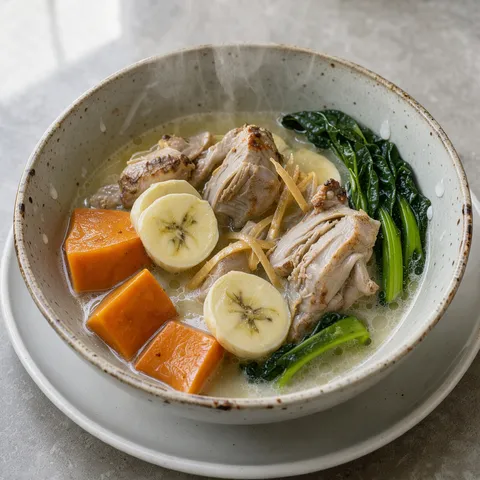 Ginger Chicken in Coconut Milk1 hr · Main course
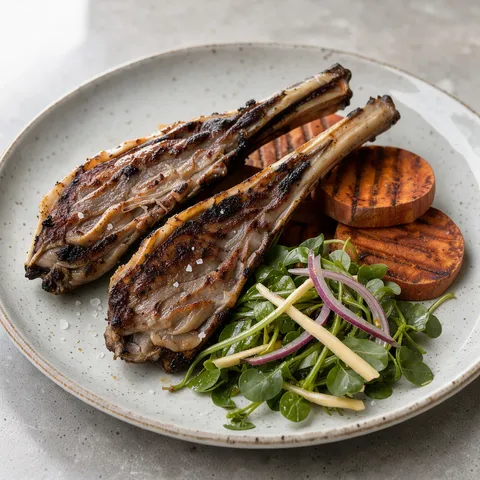 Chargrilled Lamb Breast and Salad1 hr 25 min · Main course
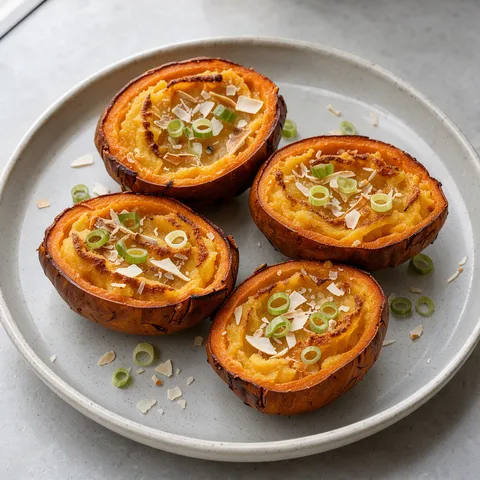 Coconut Sweet Potatoes Baked in Their Skins1 hr 25 min · Side dish
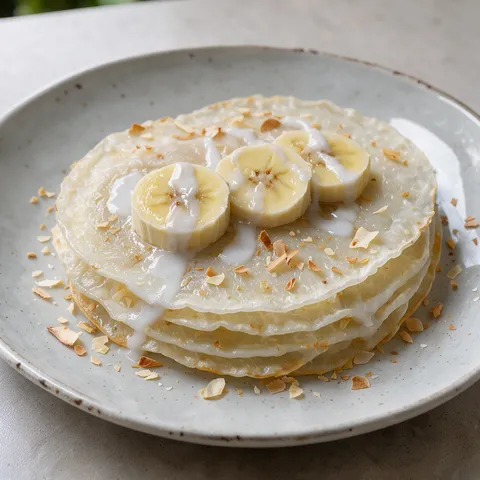 Coconut Sago Pancakes50 min · Bread & pastry
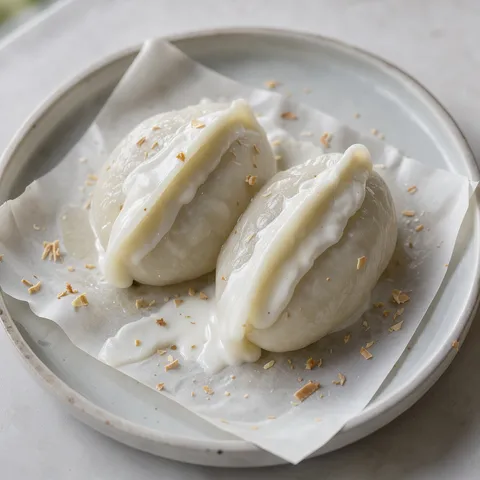 Sago and Banana Balls55 min · Dessert
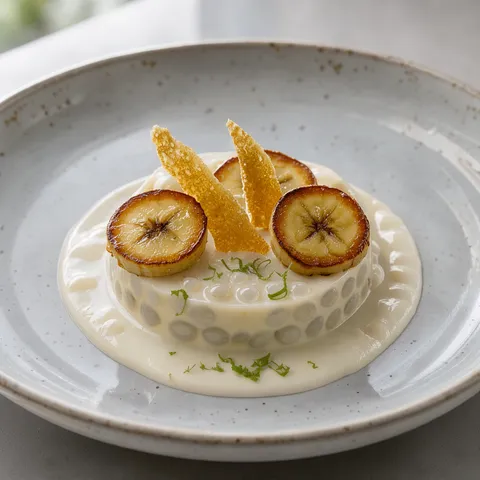 Dia 2.01 hr 10 min · Dessert