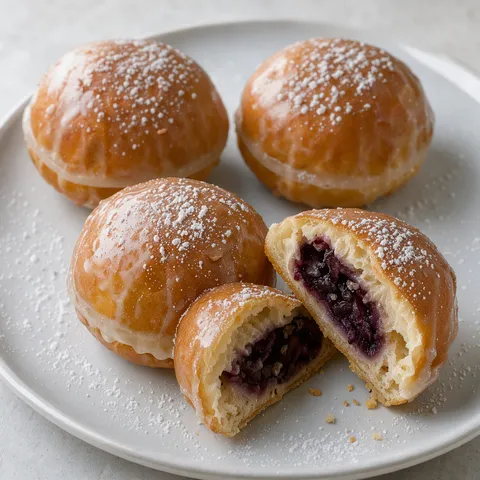
Polish Doughnuts Filled with Plum Butter Pączki
A Polish dessert. Takes 2 hr 50 min, Makes 16. Difficulty: challenging.
At a glance
- Total time
- 2 hr 50 min
- Serves
- Makes 16
- Difficulty
- Challenging
- Cuisine
- Polish cuisine
- Dish type
- Dessert
- Allergens
- Gluten, Milk, Eggs
Ingredients
Dough
- 500 g plain flour
- 8 g fast-action dried yeast
- 80 g caster sugar
- 250 ml lukewarm milk
- 4 egg yolks
- 1 whole egg
- 80 g butter (melted and lukewarm)
- 1 tbsp vodka (alcohol-free: 1 tbsp white vinegar)
- finely grated zest of 1 lemon
- 1/2 tsp salt
Quick powidła (plum butter)
- 600 g damson plums (stoned)
- 80 g light brown sugar
- 1/2 tsp cinnamon
- 1 tbsp lemon juice
Frying
- 2 litres sunflower oil
Glaze
- 150 g icing sugar
- 2 tbsp lemon juice
- 1 tbsp hot water
- 1 tbsp icing sugar (to serve)
Equipment
- Stand mixer
- Mixing bowls
- Cling film
- Heavy-based saucepan
- Stick blender
- Precision scales
- Probe thermometer
- Colander
- Piping bag
- Piping nozzles
- Balloon whisk
- Chef's knife
- Chopping board
- Fine sieve / chinois
Method
- Make the sponge (0-15 min): Warm half the milk to 37°C, add the yeast, 1 tbsp of the sugar and 3 tbsp of the flour and whisk. Cover and leave for 10-15 min, until the surface froths and rises. If it doesn't froth, the yeast is dead: don't go on
- Knead the dough (15-27 min): Put the remaining flour, sugar, salt and lemon zest in the bowl of a stand mixer. Add the sponge, the remaining lukewarm milk, the egg yolks, whole egg and vodka (or 1 tbsp white vinegar for an alcohol-free version) and knead with the dough hook on medium speed for 6 min. Add the melted butter in three additions and knead for another 5-6 min, until the dough comes away from the sides of the bowl and is glossy and elastic. The dough should stay soft and slightly sticky: too much flour makes pączki heavy. The vodka reduces the amount of oil the dough absorbs when frying
- First rise (27-87 min): Put the dough in a lightly oiled bowl, cover with cling film and leave somewhere at 26-28°C for 1 hr, until doubled in size
- Make the powidła (30-75 min, in parallel): Roughly chop the plums and cook with the sugar, cinnamon and lemon juice in a heavy-based saucepan over medium heat for 10 min, until they release their juice. Lower the heat and cook for 30 min, stirring often, until deep purple and thick enough that a line drawn across the bottom with a spoon stays put. Blend until smooth with a stick blender and leave to cool completely: you will have about 400 g. Hot filling melts the dough from the inside
- Divide and shape (87-100 min): Turn the dough out onto a floured worktop and divide into 16 equal pieces using scales. The whole dough weighs about 1.06 kg, so each piece is about 65 g. Shape each piece into a taut, smooth ball by pressing it against the worktop with your cupped palm, seam underneath. Lay them 5 cm apart on a floured cloth
- Second rise (100-135 min): Cover with a cloth and leave for 30-35 min, until the balls have grown by about half and a dent made with a finger springs back slowly. Over-risen dough collapses when fried
- Heat the oil (125-135 min, in parallel): Pour the 2 litres of oil into a heavy-based saucepan 24 cm across that holds at least 4 litres (about 4.4 cm deep): the oil should not come more than halfway up the pan. Bring to 170°C, checking with a thermometer. In hotter oil the outside darkens while the inside stays raw: in cooler oil pączki soak up oil
- Fry (135-160 min): Fry in batches of 4: drop 4 balls into the oil at a time, with the side that faced up on the cloth facing down. The oil doesn't cover the balls completely, so fry for 2.5-3 min on each side, until deep golden, spooning oil over the top as you turn them. Well-fried pączki have a pale ring around their middle. Lift out with a slotted spoon onto a wire rack lined with kitchen paper, and bring the oil back to 170°C between batches
- Fill (160-165 min): Spoon the powidła into a piping bag fitted with a long, straight nozzle. Push the tip into the side of each pączek as far as the centre and pipe in about 20 g of filling: the pączek should feel slightly heavier in your hand
- Glaze (165-170 min): Whisk the 150 g icing sugar with the lemon juice and hot water to a fluid but opaque glaze. Dip the tops of the warm pączki one by one and let the excess drip off. The glaze sets on the warm dough into a thin, translucent shell
- Plate: Arrange three pączki in a triangle on a flat plate, cutting one in half with the cut side facing forward to show the purple filling. Dust with a little icing sugar through a fine sieve
Chef's note
In Poland pączki are eaten above all on Tłusty Czwartek, the last Thursday before Lent. The classic filling is rose petal jam, and plum butter (powidła) is one of the favourite alternatives. They are traditionally fried in lard; here sunflower oil is used. Strained and stored in a closed container, the frying oil can be used once more. Makes 16.
Frequently asked questions
- Why is vodka added to the paczki dough?
- Vodka reduces the amount of oil the dough absorbs during frying. The recipe uses 1 tablespoon in the dough.
- What temperature should the oil be for frying paczki?
- Bring the oil to 170°C using a thermometer. In hotter oil the outside darkens and the inside stays raw, and in cooler oil the paczki soak up oil.
- How can you tell paczki are fried properly?
- A properly fried paczek has a pale ring around its middle. Fry each side for 2.5-3 minutes until deep golden.
 Polish Potato and Cheese Pierogi2 hr · Bread & pastry
 Barszcz Czerwony with Uszka1 hr 40 min · Soup
 Polish Stuffed Cabbage Rolls2 hr · Main course
 Polish Potato Pancakes55 min · Starter
 Kraków-Style Cheesecake2 hr 45 min · Patisserie
 Barszcz 2.01 hr 20 min · Soup