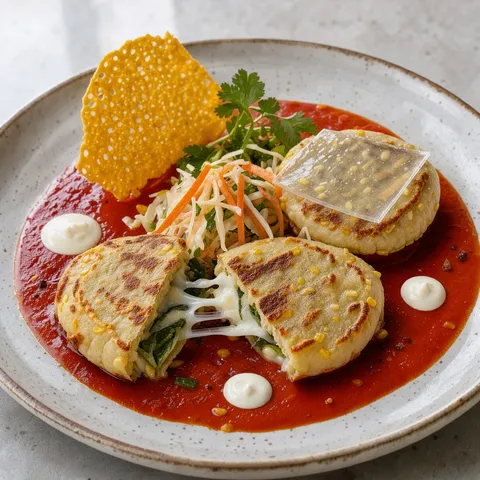
Pupusas de Queso y Loroco 2.0
A Salvadoran starter. Takes 1 hr 25 min, Serves 4. Difficulty: challenging.
At a glance
- Total time
- 1 hr 25 min
- Serves
- Serves 4
- Difficulty
- Challenging
- Cuisine
- Salvadoran cuisine
- Dish type
- Starter
- Diet
- Gluten-free
- Allergens
- Milk, Eggs
Ingredients
Curtido pickle and jelly
- 150 g white cabbage (very thin strips)
- 1 carrot (julienned)
- 1/4 white onion (thin rings)
- 1/2 tsp dried oregano
- 150 ml cider vinegar
- 100 ml water
- 1 tsp salt
- 1 tsp sugar
- 2 g agar agar
Charred salsa roja
- 5 ripe tomatoes (700 g)
- 1/4 onion
- 1 garlic clove
- 1/2 red pepper
- 1/2 tsp salt
- 30 g cold butter
Mini pupusas
- 250 g masa harina
- about 340 ml lukewarm water
- 1/2 tsp salt
Filling
- 180 g quesillo or mozzarella
- 60 g fresh fresh curd cheese
- 50 g loroco (frozen or in brine, finely chopped)
- 20 g brown butter (noisette)
Cheese lace
- 80 g parmesan or aged semi-hard cheese (finely grated)
Crema
- 100 g soured cream
- 1 tsp lime juice
- salt
To finish
- coriander shoots
- 1 tbsp olive oil
- flaky salt
Equipment
- Mixing bowls
- Colander
- Saucepan
- Baking paper
- Cast-iron frying pan
- Blender
- Fine sieve / chinois
- Frying pan
- Silicone spatula
- Box grater
- Squeezy bottle
- Balloon whisk
Method
- Quick-pickle the curtido: Put the cabbage, carrot and onion in a bowl, pour over boiling water, then drain after 1 min and squeeze dry. Bring the vinegar, water, salt, sugar and oregano to the boil, pour over the vegetables and leave for 30 min. The curtido that rests for 1-2 days in the classic reaches its flavour here in 30 min thanks to the hot brine
- Pour the curtido jelly: Once the pickle has rested, strain off 200 ml of the brine, whisk it with the agar agar in a small saucepan, bring to the boil and keep it boiling for 1 min, whisking constantly. Pour 5 mm deep into a flat 20×20 cm tray lined with baking paper and set in the fridge for 10 min. Agar also sets at room temperature, so it has to be poured quickly. The sour tang of the curtido becomes a thin, glossy sheet laid over the pupusa
- Char and strain the salsa: Char the tomatoes, onion, garlic and pepper in a cast-iron pan or under the grill for 10-12 min, until the skins blacken and split. Blend until smooth and press through a fine sieve. Reduce in a saucepan over a low heat for 12-15 min to a concentrated sauce that coats a spoon, then season with salt. Before serving, whisk in the cold butter to bind it. The thin salsa of the classic becomes a glossy, velvety sauce
- Make the filling: Brown the butter in a small frying pan until hazelnut-coloured, pour it over the loroco and leave to infuse for 2 min. Finely grate the quesillo and mash it with the fresh curd cheese and the loroco in brown butter into a smooth paste. Divide into 12 equal balls (about 22 g) and firm up in the fridge for 10 min. Cold filling does not fall apart while you shape the dough
- Make the cheese lace: Heat a non-stick frying pan over a medium heat and scatter a tablespoon of the grated cheese in a thin 8 cm round. Cook for 1-2 min, until the cheese melts, bubbles and turns into a golden lace. Lift with a spatula and drape over a rolling pin to curve it. Make 4 laces. This crisp element takes the place of the crunch of the chicharrón in the classic revueltas
- Knead and shape the dough: Knead the masa harina, salt and warm water for 3 min. It should be a moist dough that does not crack. Divide into 12 equal pieces (about 45 g). With oiled hands, press each piece into a cup in your palm, add a ball of filling, seal and flatten into small, thick discs 7-8 cm across and 1 cm thick. The mini size keeps the cheese in the centre more molten
- Cook the pupusas: Heat a cast-iron pan over a medium-high heat. Cook the pupusas for 3 min, until the underside is darkly speckled, then turn and cook for another 3 min. The cheese that seeps from the edges should crisp up in the pan, so do not scrape it off. The centre should feel soft and hot when pressed with a finger
- Cut the pickle and jelly: Cut the curtido jelly into 6 cm squares. Drain the pickle and toss with the olive oil and a few coriander leaves to make a salad. Whisk the crema with the lime juice and salt and fill a squeeze bottle
- Plate: Spoon two spoonfuls of salsa roja onto a warm shallow plate and turn the plate gently to make a flat, glossy red mirror. Arrange three mini pupusas in the centre in a triangle, edges leaning against each other, and cut one in half to show the flowing cheese and green loroco. Drape a square of curtido jelly over one of the whole pupusas like a sheet. Put a small pile of curtido salad between the pupusas and add three dots of crema. Lean a cheese lace upright on the pile, scatter over coriander shoots and flaky salt and serve immediately
Chef's note
The four elements of the classic are kept: masa, cheese and loroco, curtido and salsa roja. What changes is the textures: the pupusa is small with a more molten centre, the curtido becomes both a salad and a jelly, the salsa a charred mirror bound with butter, and the crunch of the chicharrón a cheese lace. Pour the agar jelly while the brine is hot, as cooled agar turns lumpy. Workflow: make the salsa and filling while the pickle rests, and the dough while the jelly is in the fridge.
Frequently asked questions
- How do I pickle the curtido quickly?
- Pour boiling water over the cabbage, carrot and onion, drain, then leave them in the hot vinegar brine for 30 minutes. This shortens a process that takes 1-2 days in the classic version.
- Why are the pupusas made mini?
- The mini size keeps the cheese in the middle more fluid. The filling is also firmed up in the fridge, so it does not fall apart as you shape it.
- How is the cheese lace shaped?
- Melt grated cheese in a thin circle in a non-stick pan and lift it with a spatula once it is a golden lace. Drape it over a rolling pin while hot to give it a curved shape.
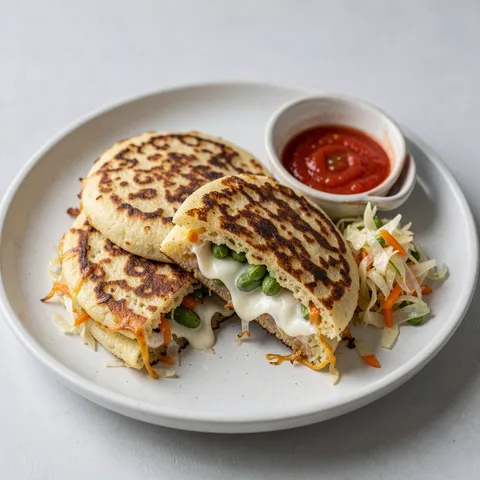 Salvadoran Stuffed Corn Cakes1 hr 45 min · Bread & pastry
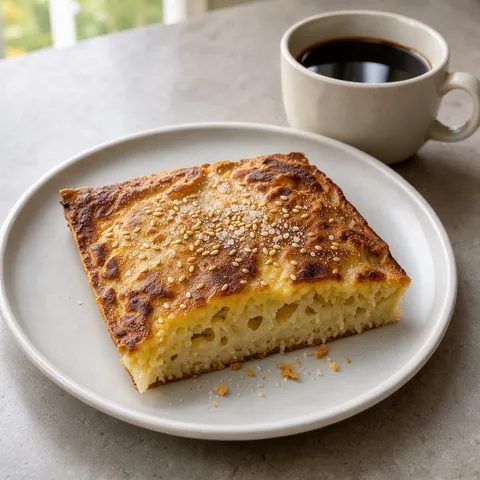 Salvadoran Rice-Flour Cheese Cake1 hr 30 min · Patisserie
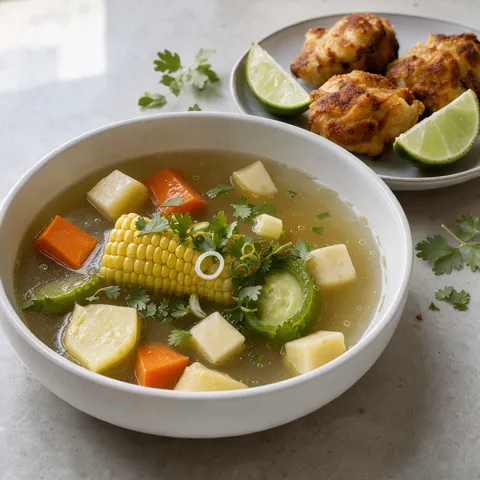 Salvadoran Free-Range Chicken Soup2 hr 10 min · Soup
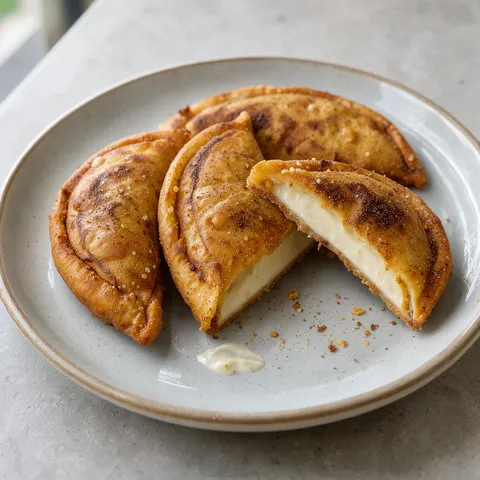 Plantain Custard Pastries1 hr 25 min · Dessert
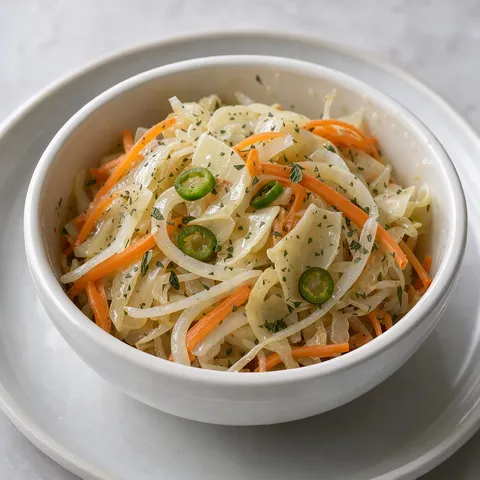 Salvadoran Quick Pickled Cabbage Slaw20 min · Side dish
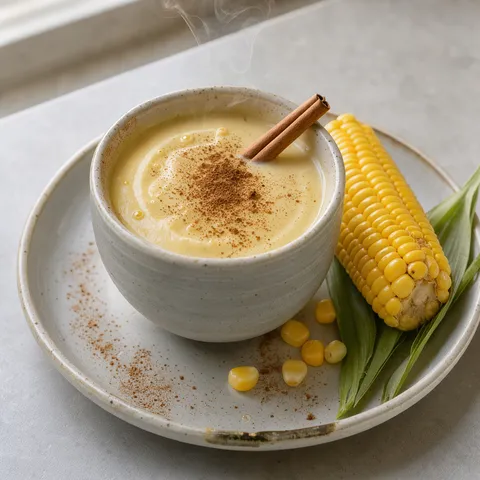 Salvadoran Hot Fresh Corn Drink30 min · Drink