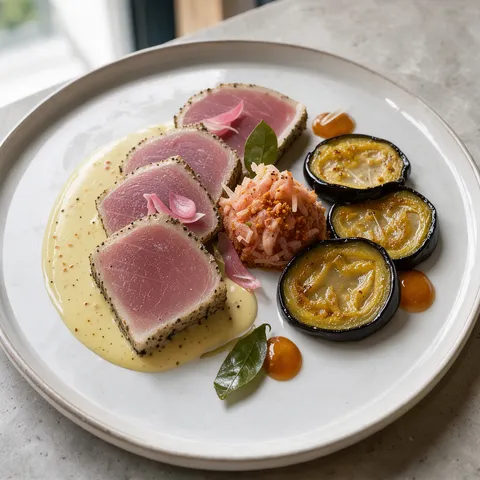
Ambul Thiyal 2.0
A Sri Lankan main course. Takes 1 hr 20 min, Serves 4. Difficulty: challenging.
At a glance
- Total time
- 1 hr 20 min
- Serves
- Serves 4
- Difficulty
- Challenging
- Cuisine
- Sri Lankan cuisine
- Dish type
- Main course
- Diet
- Gluten-free
- Allergens
- Milk, Fish, Tree nuts, Mustard, Sulphites
Ingredients
Tuna
- 600 g tuna fillet (two long blocks, about 5×5 cm in cross-section)
- 1/2 tsp salt
- 1 tbsp coconut oil
Goraka and pepper paste
- 6 pieces of dried goraka (about 20 g)
- 150 ml hot water
- 1 tbsp black peppercorns
- 4 garlic cloves
- 15 g ginger
- 1/2 tsp turmeric
- 1/2 tsp salt
Goraka glaze
- the rest of the goraka soaking water (about 120 ml)
- 30 g kithul jaggery or palm sugar
- 6 curry leaves
- 1/4 tsp crushed black pepper
Kiri hodi
- 1 tbsp coconut oil
- 1/4 tsp fenugreek seeds
- 2 shallots (finely chopped)
- 1 garlic clove (finely chopped)
- 10 curry leaves
- 5 cm pandan leaf (rampe)
- 1 piece of cinnamon (3 cm)
- 1/4 tsp turmeric
- 300 ml unsweetened coconut milk
- 1/4 tsp salt
- 1 tbsp lime juice
Moju aubergine
- 2 long thin aubergines (about 300 g)
- 1/4 tsp turmeric
- 1/4 tsp salt
- 3 tbsp sunflower oil
- 1 tsp yellow mustard seeds (crushed)
- 2 tbsp cider vinegar
- 1 tbsp sugar
- 1/4 tsp chilli powder
Pol sambol
- 80 g freshly grated coconut (or 60 g desiccated coconut and 2 tbsp lukewarm water)
- 1 shallot
- 1/2 tsp chilli flakes
- 1/4 tsp chilli powder
- a pinch of salt
- 1 tbsp lime juice
Crispy curry leaves
- 20 curry leaves
- 100 ml sunflower oil
Pickled shallots
- 4 shallots (halved and separated into layers)
- 3 tbsp cider vinegar
- 1 tsp sugar
- a pinch of salt
To finish
- flaky salt
Equipment
- Mixing bowls
- Pestle and mortar
- Saucepan
- Precision scales
- Fine sieve / chinois
- Stick blender
- Frying pan
- Cast-iron frying pan
- Oven
- Probe thermometer
- Pastry brush
- Colander
- Chef's knife
- Chopping board
- Box grater (optional)
Method
- Soak the goraka and make the pickle: The order is: paste and pickle, tuna prep, glaze, kiri hodi, aubergine, sambol, curry leaves, tuna and plating, 80 min in total. Soak the goraka pieces in 150 ml hot water for 10 min, lift them out and keep the water. Mix the shallot layers with the vinegar, sugar and salt in a bowl and leave until serving: they turn pink and translucent
- Pound the paste: Coarsely pound the peppercorns in a pestle and mortar, then add the garlic and ginger and crush. Add the goraka pieces, turmeric, salt and 2 tbsp of the goraka water and pound for 4-5 min to a dark, slightly grainy paste. In the classic this paste coats the whole fish: here it becomes a thin crust
- Prepare the tuna: Pat the tuna blocks dry with kitchen paper, sprinkle with salt and spread the paste over every side in a thin, even layer. Leave uncovered in the fridge for 30 min: the paste dries on the surface and does not stick to the pan during searing
- Goraka glaze: Weigh the saucepan first. Put the remaining goraka water, kithul jaggery, curry leaves and pepper in it and reduce over medium heat for 12-15 min. It is ready when the pan shows a net weight of about 60 g and the syrup turns deep amber and coats the back of a spoon like runny honey. Strain through a fine sieve
- Kiri hodi: Heat the coconut oil in a second saucepan over medium-low heat and toast the fenugreek seeds for 20 sec until light brown: if they darken, they turn bitter. Stir in the shallots, garlic, curry leaves, pandan and cinnamon for 3 min until soft, then stir in the turmeric. Add the coconut milk and salt and cook at a gentle simmer, without boiling, for 12-15 min, until reduced to about 200 ml and it coats the back of a spoon. Pass through a fine sieve and blend with a stick blender for 20 sec until smooth. Add the lime at the moment of serving and keep warm over low heat
- Moju aubergine: Slice the aubergines on the diagonal 1.5 cm thick, rub with the turmeric and salt, leave for 10 min, then pat dry with kitchen paper. Heat the oil in a wide frying pan over medium-high heat and cook the slices in two batches for 3-4 min on each side, until deep golden and completely soft. Mix the mustard, vinegar, sugar and chilli powder, pour into the pan and turn the slices for 1 min to glaze. The sweet, sour mustardy flavour of wambatu moju is carried here by large, glossy slices
- Pol sambol: Crush the shallot, chilli flakes, chilli powder and salt in a pestle and mortar. Add the coconut and rub with your fingertips for 1 min: the colour passes into the coconut and turns it pinkish orange. Stir in the lime: it should stay moist and loose
- Crispy curry leaves: Heat 100 ml oil (about 6-7 mm deep) to 170°C in a small 14 cm saucepan. Pat the curry leaves dry, drop them into the oil and fry for 10-15 sec, turning with a slotted spoon, until the sizzling stops and the leaves are translucent and crisp. Drain on kitchen paper. The leaves should stay green: if they turn brown, they go bitter
- Sear the tuna: Preheat the oven to 200°C. Heat a cast-iron frying pan over very high heat until the first smoke appears and add the coconut oil. Sear the four long sides of the blocks for 1 min, until the crust darkens. Transfer the pan to the oven and cook for 8-10 min, until a thermometer reads 55°C in the centre. Transfer to a board and rest for 3 min
- Slice: Brush a thin layer of glaze over the blocks with a pastry brush. Cut into 12 slices 2 cm thick with a sharp knife. The cut face should show a dark peppery crust, a thin opaque ring and a moist, pale pink centre
- Plate: Spoon two or three spoonfuls of kiri hodi onto the left half of a warm shallow plate and make an oval pool with the back of the spoon. Arrange three tuna slices in the pool, staggered, cut sides up. Place three moju aubergine slices on the right and put a spoonful of pol sambol in a small heap between the slices and the aubergine
- Finish: Leave three dots of glaze beside the tuna slices. Arrange the pickled shallot layers on the aubergine, scatter the crispy curry leaves over the plate and sprinkle a pinch of flaky salt over the tuna. Serve immediately
Chef's note
The identity of the classic ambul thiyal, goraka sourness and plenty of black pepper, sits here as a crust on the outside of the fish and a glossy glaze. In the classic the fish is dried out until all the liquid has evaporated: here it is taken to 55°C so the centre stays moist. The other mainstays of the southern Sri Lankan table also come onto the plate: kiri hodi (coconut milk sauce), mustardy aubergine inspired by wambatu moju, and pol sambol. Goraka, kithul jaggery and unsweetened coconut milk are bought ready-made. Buy the tuna fresh from a reliable source. For pregnant women, children, older people and anyone with a weakened immune system, cook the tuna to 63°C. If goraka is unavailable, use 2 tbsp tamarind concentrate with the same amount of water in place of the goraka in the paste and glaze: the flavour will be fruitier.
Frequently asked questions
- Why take care when toasting fenugreek seeds?
- Fenugreek turns bitter if it darkens. Toast it in oil over a medium-low heat until light brown.
- What internal temperature should the tuna be taken out at?
- After searing, the tuna blocks are baked until the thickest part reaches 55°C. The inside stays moist and light pink.
- What happens if the crispy curry leaves turn brown?
- If they turn brown they go bitter, so the leaves should stay green. Take them out of oil at 170°C once the sizzling stops and they turn translucent.
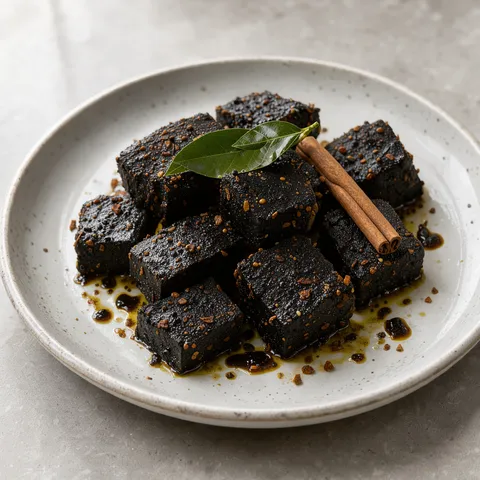 Southern Sri Lankan Sour Tuna1 hr 15 min · Main course
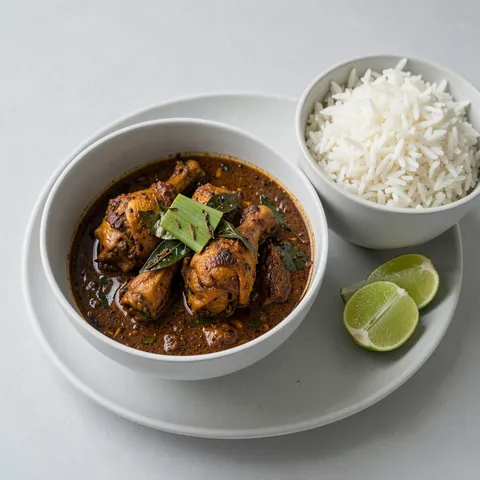 Sri Lankan Chicken Curry1 hr 15 min · Main course
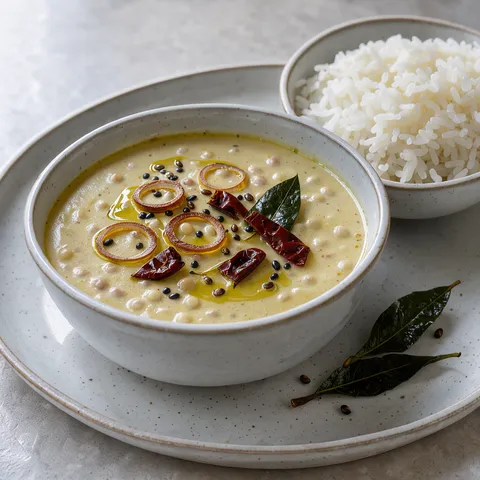 Sri Lankan Red Lentil Curry with Coconut45 min · Side dish
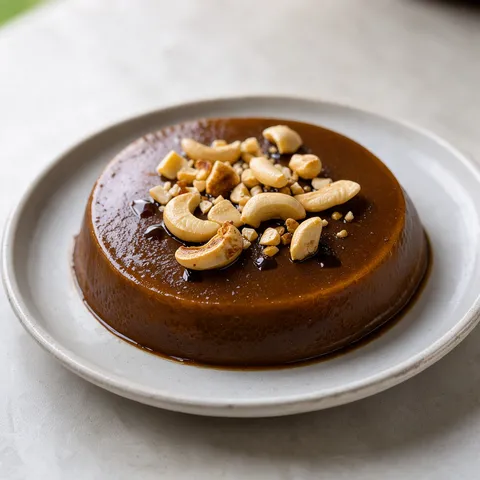 Sri Lankan Coconut Custard with Kithul Jaggery1 hr 5 min · Dessert
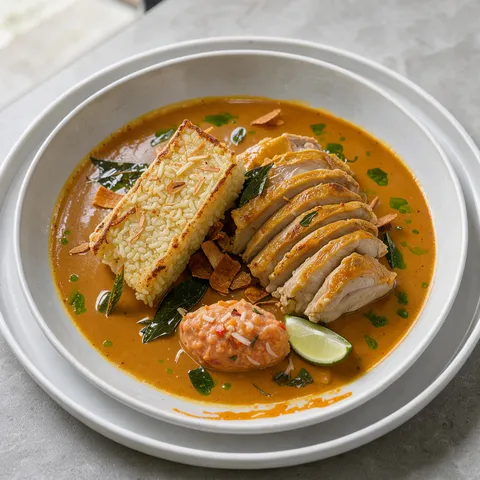 Kukul Mas Curry 2.01 hr 25 min · Main course
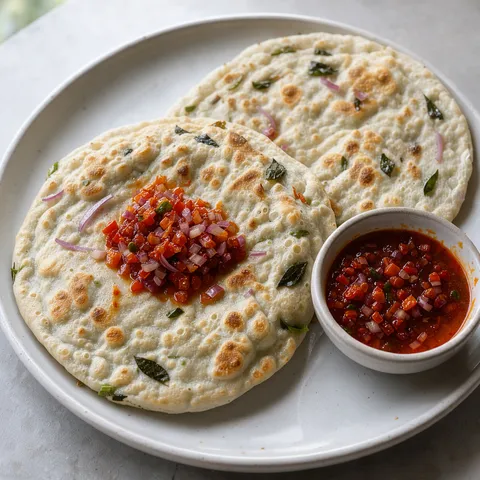 Pol Roti and Lunu Miris1 hr 15 min · Bread & pastry
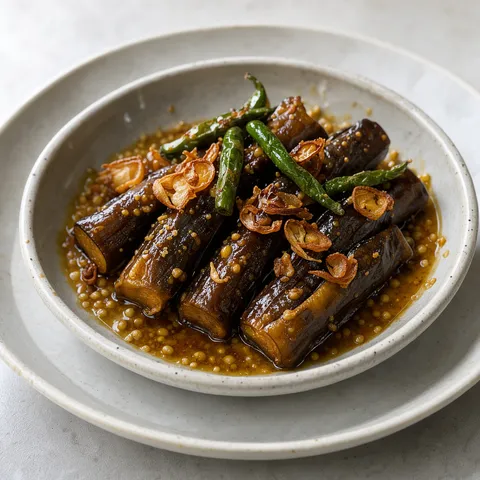 Sri Lankan Sweet-Sour Aubergine Pickle1 hr 5 min · Side dish