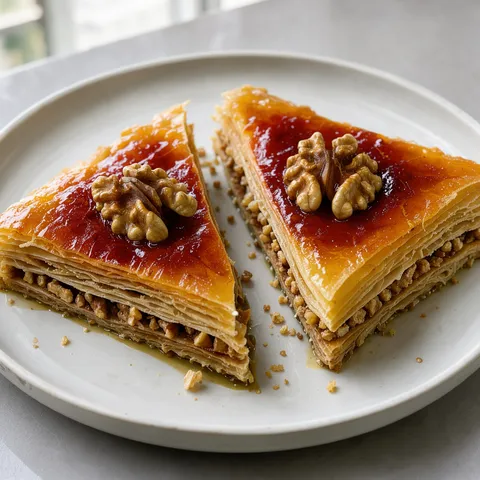
Baku Pakhlava Azerbaijani Saffron and Walnut Baklava
An Azerbaijani dessert. Takes 2 hr 55 min · +4 hr resting, Serves 4. Difficulty: challenging.
At a glance
- Total time
- 2 hr 55 min · +4 hr resting
- Serves
- Serves 4
- Difficulty
- Challenging
- Cuisine
- Azerbaijani cuisine
- Dish type
- Dessert
- Allergens
- Gluten, Milk, Eggs, Tree nuts
Ingredients
Dough
- 500 g plain flour
- 7 g fast-action dried yeast
- 1 tbsp caster sugar
- 1/2 tsp salt
- 200 ml lukewarm milk
- 1 egg
- 50 g melted butter
For rolling
- 60 g wheat starch
Filling
- 400 g walnuts (or half hazelnuts)
- 350 g caster sugar
- 1.5 tsp ground cardamom
For the layers
- 240 g melted butter (set aside 150 g for the layers and tin, 90 g for after baking)
Topping
- 2 egg yolks
- 1/4 tsp saffron (steeped in 2 tbsp hot water)
- about 30 walnut halves or whole almonds
Syrup
- 250 g honey
- 100 g caster sugar
- 150 ml water (24×30 cm tin, about 30 pieces)
Equipment
- Mixing bowls
- Food processor
- Rolling pin / oklava
- Baking tray
- Pastry brush
- Chef's knife
- Oven
- Saucepan
- Silicone spatula
Method
- Knead the dough: Mix the flour, yeast, sugar and salt. Add the lukewarm milk, egg and melted butter and knead for 10 min, until smooth and elastic. Cover and rest for 40 min: the dough rises slightly and the gluten relaxes, so it rolls out thinly
- Make the filling: While the dough rests, pulse the walnuts in short bursts in a food processor to coarse sand: it should not become a paste. Mix in the sugar and cardamom. Put the saffron to steep
- Divide and roll out: Divide the dough into 12 equal balls (about 65 g each). On a surface dusted with starch, roll each ball out with a rolling pin to the size of the tin (24×30 cm), about 1 mm thick: thicker than Turkish baklava filo, but thin enough not to tear. Stack the rolled sheets with starch sprinkled between them. The 12 sheets take about 35 min
- Layer: Brush the tin with some of the 150 g reserved butter. Lay two sheets in it, brushing butter between them. Then, for 8 layers, lay down each sheet, brush it with a thin coat of the 150 g butter and spread an eighth of the filling evenly over it. Cover with the last two sheets, brushing butter between them, and tuck the overhanging edges inside. Takes 20 min
- Cut and decorate: Preheat the oven to 180°C. With a sharp knife, cutting right down to the base of the tin, first cut 6 strips lengthways, then cut diagonally to make about 30 diamond-shaped pieces. Whisk the egg yolks with the saffron water and brush over the top. Press half a walnut or an almond into the centre of each piece. Takes 10 min
- Bake: Put the tin on the lower-middle shelf of the oven and bake for 40 min. Take it out, pour the 90 g reserved melted butter into the cut lines and bake for another 15 min. The bases of the pieces should be deep golden and the tops a reddish amber from the saffron
- Make the syrup: While the pakhlava bakes, bring the honey, sugar and water to the boil in a small saucepan, boil for 5 min, then take off the heat and keep warm. Boiling honey for long kills its aroma
- Soak in syrup: Slowly pour the warm syrup into the cut lines of the hot pakhlava straight from the oven. Hot pastry and warm syrup keep the layers crisp. Leave at room temperature for at least 4 hr so the syrup soaks into the layers
- Plate: Lift the pieces out with a spatula and place two on a dessert plate with their tips facing each other, so the saffron sheen on top shows. Serve with strong tea
Chef's note
Baku pakhlava is one of the three essentials of the Novruz table, alongside shekerbura and shekerchorek. It differs from Turkish baklava in its yeasted, egg-enriched dough with sheets slightly thicker than Turkish baklava filo (about 1 mm), its red saffron top and its honey syrup instead of sugar syrup. In the Ganja style hazelnuts go between the layers, while the Sheki style uses a lacy net (tor) made from rice flour: that is a different dessert. Pakhlava keeps for 4-5 days at room temperature, covered.
Frequently asked questions
- Why is Pakhlava dough rolled out with starch?
- The dough is rolled to about 1 mm thick on a starch-dusted surface, to the size of the tin. The sheets are stacked with starch sprinkled between them. This dough is thicker than Turkish baklava filo but thin enough not to tear.
- Why is the syrup poured on lukewarm?
- Lukewarm syrup is poured over the hot pakhlava straight from the oven, which keeps the layers crisp. Boil the syrup for 5 minutes, take it off the heat and leave it lukewarm. Boiling the honey for long kills its aroma.
- How long should Pakhlava rest after syrup?
- Rest it at room temperature for at least 4 hours so the syrup soaks into the layers. The tray is baked for 40 minutes first, then for 15 more minutes after drizzling with melted butter. The slices should be deep golden underneath and reddish amber on top from the saffron.
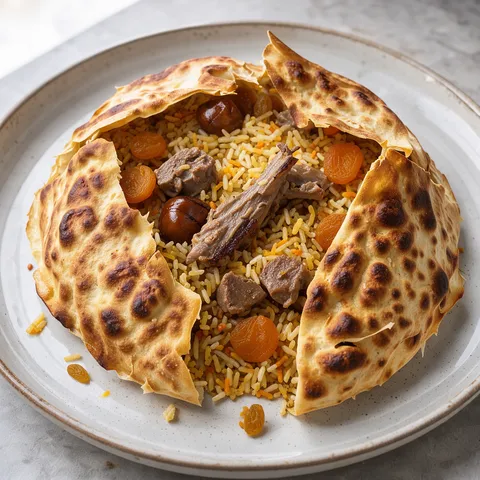 Shah Plov3 hr · Main course
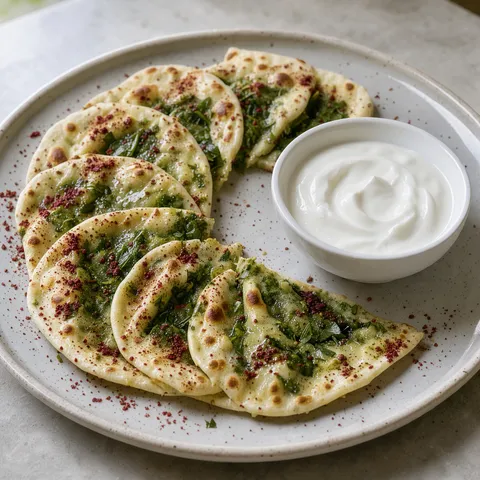 Azerbaijani Herb-Filled Flatbreads1 hr 20 min · Bread & pastry
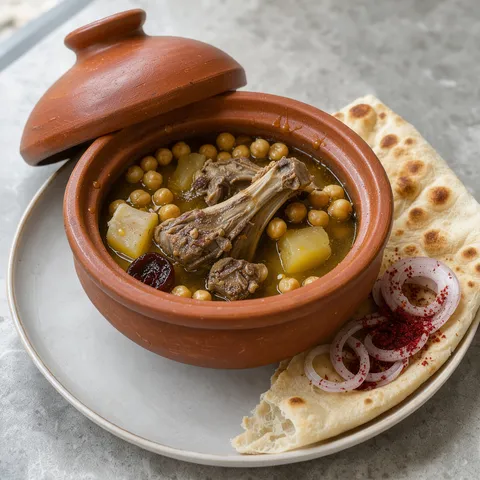 Sheki-Style, Cooked in Clay Pots4 hr 45 min · Soup
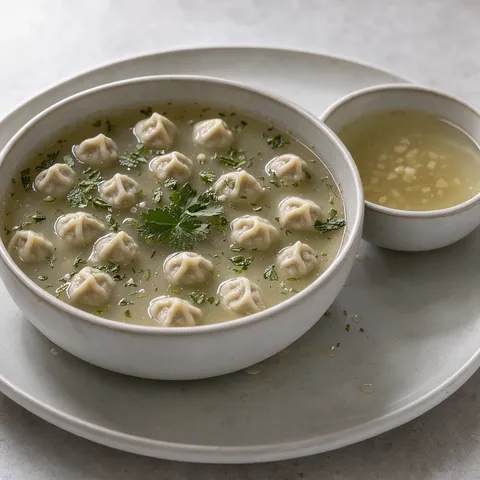 Tiny Lamb Dumpling Soup1 hr 50 min · Soup
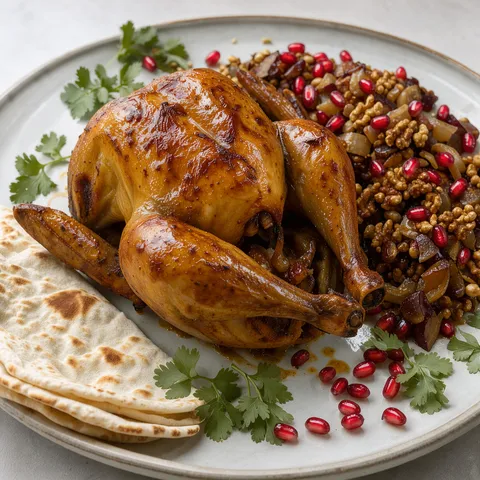 Lankaran-Style Chicken with Walnuts2 hr · Main course
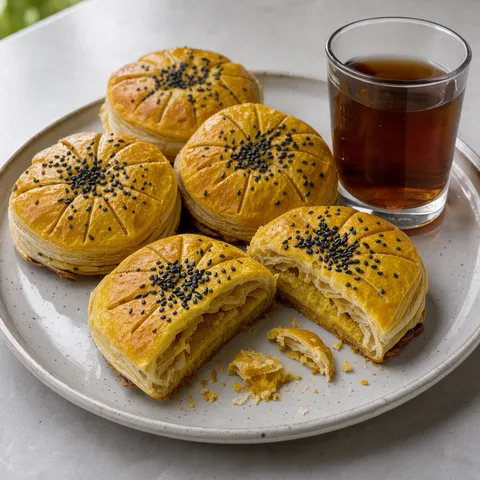 Layered Novruz Pastries with Fennel and Turmeric2 hr 55 min · Bread & pastry