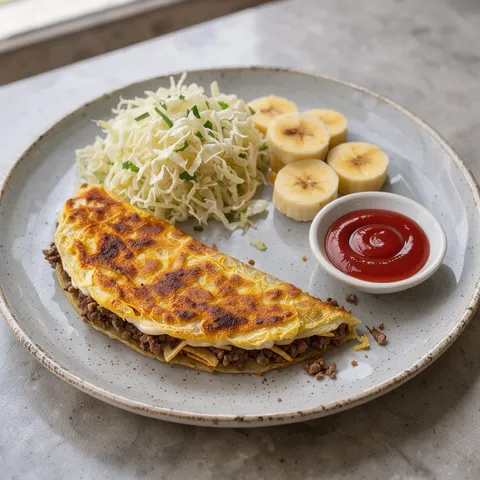
Mince and Egg Flatbread Omelette Fatira
A Djiboutian bread & pastry. Takes 1 hr 5 min · +30 min resting, Serves 4. Difficulty: challenging.
At a glance
- Total time
- 1 hr 5 min · +30 min resting
- Serves
- Serves 4
- Difficulty
- Challenging
- Cuisine
- Djiboutian cuisine
- Dish type
- Bread & pastry
- Allergens
- Gluten, Milk, Eggs, Mustard, Sulphites
Ingredients
Sabayad
- 300 g plain flour
- 1 tsp caster sugar
- 1/2 tsp salt
- 180 ml lukewarm water
- 4 tbsp sunflower oil (2 tbsp for the dough, 2 tbsp for folding)
- 2 tbsp sunflower oil (for cooking)
Mince filling
- 1 tbsp sunflower oil
- 300 g beef mince
- 1 onion (finely chopped)
- 1 small leek (white part only, cut into thin rings)
- 1 long green pepper (finely chopped)
- 2 garlic cloves (crushed)
- 1 tsp cumin
- 1 tomato (small dice)
- 1/2 tsp black pepper
- 1/2 tsp salt
Binding
- 4 eggs
- a pinch of salt
- 2 tbsp sunflower oil (for the pan)
To serve
- 4 tbsp Homemade Mayonnaise (Basics)
- 4 tbsp Homemade Ketchup (Basics)
- 200 g white cabbage (finely shredded)
- juice of 1/2 lemon
- a pinch of salt
- 2 bananas (sliced)
Equipment
- Mixing bowls
- Cling film
- Chopping board
- Chef's knife
- Frying pan
- Wooden spoon / spatula
- Rolling pin / oklava
- Pastry brush
- Silicone spatula
- Probe thermometer
Method
- Knead the dough: Mix the flour, sugar and salt in a bowl, add the lukewarm water and 2 tbsp oil and knead for 8 min, until you have a smooth, soft dough. Cover the bowl with cling film and rest for 30 min. Rested dough has a relaxed gluten and rolls out paper-thin
- Cook the filling: While the dough rests, chop the vegetables on a chopping board with a chef's knife. Heat 1 tbsp oil in a pan over medium heat, soften the onion for 5 min, add the leek and pepper and cook for 4 min. Add the garlic and cumin and stir for 1 min. Add the mince and cook for 8 min, breaking it up with a wooden spoon, until no pink remains. The internal temperature of the mince should reach 71°C on a thermometer. Add the tomato, black pepper and salt and cook for 3 min, until the liquid has evaporated. Transfer to a bowl. A dry filling does not make the sabayad soggy
- Prepare the cabbage: Rub the shredded cabbage with the lemon juice and a pinch of salt by hand in a bowl for 2 min and leave. Salt softens the cabbage and makes it a sour, crisp accompaniment
- Roll out and fold the sabayad: Divide the dough into 4 equal balls. Roll each ball out thinly with a rolling pin to 22 cm across and brush the surface with 1/2 tbsp oil using a pastry brush. Starting from one edge, roll up tightly, coil the roll around itself like a snail and rest for 5 min. Then roll each out again to 20 cm across. The oiled layers separate as they cook, and this is what makes sabayad layered like a katmer
- Cook the sabayad: Heat a dry pan over medium-high heat. Place the sabayad in it and cook for 1.5 min, until brown spots form underneath, brush the top with about 1/2 tbsp of the cooking oil, turn and cook for another 1.5 min. Cook the four sabayad in turn (about 12 min in total), stacking them on top of each other and covering with a clean cloth to keep them soft
- Cut the sabayad: Cut the cooked sabayad into short 1 cm wide strips with a chef's knife. In Djibouti, the base of fatira is this chopped bread, and the egg binds the strips together
- Cook the fatira: Beat the eggs with a pinch of salt in a bowl with a fork. Heat 1/2 tbsp oil in a pan over medium heat and warm a quarter of the strips and a quarter of the filling for 2 min, turning. Pour a quarter of the beaten egg over, press with a spatula and flatten into a thin pancake covering the base of the pan. Cook for 2 min, until the underside is browned and the egg has set, turn with the spatula and cook for another 1-2 min. The egg must be fully cooked
- Fold with mayonnaise: Transfer the fatira to a plate, spread 1 tbsp mayonnaise on half and fold in two. Cook and fold the other three in the same way
- Serve: Serve each fatira hot with the cabbage salad, banana slices and 1 tbsp ketchup. In Djibouti, the banana is bitten together with a slice, and its sweetness balances the cumin mince
Chef's note
Fatira (fadira) is a popular evening street and home dish in Djibouti, made with a layered flatbread called sabayad. Sources describe it as served with mince, omelette, cabbage, banana and onion, with ketchup and mayonnaise, with the bread cut into strips and pressed into the pan with the mince filling, then folded over with mayonnaise. The mayonnaise and ketchup are made from scratch, so see the recipes in the Basics section. Unlike Uganda's Rolex (Ugandan Chapati and Omelette Roll), the bread is not rolled in an omelette but chopped and cooked in the pan with the mince and egg as a single katmer-like layer. Do not go for a runny egg: the egg is cooked through. Unlike Mutabbaq (Hejazi Saj Pastry with Mince and Egg), the filling is not wrapped inside the dough like an envelope, the sabayad is cut into strips and mixed with the mince filling, bound with poured egg like an omelette in the pan, folded with mayonnaise and eaten with cabbage and banana. Homemade mayonnaise contains raw egg yolk, so make it with pasteurised egg for pregnant women, children and the elderly.
Frequently asked questions
- Why isn't my sabayad flaky?
- Roll the dough out thin and oil it, then roll it up, coil it like a snail and rest it before rolling it out again. The oiled layers separate during cooking and give the flatbread its flaky, layered look.
- Why must the mince filling be dry?
- A dry filling doesn't make the sabayad soggy. After adding the tomato, cook until its liquid has evaporated.
- What is fatira served with?
- Each fatira is served hot with cabbage salad, banana slices and ketchup. In Djibouti the banana is eaten with a bite of the fatira, and its sweetness balances the cumin-spiced mince.
 Spicy Lamb and Vegetable Soup1 hr 25 min · Soup
 Roast Fish with Banana Fata50 min · Main course
 Rice-Stuffed Slow-Roast Lamb Shoulder3 hr 30 min · Main course
 Thin Cardamom Pancakes with Honey40 min · Dessert
 Mukbassa 2.055 min · Main course