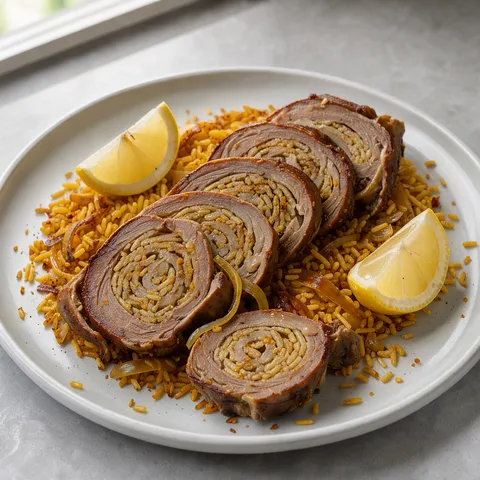
Rice-Stuffed Slow-Roast Lamb Shoulder Hanid
A Djiboutian main course. Takes 3 hr 30 min, Serves 4. Difficulty: challenging.
At a glance
- Total time
- 3 hr 30 min
- Serves
- Serves 4
- Difficulty
- Challenging
- Cuisine
- Djiboutian cuisine
- Dish type
- Main course
- Diet
- Gluten-free
- Allergens
- Celery
Ingredients
Lamb
- 1.1 kg boneless lamb shoulder (butterflied, which the butcher can do)
- 1.5 tsp salt (1 tsp inside, 1/2 tsp outside)
Spices
- 1 tsp ground cardamom
- 1 tsp cumin
- 1 tsp black pepper
- 1/2 tsp cinnamon
- 1/2 tsp turmeric
- 1/4 tsp ground cloves
Spice paste
- 4 garlic cloves (crushed)
- 2 tbsp sunflower oil
Stuffing
- 250 g basmati rice (washed, soaked for 20 min)
- 1 onion (finely chopped)
- 1 tbsp sunflower oil
- 1 tomato (grated)
- 1/2 tsp salt
- 300 ml water
Oven
- 2 onions (cut into thick rings)
- 300 ml water (150 ml at the start, 150 ml hot with the rice)
To serve
- 1 lemon (sliced)
Equipment
- Mixing bowls
- Chopping board
- Chef's knife
- Saucepan
- Box grater
- Wooden spoon / spatula
- Oven
- Cast-iron casserole
- Kitchen scissors
- Probe thermometer (optional)
Method
- Divide the spices: Mix all the spices in a small bowl. Crush half of them with the garlic and 2 tbsp oil to make a paste, and set the other half aside for the rice. Using the same mixture inside and out gives the meat and rice a single aroma
- Open the meat: Spread the butterflied shoulder flat, inside up, on a chopping board. With a chef's knife, open up the thick parts with horizontal cuts to bring the meat to an even thickness of about 2.5 cm, because any thick part will cook late. Sprinkle 1 tsp salt on the inside and rub in half of the spice paste
- Part-cook the rice: Grate the tomato on the coarse side of the grater. Heat 1 tbsp oil in a pan over medium heat and cook the onion for 6 min, until soft and golden. Stir in the reserved spices for 1 min, then add the tomato and cook for 3 min. Add the drained rice and stir for 1 min, then add the 300 ml water and 1/2 tsp salt. Once it boils, reduce the heat and cook covered for 6 min. The rice should have absorbed the water but the middle of the grains should still be firm. Take off the heat, remove the lid and cool for 10 min. Half of the rice will be the stuffing inside the meat, and the other half will wait in a bowl and join the meat in the last part of the oven time, so it does not turn mushy
- Heat the oven and roll the meat: Heat the oven to 160°C (conventional). Spread half of the rice over the meat in a 1 cm layer, leaving a 2 cm gap at the edges, and press lightly. Roll the meat up tightly from the long edge and tie with kitchen string at 3 cm intervals. Rub the outside with 1/2 tsp salt and the remaining spice paste
- Set up the cast-iron pot: Spread the onion rings over the bottom of a lidded cast-iron casserole and set the roll on top, seam-side down. Pour 150 ml water in at the side. The rice waiting in the bowl does not go into the pot yet. The onion lifts the meat off the base, prevents burning and flavours the water
- Slow-cook: Close the lid tightly and cook in the 160°C oven for 1 hr 40 min. The lid must stay on, as the steam tenderises the meat. Covered cooking imitates the heavy, moist heat of Djibouti's earth oven
- Add the surrounding rice: Open the lid, slide the roll to one side of the pot, spread the waiting part-cooked rice around the onion rings and the roll, pour 150 ml boiling water over the rice, close the lid tightly and cook for 25 min. Rice cooks in a closed pot with separate grains and does not turn to mush, which is why it goes in for the last 25 min
- Roast: Open the lid, raise the oven to 220°C and cook for 20 min in total (5 min to heat up, 15 min to brown), until the outside of the roll forms a dark brown crust and the rice at the edge crisps slightly. The meat should be easily pierced by a fork, and the internal temperature on a thermometer will be around 85-90°C. Shoulder meat is soft enough to fall apart at this temperature
- Rest: Move the roll to a chopping board, cover loosely and rest for 10 min. Meanwhile stir the rice in the pot with the onion at the bottom using a wooden spoon, so it absorbs the cooking juices
- Serve: Cut and remove the strings with scissors and slice the roll 2 cm thick with a chef's knife. Spread the surrounding rice on a serving plate, arrange the slices on top with the inner rice showing, and serve with lemon slices
Chef's note
Hanid is a baked kid goat or mutton dish remembered in Djibouti as a legacy of nomadic shepherding and eaten at lunch on feast days and celebrations. In French it is also called "cabri farci" or "mouton farci". Sources describe small kid goat cooked in an old-style earth oven, often stuffed with spiced rice. Boneless lamb shoulder was used here for a home-sized 4 servings, and if you find kid goat, it cooks in the same time. Unlike Yemen's Mandi Djaj (Hadhrami Smoked Spiced Chicken and Rice) and Oman's Shuwa (Omani Spiced Lamb Slow-Cooked in Banana Leaves), the rice goes inside the meat as a stuffing, and the meat is not wrapped in leaves or smoked. Unlike Iraq's Quzi (Iraqi Spiced Lamb Shanks with Vermicelli and Nut Rice) and Damascus's Ouzi (Damascus-Style Pastry Parcels of Spiced Rice), the rice is rolled inside the meat, there is no pastry, lamb shank is not boiled, and the roll cooks in a closed pot in the oven.
Frequently asked questions
- Why is half the rice added later?
- Half the rice goes inside the meat as stuffing and the rest goes in beside the lamb for the last part of the roasting. This stops the rice turning mushy.
- Why isn't the lid lifted while the hanid cooks?
- Keep it closed, as the steam tenderises the meat. Cooking it covered mimics the heavy, moist heat of Djibouti's clay oven.
- Why are onion rings laid under the meat?
- The onion lifts the meat off the base and stops it burning. It also adds flavour to the cooking liquid.
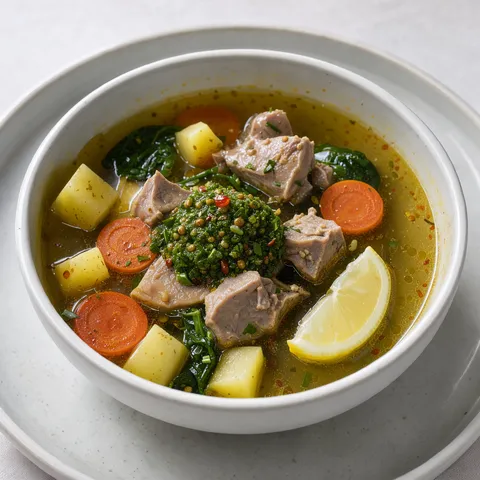 Spicy Lamb and Vegetable Soup1 hr 25 min · Soup
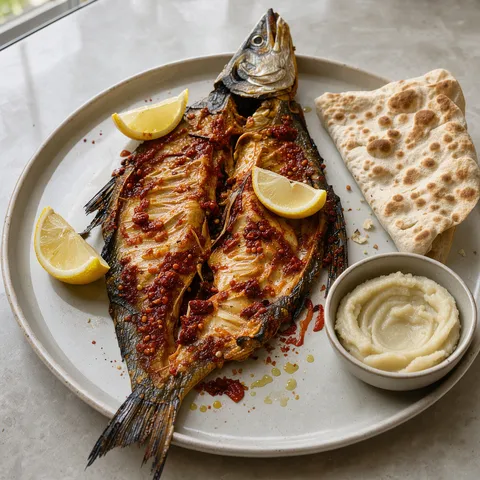 Roast Fish with Banana Fata50 min · Main course
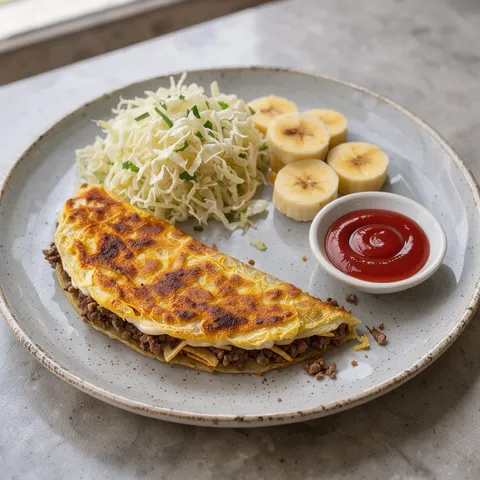 Mince and Egg Flatbread Omelette1 hr 5 min · Bread & pastry
 Thin Cardamom Pancakes with Honey40 min · Dessert
 Mukbassa 2.055 min · Main course