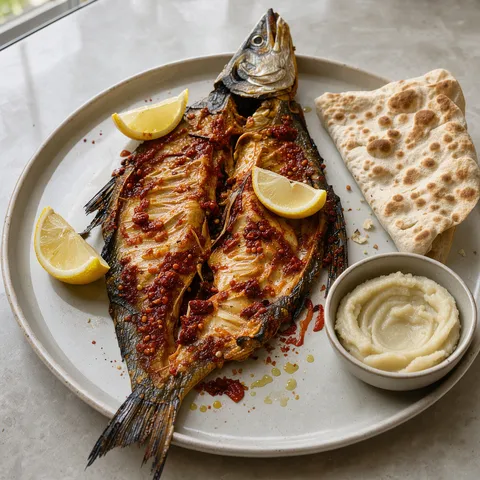
Roast Fish with Banana Fata Mukbassa
A Djiboutian main course. Takes 50 min, Serves 4. Difficulty: medium.
At a glance
- Total time
- 50 min
- Serves
- Serves 4
- Difficulty
- Medium
- Cuisine
- Djiboutian cuisine
- Dish type
- Main course
- Allergens
- Gluten, Milk, Fish
Ingredients
Fish
- 4 whole sea bream or grey mullet (about 400 g each, scaled and gutted)
- 1 tsp salt
- juice of 1 lemon
Chilli paste
- 4 garlic cloves
- 1/2 tsp salt
- 2 tbsp sweet paprika
- 2 tsp chilli flakes
- 1 tsp cumin
- 2 tbsp lemon juice
- 4 tbsp sunflower oil
Fata
- 4 ripe bananas
- 1 Lavash (Basics)
- 30 g Clarified Butter (Basics)
- 2 tbsp honey
- a pinch of salt
To serve
- 3 Lavash (Basics)
- 1 lemon (sliced)
Equipment
- Oven
- Baking tray
- Chopping board
- Filleting knife
- Kitchen scissors
- Plating tweezers
- Pestle and mortar
- Probe thermometer
- Mixing bowls
- Frying pan
- Wooden spoon / spatula
Method
- Heat the oven and the trays: Put a tray upside down on the bottom and middle shelves of the oven and heat the oven to its highest setting (250°C, conventional) for 25 min. The hot tray gives the fish instant heat from below, like the hot wall of a clay oven in Djibouti, and the fish cooks in 15 min without drying out
- Butterfly the fish: While the oven heats, lay the fish on a chopping board with its back towards you. With a filleting knife, start just beside the dorsal fin and cut parallel to the backbone down to the belly skin, without cutting through the belly skin, to open the fish. Spread it flat like a book. Cut out the backbone at the base of the head and tail with kitchen scissors and pull out any remaining large bones with tweezers. A butterflied fish is the same thickness from end to end and cooks evenly
- Salt: Rub both sides of the butterflied fish with 1 tsp salt and the lemon juice and leave in the fridge for 10 min while you prepare the paste. Salt and acid firm up the flesh and stop it falling apart at high heat
- Make the chilli paste: Crush the garlic with 1/2 tsp salt to a paste in a mortar. Add the paprika, chilli flakes, cumin and lemon juice and mix, then add the oil gradually to make a deep red, spreadable paste. In Djibouti, sweet red pepper from Ethiopia gives this paste its colour, and sweet paprika is the closest match for this colour and mild heat
- Spread the paste: Pat the fish dry with kitchen paper. Spread three-quarters of the paste in a thick layer on the flesh sides and the remainder thinly on the skin sides. The flesh side forms a crust in the hot oven, and the thinly coated skin browns without burning
- Cook the fish: Place two fish on each of two pieces of foil (about 40×30 cm each), flesh side up, and slide the foil onto the hot trays in the oven. Cook for 12 min, swapping the trays at 6 min. For the last 2 min, switch the oven to the grill setting, and the edges of the paste should darken slightly. The thickest part should read 63°C on a thermometer and the flesh should come away easily from the bone. Take out and rest for 3 min
- Prepare the fata: While the fish cooks, peel the bananas and roughly mash with a fork in a bowl. Break the lavash into 2 cm pieces. Melt the clarified butter in a pan over medium heat and toast the lavash pieces for 2 min, turning, until lightly golden. Add the mashed banana, honey and salt and cook for 3-4 min, mashing and mixing with a wooden spoon, until the bread pieces have absorbed the banana and it becomes a thick paste. Take off the heat and keep hot
- Warm the lavash: While the fish rests, warm the serving lavash on the bottom shelf of the oven for 1 min. It should stay soft and hot
- Serve: Put the open fish on a serving plate and serve with lemon slices, lavash and fata. In Djibouti, the fish is eaten by hand, tearing it with a piece of lavash, and the sweet-salty fata softens the heat
Chef's note
Mukbassa (moukbaza) is a fish associated with Djibouti's Yemeni-origin community, split open, salted, coated in a red chilli paste and cooked for about 15 min in a clay oven similar to a tandoor. An AFP report in the French press calls it Djibouti's "national dish" and says it is made with sea bream, grey mullet or red mullet and eaten with flatbread and a sweet fata of banana or dates. Djiboutian sources describe fata as a paste of honey and dates or banana. This version with lavash and clarified butter is adapted from the banana bread desserts of Yemen, and the measures and technique are our own. Instead of the banana, you can use 150 g soft pitted dates. Unlike Oman's Mashuai (Omani Spiced Chargrilled Fish with Lemon Rice), the fish is butterflied and cooked whole with chilli paste in a very hot oven, and it is eaten with bread and banana fata, not rice.
Frequently asked questions
- Why is the fish butterflied from the back?
- A butterflied fish is the same thickness throughout and cooks evenly. Remove the backbone with scissors and pull out the remaining large bones with tweezers.
- Why are the oven trays preheated?
- A hot tray gives the fish instant heat from below. The fish cooks quickly and doesn't dry out.
- How do I know the fish is cooked?
- The thickest part should read 63°C on a thermometer and the flesh should come away from the bone easily. Rest the fish for 3 minutes after taking it out of the oven.
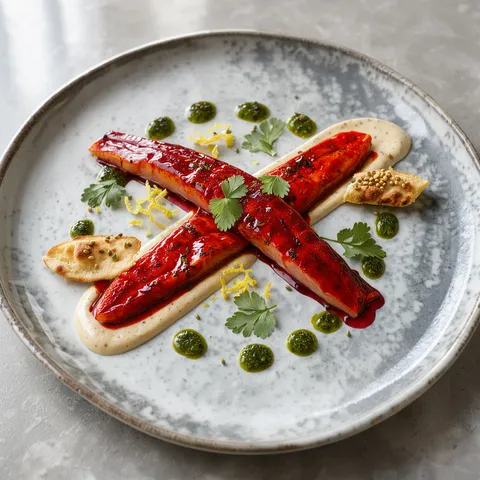 Mukbassa 2.055 min · Main course
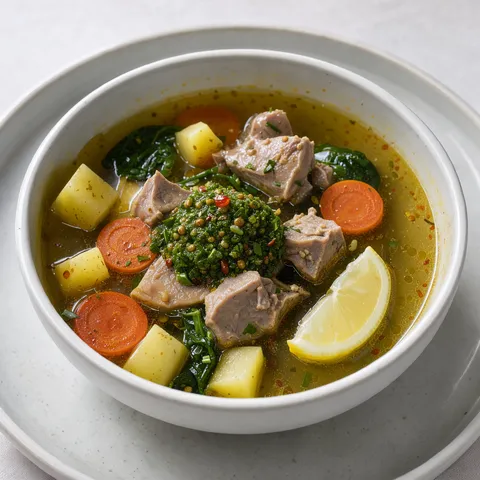 Spicy Lamb and Vegetable Soup1 hr 25 min · Soup
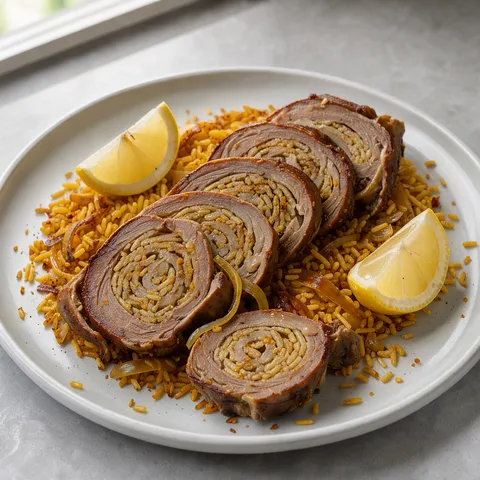 Rice-Stuffed Slow-Roast Lamb Shoulder3 hr 30 min · Main course
 Mince and Egg Flatbread Omelette1 hr 5 min · Bread & pastry
 Thin Cardamom Pancakes with Honey40 min · Dessert