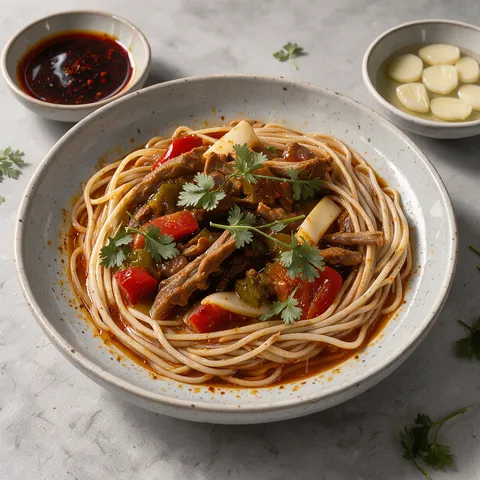
Hand-Pulled Noodles Lagman
An Uzbek main course. Takes 2 hr 15 min, Serves 4. Difficulty: challenging.
At a glance
- Total time
- 2 hr 15 min
- Serves
- Serves 4
- Difficulty
- Challenging
- Cuisine
- Uzbek cuisine
- Dish type
- Main course
- Allergens
- Gluten, Milk, Sesame, Celery
Ingredients
Noodle dough
- 500 g strong white bread flour (high-protein)
- 260 ml lukewarm water
- 1 tsp salt
- 1/2 tsp bicarbonate of soda (dissolved in 1 tbsp hot water)
- 50 ml sunflower oil (for pulling)
Vaju (sauce)
- 400 g leg of lamb (in thin strips)
- 40 ml sunflower oil
- 1 medium onion (in half-moons)
- 1 red and 1 green pepper (in strips)
- 3 ripe tomatoes (skinned, diced)
- 150 g white radish or green Margilan radish (in thin sticks)
- 1 celery stick (finely chopped)
- 1 small aubergine (optional, diced)
- 4 garlic cloves (finely chopped)
- 1 tsp cumin
- 1/2 tsp chilli flakes
- 1 star anise (optional)
- 600 ml lamb or chicken stock
- 1 tsp salt
To serve
- coriander
- garlic in vinegar
- chilli oil
Equipment
- Mixing bowls
- Cling film
- Rolling pin / oklava
- Chef's knife
- Baking tray
- Pastry brush
- Sauté pan
- Saucepan
- Ladle
- Colander
- Wok (optional)
Method
- Knead the dough: Mix the flour and salt, then knead for 10 min, adding the water gradually. Sprinkle the bicarbonate water over the dough and knead for another 5 min. The bicarbonate makes the dough elastic and able to withstand pulling. The dough should be smooth, soft and elastic
- Rest: Leave the dough to rest, covered, for 30 min, then knead again for 2-3 min and leave for another 30 min. Each rest relaxes the gluten so the dough stretches without breaking
- Prepare the ropes: Roll the dough out 1.5 cm thick and cut into strips 1.5 cm wide. Roll each strip into a rope as thick as a finger and coil into a spiral on an oiled tray. Brush generously with oil, cover with cling film and leave to rest for 20 min
- Fry the meat for the vaju: Heat the oil in a wide frying pan or wok over high heat until almost smoking. Add the lamb strips and fry for 4-5 min, until the liquid has evaporated and they are browned. High heat sears the meat instead of stewing it
- Add the vegetables: Add the onion and fry for 3 min, then add the peppers, radish, celery and aubergine. Stir-fry over high heat for 5 min, until the vegetables soften slightly and brown at the edges. Add the garlic and spices and fry for 1 min
- Cook the sauce: Add the tomatoes and stock and season with salt. Simmer over low heat for 20-25 min, until the sauce thickens and the vegetables soften. Vaju should be saucy but not soupy, with the consistency of a stew that runs slowly off a spoon
- Boil the water: Bring a large pan of well-salted water to the boil
- Pull the noodles: Hold a rope by both ends and stretch it slowly, tapping it lightly on the work surface. Swing the noodle between your hands to stretch it without breaking, fold it and stretch again. The noodle should be about 3-4 mm thick and at least 1.5 m long. The longer and more unbroken the noodle, the better it gathers on the fork and carries the sauce
- Boil: Drop the pulled noodles straight into the boiling water and cook for 2-3 min. They are ready when they rise to the surface and turn slightly translucent. Lift out with a slotted spoon, rinse quickly in cold water and drain. Rinsing removes the surface starch so the noodles do not stick together
- Reheat: Just before serving, reheat the noodles by dipping them in hot water for 30 sec and draining
- Plate: Arrange the noodles like a nest in deep, wide white bowls. Pour plenty of hot vaju over the top so the vegetables and meat cover the noodles but the noodles still show at the edges. Scatter over fresh coriander leaves. Serve with garlic in vinegar and chilli oil alongside
Chef's note
Lagman is of Uyghur origin and has become established at the tables of Uzbekistan, Kazakhstan and Kyrgyzstan. The Uyghurs make their own version spicier. If you cannot pull the noodles yourself, you can roll the dough out 3 mm thick and cut it into strips, but you lose the springiness typical of pulled noodles. If you reduce the liquid in the vaju and toss it with the noodles over high heat, you get fried lagman (kovurma lagman). Serves 4.
Frequently asked questions
- Why is bicarbonate of soda added to Lagman dough?
- It makes the dough stretchy and strong enough to withstand pulling.
- How long should hand-pulled noodles be?
- The noodles should be about 3-4 mm thick and at least 1.5 m long. Long, unbroken noodles twirl better on a fork and carry the sauce well.
- How thick should the vaju (sauce) be?
- The vaju should be juicy but not soupy. It should stay at a stew-like consistency that flows slowly off a spoon.
 Uzbek Layered Butter Flatbread51 min · Breakfast
 Uzbek Plov2 hr 30 min · Main course
 Uzbek Pastries with Lamb and Tail Fat2 hr 45 min · Bread & pastry
 Uzbek Plov 2.01 hr 30 min · Main course
 Uzbek Layered Lamb and Vegetable Stew2 hr 10 min · Main course
 Uzbek Stamped Tandoor Bread2 hr 30 min · Bread & pastry