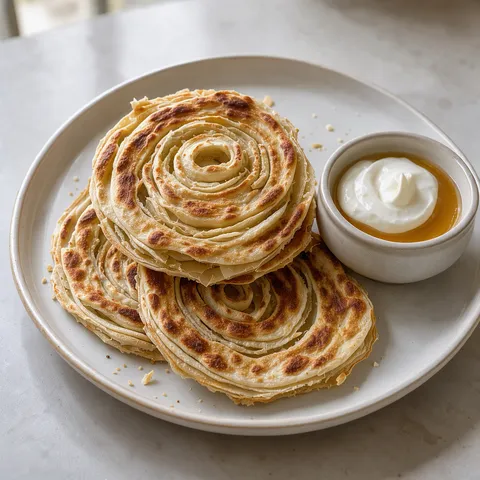
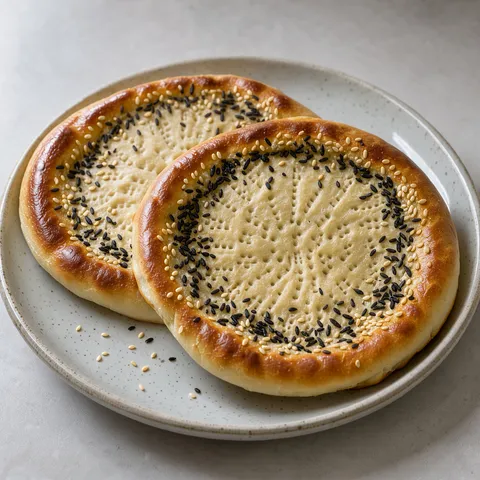
Uzbek Layered Butter Flatbread Qatlama
An Uzbek breakfast. Takes 51 min · +40 min resting, 6 pieces (4 servings). Difficulty: medium.
At a glance
- Total time
- 51 min · +40 min resting
- Serves
- 6 pieces (4 servings)
- Difficulty
- Medium
- Cuisine
- Uzbek cuisine
- Dish type
- Breakfast
- Allergens
- Gluten, Milk
Ingredients
Dough
- 400 g plain flour
- 200 ml lukewarm water
- 1 tsp fine salt
Layering
- 100 g butter
- 2 tbsp plain flour
Cooking
- 2 tbsp sunflower oil
To serve
- 4 tbsp clotted cream or strained yoghurt
- honey or jam
Equipment
- Mixing bowls
- Rolling pin / oklava
- Frying pan
- Pastry brush
- Saucepan
Method
- Knead the dough: Mix the 400 g flour and 1 tsp salt in a large bowl, add the lukewarm water a little at a time to bring it together and knead on the worktop for 8 min, until it is a smooth ball that does not stick to your hands. For layered breads the dough should be medium-stiff, as in a very soft dough the layers stick and merge (~8 min).
- Rest the dough: Put the dough in a bowl, cover with a damp tea towel and leave for 30 min. The gluten relaxes and the dough can later be rolled out as thin as paper (resting, 30 min).
- Prepare the butter mixture: Melt the 100 g butter in a small pan, whisk in 2 tbsp flour and leave to cool until lukewarm. The butter mixed with flour acts like a binder between the layers, keeps them separate and makes them crisp as they cook (~3 min).
- Divide and roll out: Divide the dough into 6 equal pieces (about 100 g each). Roll one piece out on a floured worktop with a rolling pin to about 28 cm across, as thin as to let light through. If the dough springs back, rest it for 2 min and roll out again (~8 min).
- Brush and roll up: Brush the rolled-out dough with the butter mixture, roll it up tightly from one edge, then stretch the roll gently with your hands until it is long like a thin rope and coil it into a flat spiral like a snail, tucking the end underneath. The spiral keeps the layers upright so that they form without spreading sideways as they cook. Do the same with all six pieces (~8 min).
- Rest: Rest the spirals covered for 10 min so that the layers relax (resting, 10 min).
- Flatten: Press each spiral with the palm of your hand and flatten with a rolling pin to about 14 cm across and 5 mm thick. If you roll it too thick the inside stays raw, and if too thin the layers are lost (~4 min).
- Cook: Heat a large frying pan over medium heat, grease with 1 tsp oil and put in 2 breads at a time. Cook 3 min on each side, until golden brown spots appear and the layers puff up. When cooked, press lightly from both sides with your hands to separate the layers. All come out in 3 rounds (each round 2 breads x 2 sides x 3 min = 6 min), and add 1 tsp oil to the pan before each round (~18 min).
- Serve: Divide the hot qatlama among 4 plates and put clotted cream and honey or jam beside them (~2 min)
Chef's note
Qatlama is a layered butter pan bread eaten in the morning and during the day with tea in Uzbekistan and the surrounding region. The butter and flour mixture separates the layers with steam. It is traditionally cooked in a tandoor or on a saj; here it is cooked in a home frying pan. Clotted cream and honey are a common pairing on the Uzbek table. Eat it hot; when it cools it can be warmed for 1 min in a dry pan.
Frequently asked questions
- Why do the Qatlama layers stick together?
- In a very soft dough the layers stick and fuse. The dough should be medium-firm.
- What does the butter mixed with flour do in Qatlama?
- The flour and butter paste works like glue between the layers, keeps them apart and makes them crisp as they cook.
- What happens if I roll Qatlama too thick or too thin?
- Too thick and the middle stays raw, too thin and the layers are lost. Flatten the spirals to about 5 mm thick.
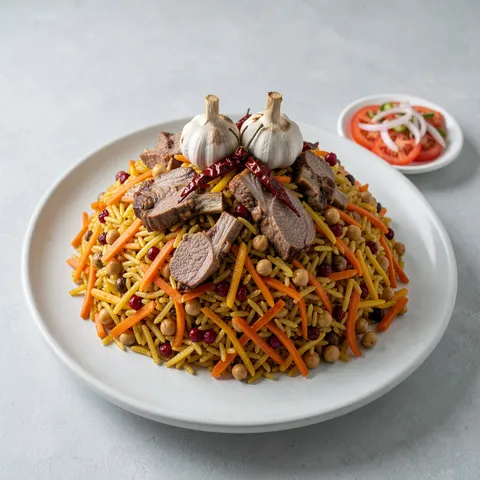 Uzbek Plov2 hr 30 min · Main course
 Uzbek Pastries with Lamb and Tail Fat2 hr 45 min · Bread & pastry
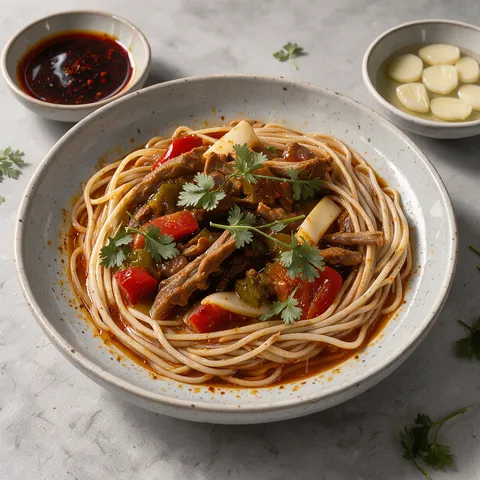 Hand-Pulled Noodles2 hr 15 min · Main course
 Uzbek Plov 2.01 hr 30 min · Main course
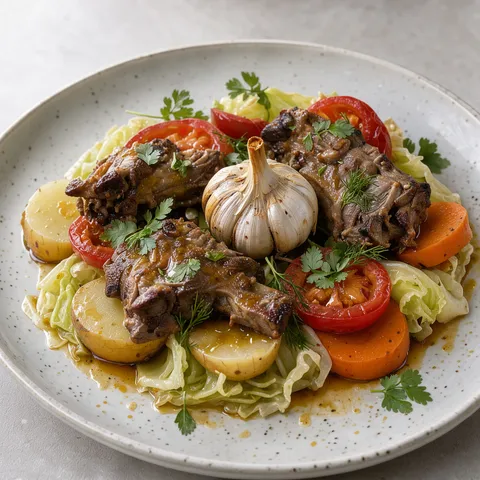 Uzbek Layered Lamb and Vegetable Stew2 hr 10 min · Main course
 Uzbek Stamped Tandoor Bread2 hr 30 min · Bread & pastry